Top Tools for Edge Analytics in Steel Plants
- BlogSmarter AI
- Edited by Steph Locke
- Blog
- July 27, 2026
- Updated:
Table of Contents Show Hide
Your mill can make steel in seconds and lose money in milliseconds. The top edge analytics tools for steel plants are the ones that process data on site, cut delay, and help you act before scrap, downtime, or paperwork piles up.
The pain is plain enough. Bad data timing, old kit, and clumsy admin burn cash.
I would shortlist these tools by the mess you need to fix first. GoSmarter, built by Nightingale HQ, fits teams buried in mill certs, scrap maths, and production planning. Siemens, IOTech, iba, AWS, Azure, MachineMetrics, and FairCom fit plants that need local analytics on machines, lines, and inspection systems.
What you get from this list:
- A straight view of which tools fit downtime, scrap, traceability, or reporting
- Clear differences between operational technology (OT) connectivity, local Artificial Intelligence (AI), and plant system links
- A faster shortlist for Production Managers, Engineers, and plant IT teams
- Less waffle and more focus on what each tool fixes on the shop floor
Here’s how to sort the shortlist without buying another shiny software problem.
The Reality of Deploying AI in Extreme Factory Environments
Where Edge Analytics Adds the Most Value in Steel Plants
What is edge analytics? It means processing sensor, machine and quality data on hardware close to the equipment, not in a distant cloud server. That cuts the delay between a reading and a response from seconds to milliseconds.
Edge analytics pays off first where milliseconds, yield and traceability decide whether you make money or burn it. That’s where these tools earn their keep.
Predictive maintenance on rolling stands and gearboxes is one of the plainest cases. Edge nodes pull in high-frequency vibration, current and temperature data on site. Then they spot signs like bearing wear before the thing packs in. That can give you 2–4 weeks’ warning. Enough time to plan a change, not deal with a shutdown at 03:00. Tata Steel’s layered data setup and edge-based AI models helped cut critical downtime by 40% and drove more than $1.4 billion in value creation across its operations[5].
Electric Arc Furnace (EAF) and furnace monitoring also needs low-latency response. In Electric Arc Furnaces, electrode position, cooling water pressure, and air intake and exhaust flap position all need close monitoring without delay[4]. Edge control logic tracks furnace temperature in real time and alerts maintenance teams fast when readings drift outside safe limits[6]. For blast furnaces, edge-based temperature models help you adjust energy use in real time.
Strip quality and scrap reduction on finishing lines also suits edge processing. Edge AI compares live tensile and pressure data with a reference model. If the cut starts going off, the system can stop it before you make scrap[3][1]. Edge-based energy management systems add another layer. They give you 24/7 consumption monitoring and seven-day forecasting, which helps teams spot waste faster and tighten energy use[6].
Coil and heat traceability closes the loop. Edge systems log process parameters for each coil or heat. You get a full audit trail for traceability and repeatability[3]. This is also where GoSmarter, built by Nightingale HQ, fits. It reads and digitises mill certificates, cuts manual entry, and helps keep traceability records straight.
The strongest platforms usually do four things well:
- Handle rough on-site deployment
- Support operational technology (OT) protocols
- Run local analytics without waiting on the cloud
- Connect with Manufacturing Execution Systems (MES), Supervisory Control and Data Acquisition (SCADA), historians, and Enterprise Resource Planning (ERP)
The tools below make the most sense when they support one or more of these jobs.
1. GoSmarter
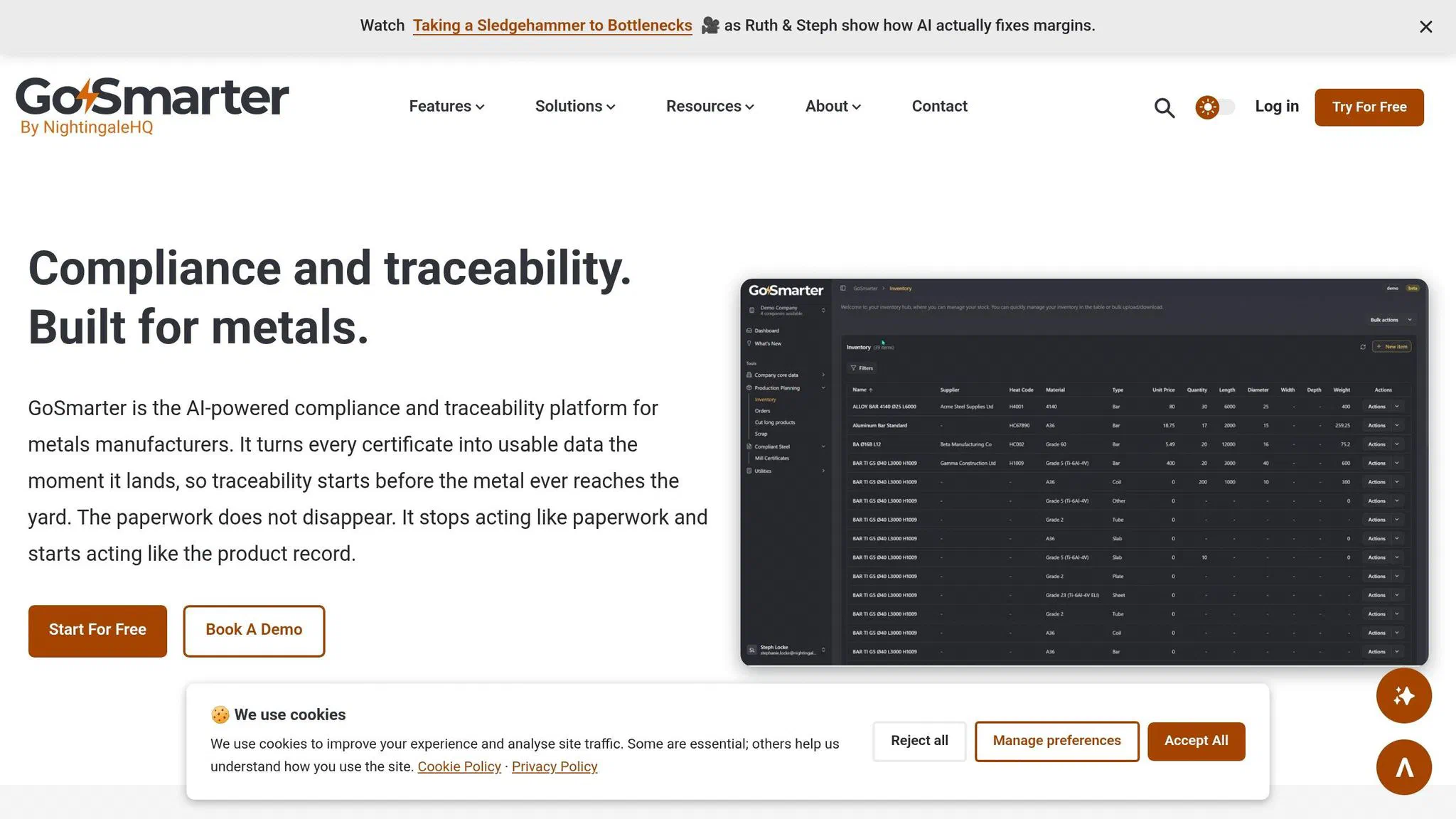
GoSmarter, built by Nightingale HQ, is made for metals manufacturing. It automates mill certificates, scrap calculations and production scheduling.
It fits best when certificate capture, cut planning and defect detection need to happen close to the shop floor. In other words, where the work moves fast and the paperwork still drags behind.
Steel-specific fit for quality and maintenance data
GoSmarter’s MillCert Reader pulls data from EN 10204 2.1, 2.2, 3.1 and 3.2 certificates. It captures heat numbers, material grades, chemical compositions and mechanical properties, then checks them against expected standards (including EN 10204 vs ASTM and ASME requirements) [8][9]. It is trained on metals terms and handles messy, multi-heat documents without falling over [9]. It links captured certificate fields straight to inventory records, which helps with grade compliance and audit readiness [8][9].
A single production manager can save over 120 hours per year by automating mill certificate data entry [8][9].
That same close-to-the-floor workflow also cuts waste on long-product lines.
For scrap reduction, the platform sorts cut plans for long products such as rebar and beams. It works out the best cut sequence to cut waste [7][8]. In a two-week trial across 193 jobs and 734 tonnes of steel, Midland Steel cut scrap by 50%. That brought it down to below 2.5%, against an industry average of 5–8% [7][8][9].
Where GoSmarter fits alongside edge tools
GoSmarter itself is cloud software, not an edge platform. It doesn’t run on plant-floor hardware or connect to Programmable Logic Controllers (PLCs), Supervisory Control and Data Acquisition (SCADA) or Distributed Control Systems (DCS). For that layer, pair it with one of the OT-native tools above.
What GoSmarter does well sits one step downstream of the edge: turning the certificates, cut plans and production records those edge tools help generate into clean, usable data. It connects to your existing IT and Enterprise Resource Planning (ERP) systems through a REST API. Authentication uses OAuth 2.0 and Microsoft Entra single sign-on. GoSmarter stores your data on Microsoft Azure in UK data centres. GoSmarter uses de-identified certificates to improve its own extraction models. It never shares them with other customers or third-party AI providers. Setup can take as little as 1–2 days [8][7]. It syncs inventory and open orders to generate live cut plans for operators [7][8]. GoSmarter is priced per site with unlimited users [8][7]. MillCert Reader starts at £350/month, and the Production tier with AI cut plans starts at £950/month. Most teams recover that cost from scrap or admin-time savings inside the first quarter [7].
Its strongest fit is where certificate capture and cut planning need to feed straight into production decisions, after the edge layer has done its job on the shop floor.
2. IOTech Edge Xpert
If you need standard data capture across a mixed bag of kit, Edge Xpert is a solid fit. IOTech Edge Xpert is a commercial implementation of the open-source EdgeX Foundry framework for industrial edge computing [6]. It gives you a vendor-neutral data layer between plant-floor assets and your higher-level systems.
OT Connectivity and Protocol Support
Edge Xpert ships with a big library of operational technology (OT) device connectors. Out of the box, it supports OPC Unified Architecture (OPC UA), Modbus, BACnet and Message Queuing Telemetry Transport (MQTT) [11]. That means you can pull data from older machines and newer kit without building a pile of one-off fixes. Once connected, the platform feeds that data into local analytics and AI inference.
Local Analytics and AI
Its microservices architecture runs AI and data processing at the edge [6]. You process machine and sensor data close to the source, not after it has bounced around your network. That helps with predictive maintenance and process optimisation, which matters when delays cost you money.
Deployment Model and Integration
Edge Xpert does not stop at one line or one cell. It runs on Linux and supports Docker and Kubernetes [11]. That Kubernetes support makes sense for centrally managed, multi-site deployments [11]. It also integrates with AWS, Azure and Google Cloud [11].
IOTech offers a free tier, with commercial support for enterprise deployments [11]. Use it where standard connectivity and local processing matter most.
3. Siemens MindConnect Edge and MindSphere
Siemens Industrial Edge suits mixed-vendor brownfield plants that need local analytics and cloud-linked reporting. It ties together plant kit from different suppliers and supports edge-and-cloud setups. You can link it with MindSphere or Microsoft Azure for long-term analytics and cross-plant correlation [13]. That matters when you need local decisions from mixed PLC, camera and drive data, not another pile of dashboards nobody checks.
OT Connectivity and Protocol Support
Siemens Industrial Edge supports more than 2,400 native protocols. That includes PROFINET, S7, OPC UA, EtherNet/IP and Modbus TCP. It connects straight to PLCs, drives, robots and industrial cameras [12].
The Industrial Information Hub (IIH) maps PLC tags into a standard data model at the edge. That cleans up the data before you push it into downstream ERP for JIT metals manufacturing, Manufacturing Execution Systems (MES) and Supervisory Control and Data Acquisition (SCADA) systems [12]. In plain English, it fixes the usual mess where every machine speaks its own dialect and your software spends half its life guessing.
On-Edge Analytics and AI Execution
The AI Inference Server runs models locally for vision, time-series and batch data. You can use it for defect detection and anomaly marking on high-speed rolling mills [12]. Siemens also offers compact gateways and graphics processing unit (GPU)-capable industrial PCs [15].
A Python-based software development kit (SDK) lets data scientists package models built in Amazon Web Services (AWS) or Azure into artefacts that run on the shop floor. The AI Asset Manager then handles distribution, versioning and performance monitoring across sites [12]. That saves you from the usual circus of emailing files, guessing model versions and hoping every site runs the same thing.
Steel-Specific Fit for Process, Quality and Maintenance Data
Pittarc, part of the Pittini Group, used a hybrid Siemens Industrial Edge and Microsoft Cloud setup. It cut a critical product defect from 64% to 3% [13].
The same setup fits rolling mills, inspection lines and maintenance monitoring. Dedicated apps show energy and overall equipment effectiveness (OEE) data for operators [12]. Real-time parameter monitoring and anomaly detection flag issues before they turn into stoppages [12].
Deployment Model and Integration with Plant IT, ERP and Historians
Industrial Edge Management handles centralised deployment on-premises or in the cloud. You can push firmware and application updates across multiple sites without sending someone on-site [12]. That matters if you run more than one plant and you’re tired of burning time on routine update work.
ERP in metals manufacturing, MES and historian integration runs through IT Connectors. WinCC Unified for Edge adds local human-machine interface (HMI) and SCADA visualisation through any HTML5 browser [12][14]. Security includes Trusted Platform Module (TPM) 2.0 hardware-based protection on specific devices, plus centralised firmware and application management [14][15].
Next: how Siemens compares on connectivity, local AI and fleet-wide management.
4. FairCom Edge
FairCom Edge works best when your steel plant needs to sort live shop-floor data before the rest of your stack touches it. That matters more than most software sellers admit. If your source data is messy, every system after it inherits the mess. FairCom Edge takes a data-first approach. It combines a JSON database, a SQL database, and a real-time event-stream database in one Industrial Internet of Things (IIoT) platform [16].
OT Connectivity and Protocol Support
FairCom Edge v5 supports MTConnect and MQTT. It also gives you SQL and JSON tools, so it fits plants with mixed industrial systems instead of forcing everything into one neat fantasy diagram [16][18][19]. You can use the built-in JavaScript engine to normalise data before you send it to a historian or Manufacturing Execution System (MES) [19].
That helps when you need to clean up data locally before analytics starts, or before you dump bad inputs into historian storage.
On-Edge Analytics and AI Execution
You can query live MQTT data through the JSON DB API and act on it straight away [19].
Steel-Specific Fit for Process, Quality and Maintenance Data
In steel plants, that same setup helps you analyse Programmable Logic Controller (PLC), sensor, and historian data locally, without shoving everything upstream first. That is often the difference between useful edge processing and another slow data pipeline.
FairCom Edge can run embedded inside an application or on a specific industrial device [16][17]. That suits edge deployments where you need equipment data analysed close to the asset, not bounced around the network for no good reason.
Deployment Model and Integration with Plant IT, ERP and Historians
FairCom Edge is embeddable, so you can run it inside an application or on a specific industrial device instead of setting up a dedicated edge server [17]. That gives you more choice in how you deploy it on site.
Its SQL interfaces and transformation layer move data into Enterprise Resource Planning (ERP) and historian systems. That supports migration across plant ERPs and historians [17]. FairCom also brings more than 40 years of experience building embeddable database technology for industrial and mission-critical environments [17]. For edge deployments, that gives buyers a clear reason to take it seriously.
5. MachineMetrics Edge Platform
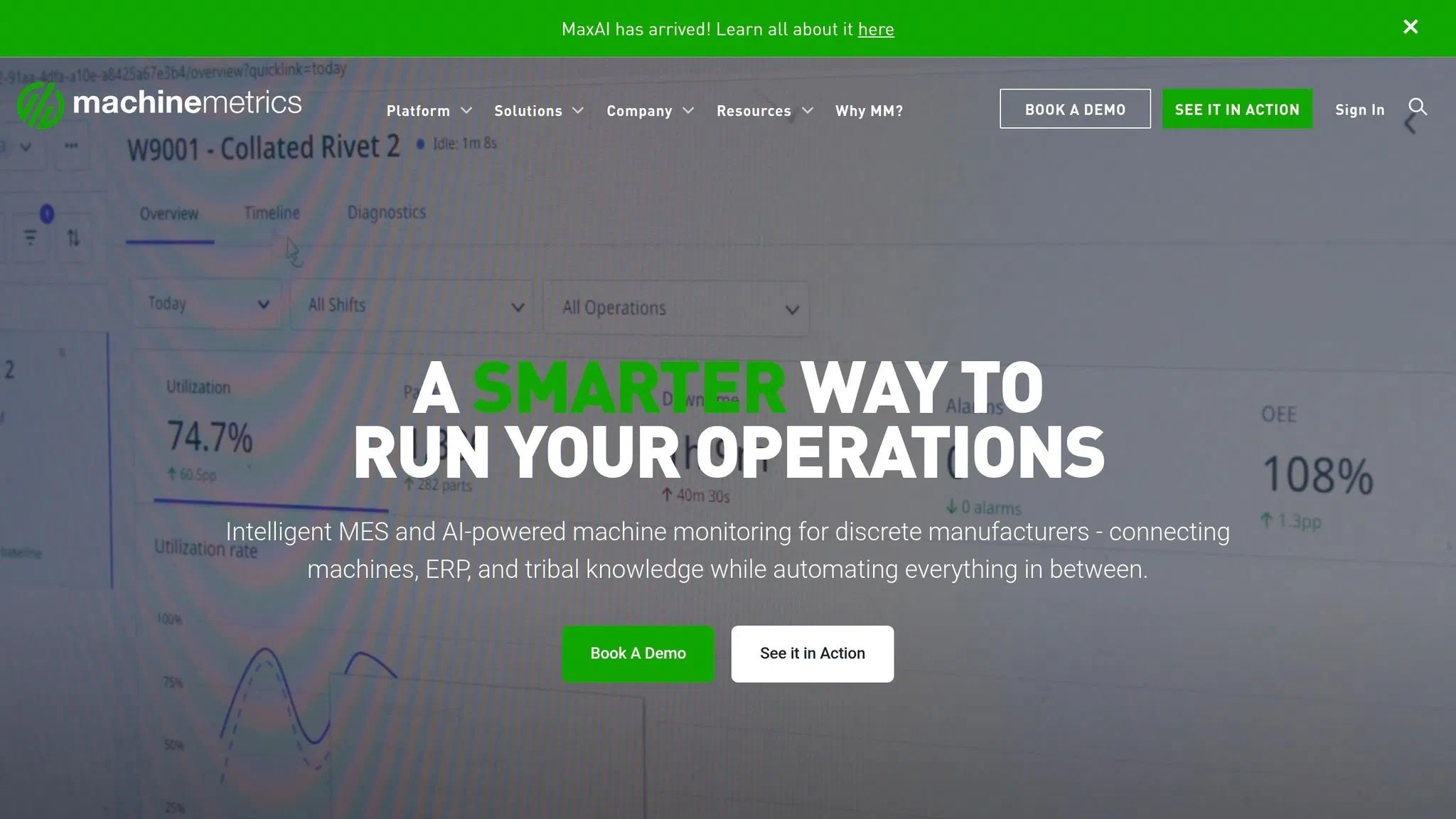
If your plant runs legacy mills and disconnected kit, live machine data comes first. No one needs another spreadsheet funeral. MachineMetrics pulls older mills and mixed equipment into one live production view with edge I/O modules and retrofit kits for ageing assets [21].
OT Connectivity and Protocol Support
MachineMetrics connects straight to machine PLCs. It also supports extra sensors such as vibration, pressure and temperature, wired into cabinet I/O, so you can pull in fast sensor data [24][22]. The platform works across a broad mix of machine types and manufacturers [20].
Once you connect the machines, you can spot problems locally and fast.
On-Edge Analytics and AI Execution
The Edge Platform handles data locally, which cuts latency to milliseconds [24]. Its MaxAI suite adds AI-guided execution at the edge [23]. MaxAI flags anomalies and supports rules-based condition monitoring on-site. That can lift machine utilisation by up to 15% by catching short downtime events that manual tracking misses [24].
Steel-Specific Fit for Process, Quality and Maintenance Data
MachineMetrics names Heavy Machinery and Metal Stamping and Fabrication as target sectors [23]. In steel plants, that fits blast furnaces, rolling mills and conveyors. You can track machine health in real time and catch early failure warnings before they hit high-value assets [24][22].
After the edge layer spots issues, the platform sends clean production data into the systems you already use.
Deployment Model and Integration with Plant IT, ERP and Historians
The platform processes data locally, then sends structured data to cloud or on-site systems for historical reporting [24]. Machine Connectivity Management and open application programming interfaces (APIs) support two-way enterprise resource planning (ERP) integration, production order tracking, job synchronisation and business intelligence (BI) tool connectivity [20]. The Enterprise tier adds multi-site rollout support and advanced security controls. Pricing across all tiers requires you to book a demo or contact sales [20].
6. iba InSpectra, InCycle and DaVIS
If your steel plant needs high-resolution, time-synchronised data, the iba suite is built for that job. This matters when edge analytics means reading fast, synchronised signals from kit that can go wrong in seconds, not just shoving data up to another server. The suite supports sampling rates up to 500 kS/s with 24-bit resolution for hard measurement jobs like vibration analysis [27].
OT Connectivity and Protocol Support
ibaPDA connects straight to PLCs, drives and sensors through PROFIBUS, PROFINET, EtherCAT, Modbus (TCP/RTU), CAN-bus and EtherNet/IP [25][28]. If you run Rockwell hardware, the ibaBM-ENetIP bus monitor gives you high-speed capture from Rockwell PLCs and variable voltage variable frequency drives using implicit messaging in sniffer mode [25].
You see this across plant assets such as:
- rolling mill stands
- batch annealing and pusher furnaces
- bucket wheel reclaimers
- crane systems
- coil strappers
That gives you direct condition monitoring on drives, bearings and gearboxes [25][26].
On-Edge Analytics
ibaInSpectra calculates vibration key performance indicators and characteristic values from raw machine data straight inside ibaPDA, so you run diagnostics where you collect the data [25][26]. Virtual signals run algorithms on raw PLC data in real time and flag wear in motors and gearboxes before failure hits [25].
Salzgitter Flachstahl put an iba-based condition monitoring system in place for early wear detection in complex mechanical plant parts. In the first year, it picked up multiple cases of wear damage before they caused unplanned downtime [26].
In a steel plant, that’s the bit that matters. You turn raw machine signals into earlier maintenance action and cleaner traceability, instead of waiting for someone to spot the problem after the line starts complaining.
Steel-Specific Fit for Process, Quality and Maintenance Data
The iba suite has a long track record in heavy steel and metals operations. Badische Stahlwerke uses it to bring transparency to scrap charging and heat analysis. The system tracks material from the scrap basket through heat analysis to optimise the refining process [25][26].
BILSTEIN Group uses ibaDaVIS with ibaDatawyzer-ICC to monitor more than 1,600 tonnes of metal coils each day. That cuts the risk of material mix-ups across its sites [25][26].
Deployment Model and Integration with Plant IT, ERP and Historians
Compact DIN-rail hardware captures and pre-processes data close to the machine, then stores it locally in DAT files built for high-resolution industrial time series [27][29]. ibaHD-Server acts as the long-term historian, with direct access to seven years of historical process data [25][26].
ibaDaVIS gives you web-based dashboards that run in any browser across the plant [25][26]. For integration, ibaDatCoordinator automates extraction from DAT files into CSV, Parquet or MATLAB formats. It also supports OPC UA, MQTT and cloud connectivity to Microsoft Azure [25][27][29].
7. AWS IoT Greengrass
AWS IoT Greengrass runs local compute, machine learning (ML) inference and containers at the plant edge. So when the cloud link falls over, your edge nodes still act on process and inspection data. That matters when inspection, maintenance and process control must keep running on site.
OT Connectivity and Protocol Support
It connects through AWS IoT SiteWise Edge and Greengrass Connectors. Gateway partners extend industrial protocol support [30][31]. On the ground, most setups use an industrial gateway on site. Hardware partners such as Belden help handle edge-to-cloud data flows [30][32].
On-Edge Analytics and AI Execution
Greengrass runs AWS Lambda functions and Docker containers locally [30]. For computer vision jobs, it works with NVIDIA DeepStream on Jetson modules to process video telemetry at the edge [31]. It also supports Small Language Models (SLMs) for local decisions on the shop floor [33].
That makes it a good fit for work such as:
- defect detection on moving product
- sensor-based maintenance checks on critical assets
- fast decisions at the edge when links drop
ADLINK Technology uses Greengrass 2.0 for its machine vision platform. It performs automated defect detection in real time as products move along production lines [35].
Steel-Specific Fit for Process, Quality and Maintenance Data
ArcelorMittal’s June 2026 collaboration with AWS shows where this fits in industrial automation, low-carbon production and edge-led optimisation [34]. Greengrass suits machine deterioration detection from sensor data and computer vision quality checks. So it fits steel plant maintenance and inspection workflows well [31][33].
Deployment Model and Integration with Plant IT, ERP and Historians
Greengrass uses the open-source Java-based Nucleus runtime. Nucleus Lite covers smaller edge devices. It also supports high-availability edge patterns where uptime is critical [31][33]. Connectors can link edge devices to third-party software, Amazon Web Services (AWS) services and existing historians [30].
If your plant already backs Microsoft heavily, Azure IoT Edge follows a similar edge-first model.
8. Azure IoT Edge
If your plant already runs on Microsoft, Azure IoT Edge will feel familiar. It uses the same edge-first setup. You put compute on the shop floor, run AI locally, and deploy Docker containerised apps right next to the process.
OT Connectivity and Protocol Support
You do not need to rip out old programmable logic controllers (PLCs) or supervisory control and data acquisition (SCADA) systems to connect Azure IoT Edge to a steel plant. That would be the usual software fantasy. In practice, industrial gateways do the heavy lifting.
Advantech’s UNO series automation box PCs sit between the operational technology (OT) layer and the edge runtime. They handle protocol translation so your old kit can still talk. Advantech’s EdgeLink software converts more than 200 industrial communication protocols, including Modbus and various PLC-specific variants, into secure data streams for cloud or local third-party systems. OPC UA Ethernet gateways also help machines and edge analytics modules exchange data securely [6].
That means legacy PLC and SCADA data can reach Azure IoT Edge without changing the existing controls. You keep the plant running. You add analytics around it.
On-Edge Analytics and AI Execution
Azure IoT Edge runs analytics and AI models locally through Docker containerisation. That keeps analytics apps separate from the local machine infrastructure. More to the point, your edge apps run on the edge. Your controllers keep doing deterministic control work instead of babysitting analytics jobs.
For steel plants, that matters in a few obvious places:
- surface quality inspection with vision-based defect detection
- predictive maintenance through continuous sensor checks for abnormal vibration or heat
- intelligent energy management (iEMS) for tracking carbon emissions and consumption in real time
Smart energy management systems built on this setup can cut energy waste and support seven-day consumption forecasting, which helps you avoid blowing past contracted capacity limits [6].
Steel-Specific Fit for Process, Quality and Maintenance Data
When Azure IoT Edge brings information technology (IT) and operational technology (OT) together, you get a cleaner flow between plant data and decision-making on site [6].
That gain comes from doing the obvious thing well. The edge layer filters data at the source and acts on it there, instead of firing everything into the cloud and hoping for the best. You cut bandwidth strain. You also meet the low-latency needs of the shop floor.
Azure IoT Edge gives you the most when you pair it with inspection, maintenance and energy models.
Deployment Model and Integration with Plant IT, ERP and Historians
Azure IoT Edge often comes as a bundled hardware and software package for jobs like overall equipment effectiveness (OEE) tracking. Containerised modules connect to plant historians such as GE Proficy or Ignition, and to enterprise resource planning (ERP) systems, through EdgeLink and EdgeHub. Those tools manage data movement both locally and to the cloud [6].
Security uses a zero-trust model for onboarding and deploying edge apps. It also supports ANSI/ISA-95 standards to secure automated links between enterprise and control systems.
In steel plants, Azure IoT Edge makes the most sense when you need local analytics to plug into historians and ERP systems. The next section compares these tools across connectivity, latency and deployment fit.
How These Tools Compare in Steel Plant Environments
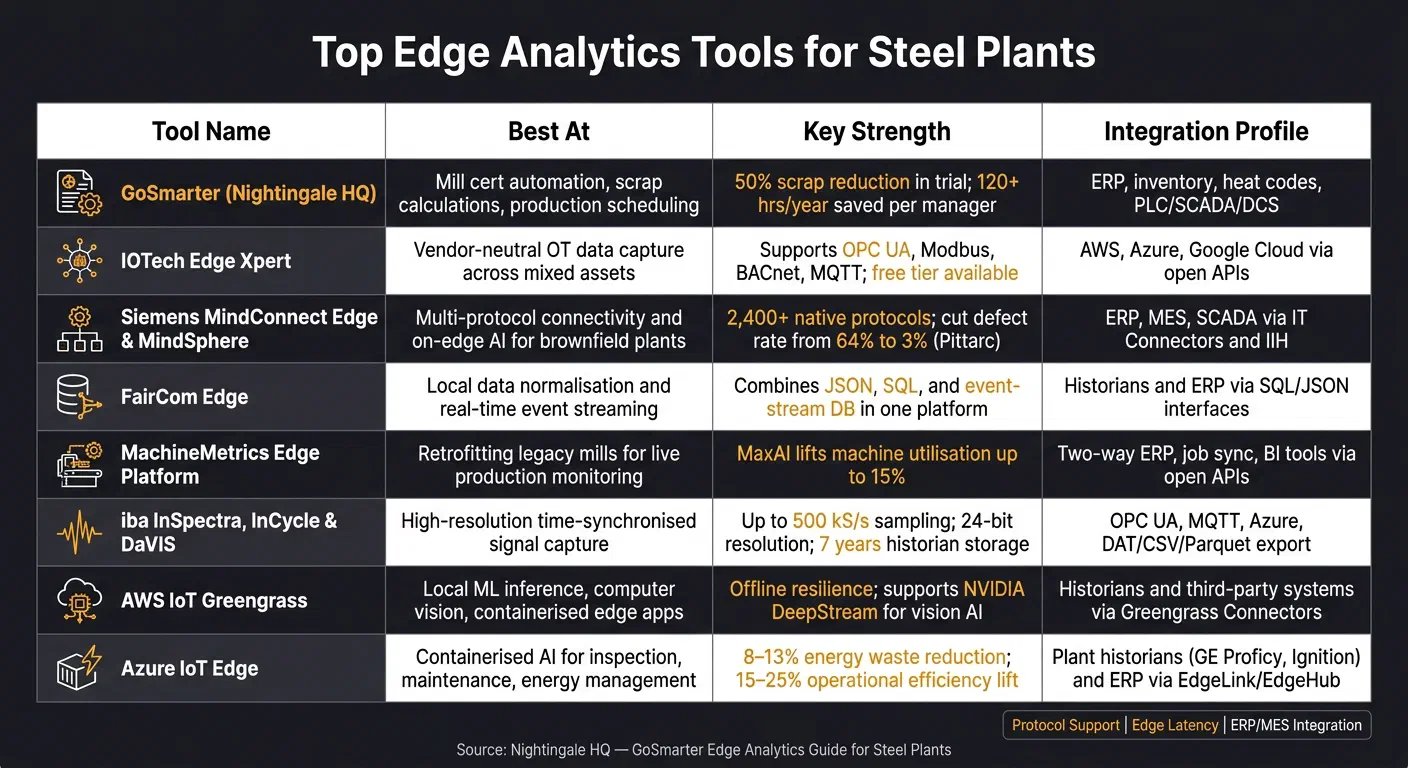
No single tool covers every awkward edge case. So don’t buy the sales pitch. Judge each one on protocol coverage, local analytics, and integration depth. Use the table below to work out what fits your line, not someone else’s demo rig.
| Tool | Best at | Integration profile |
|---|---|---|
| GoSmarter built by Nightingale HQ | Automating mill certificate reading, scrap and yield calculations and production scheduling | Sits on top of existing Enterprise Resource Planning (ERP) systems and links inventory, orders and heat codes |
| IOTech Edge Xpert | Vendor-neutral data capture across mixed operational technology (OT) assets with broad protocol support | Feeds local analytics into AWS, Azure and Google Cloud via open APIs |
| Siemens MindConnect Edge and MindSphere | Native multi-protocol connectivity and on-edge AI for mixed-vendor brownfield plants | Integrates with ERP, Manufacturing Execution Systems (MES) and Supervisory Control and Data Acquisition (SCADA) through IT Connectors and IIH data modelling |
| FairCom Edge | Local data normalisation and real-time event streaming before data reaches upstream systems | SQL and JSON interfaces connect to historians and ERP migration pipelines |
| MachineMetrics Edge Platform | Retrofitting legacy mills and mixed equipment for live production monitoring | Two-way ERP integration, job synchronisation and business intelligence (BI) tool connectivity via open APIs |
| iba InSpectra, InCycle and DaVIS | High-resolution, time-synchronised signal capture for vibration and process diagnostics | OPC UA, MQTT and cloud connectivity alongside long-term historian storage |
| AWS IoT Greengrass | Local machine learning (ML) inference, computer vision and containerised edge apps with offline resilience | Connects to historians and third-party systems via Greengrass Connectors and gateway partners |
| Azure IoT Edge | Containerised AI deployment for inspection, maintenance and energy management at the edge | Links to plant historians and ERP through EdgeLink and EdgeHub, with zero-trust security |
That leaves you with three things that decide the shortlist:
- Protocol support
- Edge latency
- ERP/MES integration
The big split is simple. Some tools plug into OT gear natively. Others rely on gateway-based protocol translation. In a steel plant full of legacy kit and ageing control systems, that difference is not small. It’s the gap between a tidy rollout and weeks of connector pain.
You also need to keep deterministic control separate from low-latency analytics. That’s not vendor snobbery. It’s basic plant sense. Edge AI should support certified safety systems, not try to play hero and replace them.
The next step is to match those factors to your plant’s deployment model, support setup, and integration stack.
Choosing the Right Tools for Your Plant
Pick tools that match the plant you actually run. Not the one software sales teams pretend you run.
Start with your current automation stack. Check whether data has to stay on-premises. Look at latency too. Then ask a blunt question: what costs you the most money right now? Downtime, scrap, or paperwork? That cuts through the noise and gets you to fit, not feature count.
If your site already leans hard on Siemens, use Siemens Industrial Edge. It fits best in Siemens-heavy plants. If your assets come from a mix of suppliers, or you need data to stay on-premises, use a vendor-neutral edge layer instead.
For predictive maintenance and vibration monitoring, specialised process analytics tools can spot deviations up to 10 minutes before they show up as defects in finished steel [10]. That matters. Ten minutes can be the gap between a small fix and a skip full of scrap. AWS IoT Greengrass and Azure IoT Edge can support this layer, but you will usually need custom development to handle metals-specific logic [2][36].
For certificates and traceability, GoSmarter, built by Nightingale HQ, pulls data from mill certificates and turns it into usable production records. If you are sorting metals paperwork and scheduling, the choke point is usually document workflow, not machine telemetry. That is where a lot of plants lose hours to clumsy PDFs, manual rekeying, and admin that should have died years ago.
Start with the biggest cost leak first. For most plants, that means unplanned downtime or scrap. Pick the tool that hits that problem first. Prove the return. Then add the next layer once the first one earns its keep.
A layered setup usually works best:
- Use an operational technology (OT) edge platform or a specialised analytics tool for machine-level monitoring.
- Then add a metals-focused platform for document flow and production data.
The conclusion below pulls these trade-offs into a final shortlist.
Conclusion
After you compare connectivity, latency, and integration, the choice is pretty simple. Fix the first problem that costs you the most money. The best edge analytics stack for a steel plant is the one that clears your worst bottleneck first. Local capture, real-time analytics, and integration only matter when they sort a live plant problem.
Use the comparison table and pick one use case. Then test it on one line or one asset. For machine monitoring, start with one critical asset and roll the platform out there first. When the data is clean and the alerts prove they can earn your trust, move to the next line. If certificates or manual inventory tracking are eating your team’s time, fix that mess before you pile on more software. Once it works, apply the same approach across the plant.
The plants that get edge analytics right start small, prove it on the shop floor, and then scale.
FAQs
How do I choose the right edge analytics tool for my plant?
Choose the right edge analytics tool by looking at the pain points that actually slow your plant down, and the systems you already have in place. Start with a plain question: do you need to cut latency, ease bandwidth pressure, or make faster decisions on a specific machine or line?
For many steel plants, the smart move is to start small. Pick one high-impact use case. Do not rip everything up at once. Full overhauls sound great in a sales deck. On the shop floor, they usually mean months of hassle.
Look for tools that fit the setup you already run:
- They should connect with your Enterprise Resource Planning (ERP) system
- They should support your current communication protocols
- They should be simple enough to use without on-site IT staff or specialist engineering help
That matters more than flashy features. If the software adds more faff than it removes, it is part of the problem.
What should I pilot first: downtime, scrap or paperwork?
Pilot the problem that leaks the most cash first. If your team still rekeys certificates and write-offs by hand, start with paperwork. If bad cuts are burning material, start with scrap. Edge analytics works best when you handle data on site, right where the work happens. That cuts errors from late entry and the usual manual admin mess.
Start with automated capture and validation. Think mill certificate reading and instant logging of scrap or write-offs. You get quick gains you can measure, especially in traceability and scrap-rate accuracy.
Leave downtime analytics for later. It usually depends on equipment event signals, so you need that feed in place first.
Can edge analytics work with legacy steel plant equipment?
Yes. Edge analytics works with legacy steel plant equipment. You do not need to replace machines or rip up your whole setup.
Modern industrial gateways, edge nodes and industrial computers connect to older equipment through standard ports and protocols. They process data in real time at the source. That cuts latency. It also cuts bandwidth use, so you stop shoving every signal back and forth for no good reason.
GoSmarter, built by Nightingale HQ, works alongside this setup at the IT and ERP layer. It plugs into your existing production and order systems without a rip-and-replace project, so you get clean certificate and cut-plan data even if the machine-level edge layer stays exactly as it is.
Drill deeper
- Predictive Maintenance: Edge Computing in Action
Go here to see edge analytics applied to one maintenance case.
18 min read
- AI and IoT: Smarter Data for Metal Fabrication
Go here for the sensor network that feeds edge tools, in a fabrication shop.
11 min read
About the Author

Editor· Co-founder & Head of Product
Steph Locke is Co-founder and Head of Product at GoSmarter AI — former Microsoft Data & AI MVP building practical tools to cut paperwork and automate compliance for metals manufacturers.