Barcode vs RFID for Metals Inventory: The Real Accuracy Gap
- BlogSmarter AI
- Edited by Steph Locke
- Blog
- October 26, 2026
- Updated:
Table of Contents Show Hide
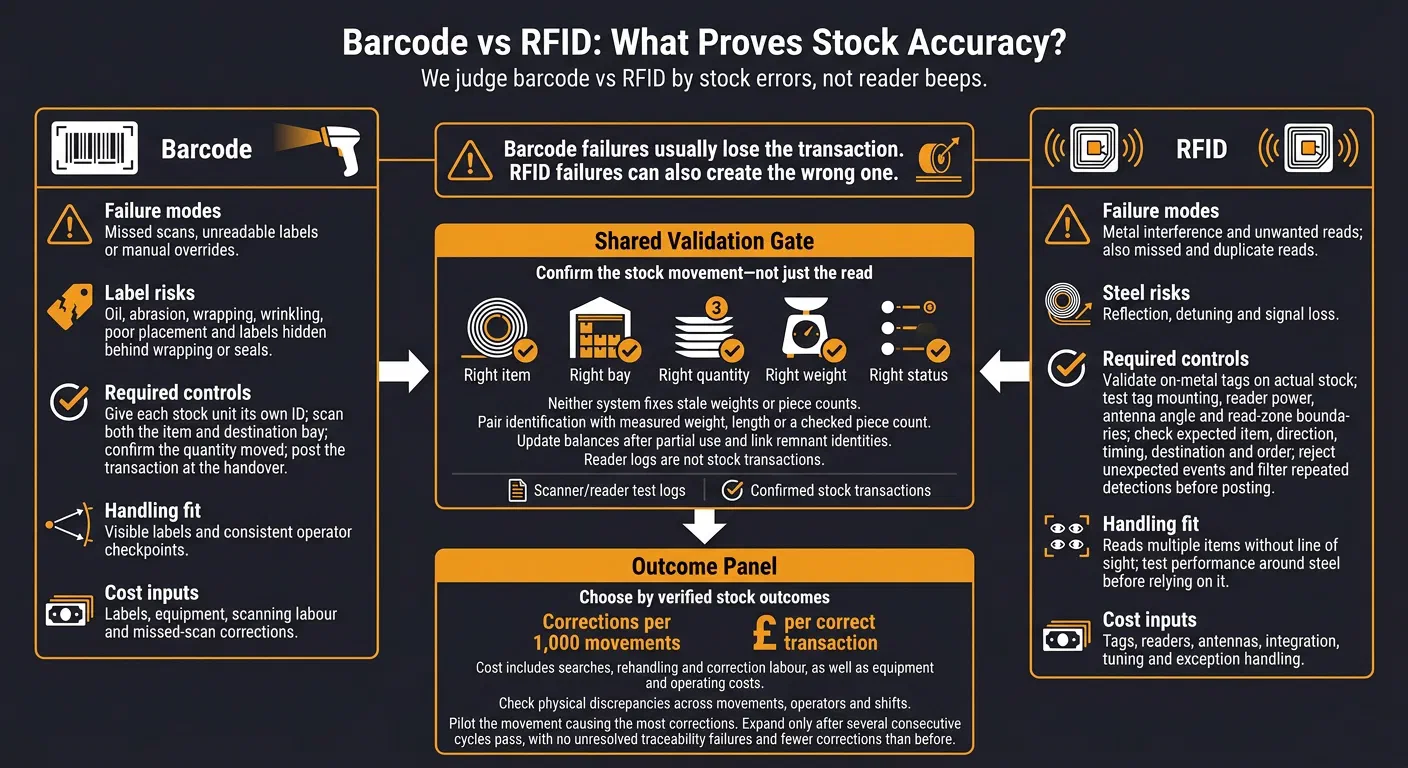
Judge barcode vs Radio-Frequency Identification (RFID) by stock errors, not reader beeps. For metals manufacturers, neither proves the right coil reached the right bay.
You still pay for wrong locations, stale weights and the paperwork to sort them out.
We compare both against checked stock movements, not sales claims. GoSmarter Metals Manager, built by Nightingale HQ, imports your existing spreadsheets and works alongside your Enterprise Resource Planning (ERP) system. You keep confirmed stock transactions apart from reader test logs.
Here’s what you can check:
- Where each fails: missed barcode scans, metal interference and unwanted RFID reads.
- What accuracy means: the right item, bay, quantity, weight and status.
- What to measure: corrections per 1,000 movements and £ per correct transaction.
An impressive read rate won’t find your missing plate. Here is how to test stock accuracy on your shop floor.
Watch: On-Metal RFID Labels on Metal Surfaces
What Is Inventory Accuracy in a Metals Plant?
Inventory accuracy is the share of stock records that match what is physically on the floor. A record is right only when the item, bay, quantity, weight and status all match. A coil in the wrong bay is an error, even if the weight is right.
Where Barcode and RFID Tracking Go Wrong
Receipt, put-away, production issue, partial use, return and dispatch each need a matching transaction. Errors creep in when you move stock without posting the right item, location or quantity. Here is where records drift from the floor.
Barcode Errors: Missed Scans and Damaged Labels
Barcode errors usually start with missed scans, unreadable labels or manual overrides.
Oil, abrasion and wrapping can make labels unreadable. GS1 guidance also flags wrinkling, poor placement and labels hidden behind wrapping or seals.[1] Place durable labels where you can see them. Keep human-readable text as backup only.
Scan at every handover to keep barcode records accurate.
| Application | Required scan check | Label and stock-update control |
|---|---|---|
| Coil receipt | Scan the coil ID; check grade, heat/lot, dimensions, weight and purchase-order line. | Keep one stock identity; quarantine duplicates and unreadable IDs. |
| Plate or bundle put-away | Scan the item and destination bay. | Use location barcodes, not free text; confirm the quantity you move. |
| Production issue | Confirm stock ID, grade and production requirement. | Post the issue when stock leaves storage, including direct-to-production moves. |
| Partial use and return | Confirm the original ID, actual usage and remaining quantity or weight. | Update the balance; relabel remnants with linked identities. |
| Dispatch | Match the item, order, quantity and loading location. | Block mismatches and keep dispatch confirmation. |
Reprint labels without changing the stock identity. When you split bundles, create linked records.
Barcode failures usually lose the transaction. RFID failures can also create the wrong one.
RFID Errors: Metal Interference and Unwanted Reads
Steel causes reflection, detuning and signal loss. On-metal tags help, but only site testing proves the read boundary.[2]
Steel makes RFID less predictable than barcode. Prove read zones on your actual shop floor. Accuracy depends on the tag, the reader and the surrounding steel.
| Assessment area | What to test on site | Required control |
|---|---|---|
| Tag and mounting | Actual coils, plates and bundles in different orientations, including against racking. | Choose suitable on-metal tags or spacing; protect tags from handling damage. |
| Reader configuration | Power, antenna angle and polarisation at normal handling speeds. | Tune readers for reliable detection within the read boundary. |
| Read-zone boundary | Adjacent tagged stock, neighbouring lanes and stationary loads. | Adjust antennas, power, spacing or shielding to stop unwanted reads. |
| Movement check | Expected item, direction, timing, destination and order. | Reject unexpected events; filter repeated detections before posting. |
| Partial consumption | Opened bundles, remaining stock and returned material. | Update quantity or weight separately; tag detection alone cannot prove the balance. |
Test the full route with nearby racks, forklifts, moving staff and adjacent tagged stock in place.[3] Readers can pick up tags outside the target area, such as adjacent pallets and shelves.[4][2] Repeated detections of one tag can also look like new movements, so filter duplicate reads before you post stock.
Check reader events against the expected route and work order. Record missed reads, unwanted reads and incorrect stock postings separately.
Barcode vs RFID: Which Reduces Stock Corrections?
Choose the system that cuts your most common stock error: the wrong coil, plate, bundle, location or quantity. Disciplined barcode use can beat poorly configured RFID when you need to confirm every item, bay and quantity. Tested RFID helps when missed scans drive corrections.
Match the system to the error that costs you most.
| Decision requirement | Barcode | RFID |
|---|---|---|
| Correct coil, plate or bundle | Give each stock unit its own ID. A grade-only barcode cannot tell units apart. | Encode each tag with its own ID and link it to the physical unit. |
| Correct location | Require scans of both the item and destination bay. | Check the read zone, direction and destination. A nearby tag read does not prove put-away. |
| Correct quantity | Pair the scan with measured weight, length or a checked piece count. | Apply the same measurement checks. Reading a bundle tag does not confirm its contents. |
| Correct workflow point | Block completion until the operator finishes the required scans and quantity checks. | Post only confirmed movements, not every tag detection. |
| Handling conditions | Works best with visible labels and consistent operator checkpoints. | Reads multiple items without line of sight. Test performance around steel before relying on it. |
| Total cost | Include labels, equipment, scanning labour and missed-scan corrections. | Include tags, readers, antennas, integration, tuning and exception handling. |
| Audit trail | Record the item, location, quantity, movement, operator and timestamp. | Keep checked movements, rejected reads and correction reasons, not just raw reader logs. |
Neither system fixes stale weights or piece counts. Require a checked measurement or count before posting.
Barcode often gives you more for your money when stock moves infrequently and operators already scan reliably. RFID makes more sense when missed scans and slow counts drive corrections. Unintended reads must not create new errors. Keep a barcode fallback for damaged labels and reader faults.
Judge cost in £ per correct transaction, including searches, rehandling and correction labour, rather than cost per scan. Track corrections per 1,000 movements alongside it. Faster reads must not hide less accurate records.
Test Stock Accuracy on Your Shop Floor
Once you know the likely failure points, test both on the movement that causes the most corrections.
Test Difficult Stock and Handling Conditions
Start with your biggest source of stock corrections. Build a physical baseline before testing either system. Check each test item’s identity, bay, heat number and quantity. Reconcile existing discrepancies. Freeze movements during the count, or log them separately. Compare barcode and RFID against the same baseline.
Run normal work across shifts, including busy periods, relief operators, nights and weekends. Put both systems through the real-time inventory conditions your stock actually faces:
- Dense racks, nested plates and tightly packed coils.
- Dirty, torn, folded, obscured or inaccessible labels.
- Partial bundles, offcuts, and crane and forklift routes.
For RFID, record tag position, antenna angle, reader power and read zone boundaries. Check whether neighbouring stock triggers reads. Use on-metal tags that you have validated on your stock.[5][6]
Check transfers immediately. Repeat blind counts at shift end and the next day. Log missed, unintended and duplicate reads. Link each read error to any wrong-item, wrong-location or quantity variance it caused.
Match every exception to the item, location and quantity on the floor. Record the operator, time, equipment, cause and correction. Reconcile split bundles and remaining weight. Flag impossible sequences, such as dispatch before receipt or one coil appearing in two bays.
Repeat until results stay stable across operators and shifts.
Measure Stock Errors, Corrections and Costs
Once the trial produces stable results, judge it by the stock errors it leaves behind, not just successful scans.
Set denominators and tolerances before judging results. Use the correct physical baseline for each error type:
- Measure item and location accuracy against items checked.
- Measure wrong-item errors against checked movements.
- Measure wrong-location errors against checked items.
- Measure unrecorded movements against expected movements.
- Report quantity variance in kilograms or tonnes, plus the percentage of checked items within tolerance.
Require exact identity matches. A mass tolerance never excuses the wrong coil. Break results down by movement and shift. Report corrections and adjustment value on a fixed cycle, such as weekly during the trial.[7]
Then measure what those errors cost, not just the read rate.
Record time spent counting, recounting and resolving exceptions. Report net and absolute adjustment values separately in £.
Include equipment, integration, training, maintenance, and replacement labels or tags. Add emergency material purchases, downtime, margin exposure and avoidable scrap loss. Track the full cost of accuracy, not just the scan.
Choose the process that leaves fewer physical discrepancies and cuts corrections and rework at an acceptable total ownership cost.
Start With the Movement Causing the Most Corrections
Trial the movement that causes the most corrections first. Test whether barcode or RFID cuts corrections, not just scanning time. Appoint one trial owner: an operations or inventory management lead. They must train operators, review exceptions and stop the trial if they cannot reconcile stock. Use one defined area, named operators and a fixed period.[8][9][10]
Before accepting reads, sign off the baseline by item, location and quantity. Agree pass/fail rules: exact item and location matches, plus a quantity tolerance for each stock form.[11][12][10][13] Specify which failures trigger a recount, supervisor review or trial failure.[11][13]
Record the baseline stock, locations, quantities and movements in Metals Manager. It keeps a history of who changed each record and when. Post only movements you have confirmed. Keep scanner and reader test logs separate from stock records. Reader logs are not stock transactions. To move test data into your own systems, use the REST API and CSV export.
Your payback test is simple. If corrections per 1,000 movements and £ per correct transaction both fall within the trial, the method has paid for itself. If they do not, you have saved the cost of rolling it out.
Expand only after several consecutive cycles pass, with no unresolved traceability failures and fewer corrections than before. Published RFID accuracy studies come mostly from retail, so prove the gain on your own metal.[14][15] If coils still reach the wrong bays, fix the workflow before scaling. The same applies if you post partial bundles with the wrong quantity. For wider guidance, see the metals inventory hub.
FAQs
Can I combine barcode and RFID tracking?
Yes. Many sites start with barcodes because they cost less and work reliably. They then add RFID for high-volume tasks.
Barcodes give you precise scans of individual items. RFID automatically logs bundle or pallet movements at speed, without line of sight.
Either method can feed your ERP or stock system. Whatever you use, keep an audit trail of each checked movement, its operator and its timestamp.
How many stock movements should my trial test?
There is no fixed number. Test enough stock movements to cover your material journey under actual working conditions. Include goods receipt, processing, cutting, scrap write-offs and despatch.
Identify where errors occur. Check that you record every movement where and when it happens, rather than saving updates for a batch later.
How do I preserve traceability when cutting stock?
Make sure your inventory process carries the original heat number and mill certificate link onto every cut piece, including off-cuts. Check that your system does this before you rely on it. Treat remnants as new, searchable stock, not waste, to prevent unidentified material and stock shrinkage.
Keep each piece’s full history attached: grade, mechanical properties and certificate reference. Carry those details with every piece, from the warehouse through production to despatch.
Sources
- GS1, Logistic Label Guideline, Release 1.3 (section 9.3.4, attaching the label)
- Institute of Nuclear Materials Management, paper on UHF RFID tags on metal surfaces and read selectivity
- GAO RFID, AI and RFID for warehouse clubs
- RSTCHK, RFID warehouse management system deployment guide
- CPCON Group, using RFID to track inventory in practice
- Levata, RFID inventory management explained
- Cleverence, what is cycle counting
- NetSuite, inventory accuracy
- US Government Accountability Office, GAO-02-447G, best practices for consistent, accurate physical counts of inventory
- Kardex, cycle counting and stock audits
- Cleverence, inventory count guidelines
- Cleverence, inventory management cycle count
- Cleverence, cycle counting inventory
- University of Arkansas, study on RFID and item-level inventory accuracy (retail)
- Auburn RFID Lab, item-level RFID in apparel and footwear (retail)
Drill deeper
- Still Tracking Stock Like It’s 2005? Real-Time Inventory for Metal Shops
That post covers the wider real-time stock set-up. This one tests barcode against RFID on your floor.
15 min read
- Real-Time AI Inventory Tracking for Metals Warehouses
That post gives the headline accuracy ranges. This one shows how to measure your own gap.
21 min read
- Inventory Platform Checklist for Steel Service Centres
That post is a buyer checklist for platforms. This one is a test plan for scanning methods.
14 min read
About the Author

Editor· Co-founder & Head of Product
Steph Locke is Co-founder and Head of Product at GoSmarter AI — former Microsoft Data & AI MVP building practical tools to cut paperwork and automate compliance for metals manufacturers.