Artificial Intelligence growth in the EU
- Steph Locke
- Archive
- February 18, 2021
- Updated:
Table of Contents
This article is part of an ongoing series - link no longer works sharing insights into the development of AI policy in Europe. In November last year we were appointed to the European DIGITAL SME Alliance focus group on Artificial Intelligence (AI), and as an 'AI intensive' SME, we provide feedback on the adoption of AI technologies in relation with the impact of EU initiatives on the topic.
There are many things going on, and as part of our contribution to the group, we will provide a strategic overview and hone in on the more important tactical developments.
There are two upcoming milestones due the first quarter of this year including a legislative proposal on AI and the second an updated Coordinated Plan on AI. The EU's AI Strategy published back in 2018 is also up for its first review and stakeholders are invited to provide direct input to the AI policy through ad hoc consultations and online discussions in the European AI Alliance.
Another interesting release was The Advanced Technologies report published in July last year. It gives an overview of the uptake of emerging technologies across Europe and is available for download on the AI Watch portal.
The reports also provide a concise and informative review of policies relevant to advanced technology development and deployment. The starting point of this analysis has been sixteen advanced technologies that are a priority for European industrial policy and that enable process, product and service innovation throughout the economy and hence foster industrial modernisation.
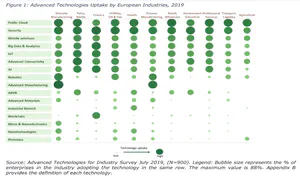
Unsurprisingly, it found that the top AI use cases are a mix of horizontal and vertical-specific applications with customer-centric cases (such as Automated Customer Service) being widespread across many sectors.
What we were most interested in was the manufacturing sector. Automation was found to be a key driver and there were strong use cases with clear benefits of driving operational efficiencies and reducing costs. Manufacturers are experimenting with robots, AR/VR and 3D printing. They were also prioritising R&D and product innovation to advance their adopting advanced technologies.
The report gives a growth outlook for AI in Europe as it becomes a general-purpose technology, and the ways in which it can be adopted will vary from industry to industry. While the Covid-19 pandemic may have disrupted the expected growth curve, the impacts of AI-driven innovation will undoubtedly remain of great relevance, infiltrating every aspect of our lives.
This is further supported by predictions from McKinsey which suggests that if Europe stays on track with AI development, it could add 19% to output by 2030, or €2.7 trillion. IDC forecasts the total worldwide spend on AI to reach €96 billion (£ ) by the end of 2023. This is a 26.5% Compound Annual Growth Rate for the period 2018–2023.
The European Union market is on track to grow faster than the global market, representing an expected share of 23% by 2023.
The Advanced Technology Watch report has been developed in the framework of the ‘Advanced Technologies for Industry’ (ATI) project, initiated by the European Commission, Directorate General for Internal Market, Industry, Entrepreneurship and SMEs and the Executive Agency for Small and Medium-sized Enterprises.