AI vs. Spreadsheets: Smarter Production Planning
- GoSmarter Team
- Edited by Ruth Kearney
- Blog
- March 25, 2026
- Updated:
Table of Contents Show Hide
Stop running your factory like it’s 1985. If you’re still using spreadsheets to plan production, you’re not just wasting time - you’re burning money. UK manufacturers lose 20 hours a week to downtime, costing an average of £100,000. Why? Because spreadsheets can’t keep up with the complexity of modern metals manufacturing.
Think about it: every time a machine breaks down or a rush order comes in, someone spends hours manually updating schedules. And let’s not forget the errors - 88% of spreadsheets contain mistakes, leading to chaos on the shop floor and missed deadlines. It’s like trying to run a database on a whiteboard.
Here’s the fix: AI-driven tools like GoSmarter. They automate the messy stuff - reading mill certificates, optimising cutting plans, and updating schedules in real time. The result? Less waste, fewer errors, and 10+ hours saved every week.
Old Way vs. Smart Way
| The Old Way (Spreadsheets) | The Smart Way (AI) |
|---|---|
| Manual data entry eats up hours | Automated updates in seconds |
| High error rate (88% of spreadsheets) | AI catches mistakes instantly |
| Static schedules that fall apart | Live, real-time updates |
It’s time to ditch the spreadsheets and let AI handle the drudgery. Let’s explore how this works.
Spreadsheets: Convenient, But Costly
The Manual Work of Data Entry
Every mill certificate that lands on your desk is a ticking time sink. Someone has to open the PDF, decode the heat codes, and painstakingly input material specifications, tensile strengths, and chemical compositions into Excel. Then there’s updating the production schedule, cross-checking inventory, and sending the latest version to the shop floor. For planners in complex manufacturing setups, this process eats up 2 to 4 hours per day - just rebuilding and sharing schedules 1. Let’s be honest, that’s not planning; it’s glorified data entry. And when a rush order pops up or a machine goes offline, the entire cycle starts from scratch. If your go-to “spreadsheet expert” isn’t around, everything grinds to a halt 2. Not only is this a colossal waste of time, but it also sets the stage for costly mistakes.
Errors and Their Hidden Costs
Spreadsheets don’t just waste time - they invite errors. Studies show that 88% of spreadsheets contain mistakes 2. A simple typo in a formula, an outdated material price, or a broken cell reference can snowball into misallocated shifts, wasted materials, and missed deadlines 3. Worse, spreadsheets don’t account for real-world constraints. They’ll happily let you double-book machines or assign three operators to one shift 3 2. The result? An “impossible plan” that looks flawless in Excel but crumbles the moment it hits the shop floor.
Disconnected Data and Limited Visibility
The problem doesn’t stop there. These errors are magnified by data silos that block real-time coordination. Production, Maintenance, and Quality teams often work from separate files, meaning they’re rarely on the same page. If a machine breaks down at 10:00 AM, the planner might not find out until hours later - by which point the schedule is already useless 4. Different departments end up working with conflicting versions, so the shop floor executes one plan, management approves another, and customers are promised something entirely different 1 2.
Toby Io from Taktora.AI sums it up perfectly:
Using spreadsheets to manage a live production floor is like using a whiteboard to run a database. It works until it does not, and when it fails, it fails silently 3.
AI-Driven Predictive Analytics: A Better Approach
Real-Time Data Integration and Automation
AI takes real-time data from sources like mill certificates, sensors, ERP systems, and inventory feeds, combining it into a live schedule that updates instantly as new information flows in 1 3. This eliminates the delays and version conflicts that plague spreadsheet-based systems, ensuring there’s always a single, up-to-date plan. For instance, when a machine breaks down or a rush order comes in, AI can analyse thousands of possible scheduling scenarios in seconds to provide a workable, updated plan 1 3.
Russell Smallridge, Supply Chain Manager at MEON, highlights the advantage:
By considering a range of factors including volatility, product lifecycle and seasonality, we can build a clearer picture of future demand. Put simply, we could not attain this level of visibility with spreadsheets alone 5.
On top of real-time updates, AI keeps an eye on production to spot potential issues before they become costly problems.
Anticipating Problems Before They Happen
Spreadsheets only show what’s already happened, but AI looks ahead. By analysing past production data, it identifies bottlenecks before they arise. Unlike traditional tools, AI understands constraints - it factors in machine capacity, operator skills, material lead times, and shift patterns. This prevents errors like double-booking equipment or overstaffing a shift 3 6.
When disruptions occur, AI doesn’t just flag them - it immediately adjusts the schedule to work around the issue 1. This proactive approach can make supply chains up to 67% more efficient compared to those managed with spreadsheets alone 5. The result? Fewer headaches and smoother operations across the board.
Cutting Waste and Supporting Sustainability
AI doesn’t just save time - it also saves materials. By optimising changeover sequences (like switching between SKUs, colours, or tool configurations), it reduces downtime and minimises scrap 1. For metals manufacturers, this means smarter nesting and better planning for offcuts, leading to less waste and a smaller carbon footprint. By quantifying the costs of changeovers, AI ensures production runs as efficiently as possible, offering a clear advantage over manual planning methods.
These features highlight how AI outperforms spreadsheets in every key area, from efficiency to sustainability.
AI in Production Planning: Helping Factory Planners Improve Schedules Without APS Systems
AI vs. Spreadsheets: A Direct Comparison
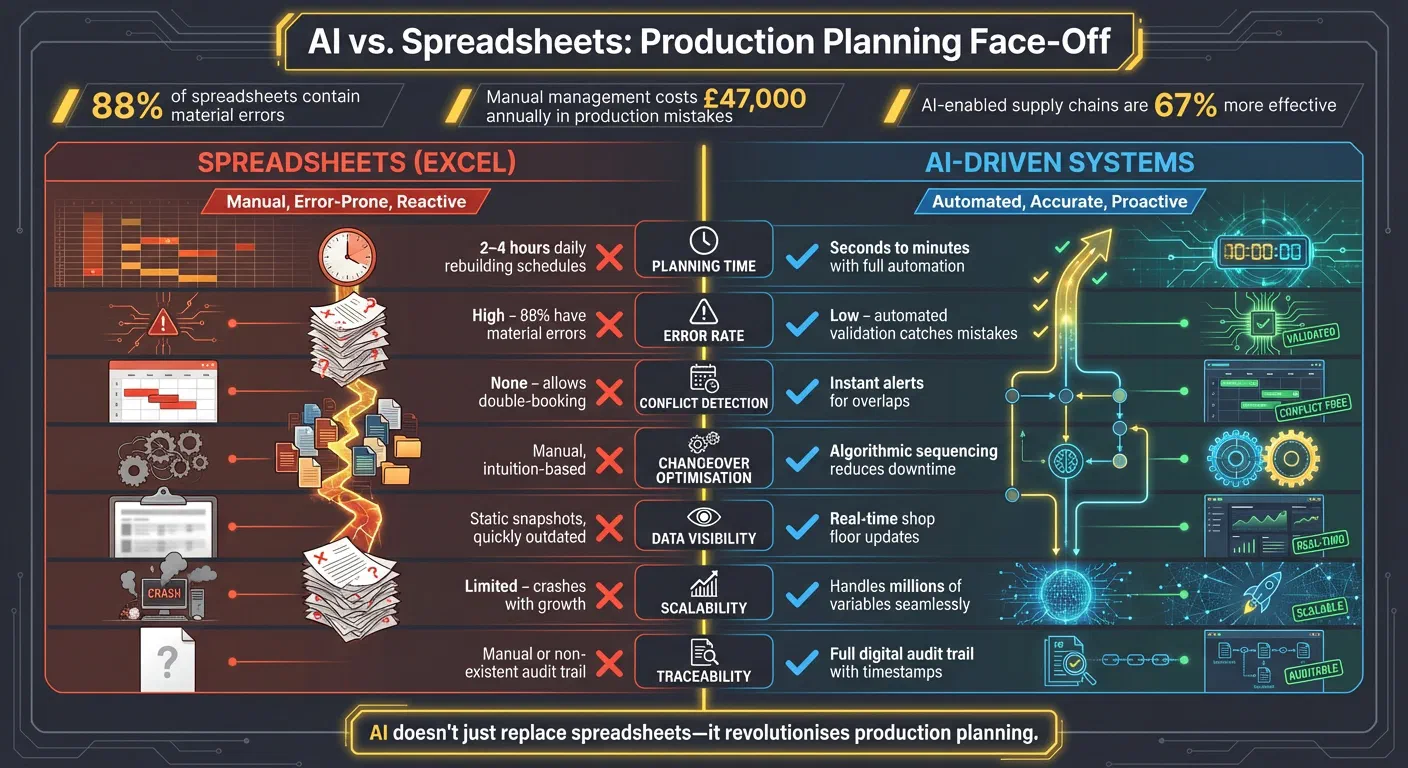
Comparison Table: Spreadsheets vs. AI
When it comes to production planning, the difference between spreadsheets and AI-driven systems is like night and day. Did you know that 88% of spreadsheets contain material errors? Or that manual spreadsheet management can eat up five hours a week - sometimes even four hours a day - just to keep schedules updated? These inefficiencies cost manufacturers an average of £47,000 annually in production mistakes 1 7.
Here’s how spreadsheets stack up against AI:
| Metric | Spreadsheets (Excel) | AI-Driven Systems |
|---|---|---|
| Planning Time | 2–4 hours daily rebuilding schedules 1 | Seconds to minutes with full automation 1 |
| Error Rate | High – 88% have material errors 7 | Low – automated validation catches mistakes 7 |
| Conflict Detection | None – allows double-booking 1 | Instant alerts for overlaps 1 |
| Changeover Optimisation | Manual, intuition-based 1 | Algorithmic sequencing reduces downtime 1 |
| Data Visibility | Static snapshots, quickly outdated 3 | Real-time shop floor updates 3 |
| Scalability | Limited – crashes with growth 3 | Handles millions of variables seamlessly 6 |
| Traceability | Manual or non-existent audit trail 7 | Stay compliant with a full digital audit trail and timestamps 8 |
These numbers paint a clear picture: AI doesn’t just replace spreadsheets - it revolutionises production planning.
Industry experts agree. Toby Io of Taktora.AI points out:
“AI is useful for constraint-based optimisation, where the number of possible schedules is too large for a human to evaluate manually.” 3
Consider this: AI-enabled supply chains are 67% more effective than manual systems, yet 23% of manufacturers still suffer costly errors from spreadsheet scheduling 5 7. The real question isn’t whether to switch - it’s how soon you can make the leap.
Greg Bigos, CEO of f33, puts it bluntly:
“Excel doesn’t fail because it’s faulty; it fails because it was never designed for complex production planning. It’s a spreadsheet, not a planning engine.” 6
If you’re managing more than 10 active SKUs and need better material visibility or running multiple production lines, spreadsheets are already holding you back 1. And if your planner spends over two hours a day wrestling with schedules, you’re essentially paying for inefficiency 1. The solution is clear: it’s time to leave spreadsheets behind and embrace AI-driven systems.
Real Results: The AI Difference for Metals Manufacturers
Case Study: Better Scheduling in Practice
Midland Steel, a rebar manufacturer operating across Ireland, the UK, and Norway, took on a two-week trial in December 2024. During this period, they processed 734 tonnes across 193 jobs and reduced their scrap rate to 2.5% - a 50% relative reduction - thanks to GoSmarter AI cutting optimisation [10]. Encouraged by these results, they expanded their toolkit with the Offcut Tracker App and Scrap Weight Tracker App, further improving material reuse.
These initial gains unlocked even more opportunities for automation. By March 2026, the MillCert Reader was saving the production team 10 hours each month by automating the extraction of chemical and mechanical data from mill certificates. The production manager summed it up perfectly:
What used to take hours every week is done in seconds - it’s helping us work smarter. [9]
The Bottom Line: Better Margins, Less Waste
These examples highlight how AI-driven tools go beyond improving operational metrics - they protect profit margins and reduce waste. By automating planning and processes, manufacturers are cutting time, increasing efficiency, and even lowering their carbon footprints. For instance, scrap rates in metals manufacturing have dropped by as much as 50% [11], while on-time delivery rates have seen improvements of 16–25%. Asset utilisation has surged by up to 52%, and some companies have reported EBITDA gains of up to 8%.
Rebar waste alone represents 3–5% of global steel production - a staggering 20 million tonnes of steel, which contributes 28.3 million tonnes of CO₂ emissions annually [10].
Spreadsheets simply can’t compete. They can’t predict machine failures, optimise cutting patterns, or adjust plans in real time. AI can - and it does it all automatically.
GoSmarter: AI Built for Metals Manufacturers
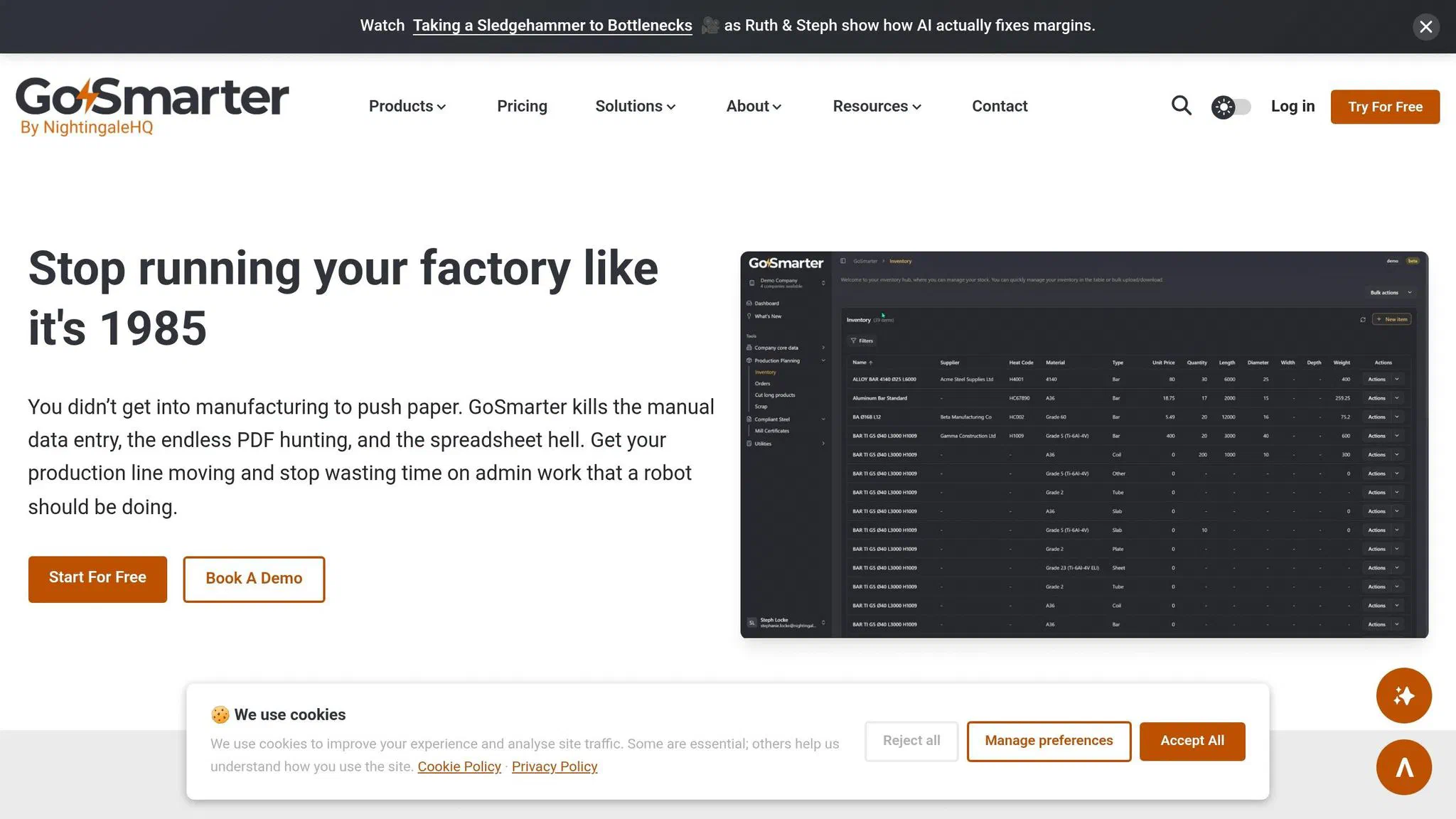
GoSmarter takes the hassle out of production planning by offering solutions tailored specifically for metals manufacturers. Forget generic software patched together for factory floors - this platform is designed to tackle the unique challenges of your industry. Whether you’re drowning in PDF mill certificates, struggling with cutting plans, or stuck chasing documents in filing cabinets, GoSmarter is here to simplify it all.
Unlike clunky spreadsheets or ERPs that take forever to implement, GoSmarter integrates seamlessly with your existing systems. There’s no need for a complete overhaul. Instead, it automates the tedious, error-prone tasks that slow your team down, allowing them to focus on what they do best - building.
The platform zeroes in on three major pain points: manual data entry from mill certificates, inefficient scheduling, and wasteful cutting plans. Each tool is purpose-built to eliminate outdated methods that drain time and resources, helping manufacturers across the UK streamline their operations.
MillCert Reader: Say Goodbye to Manual Typing
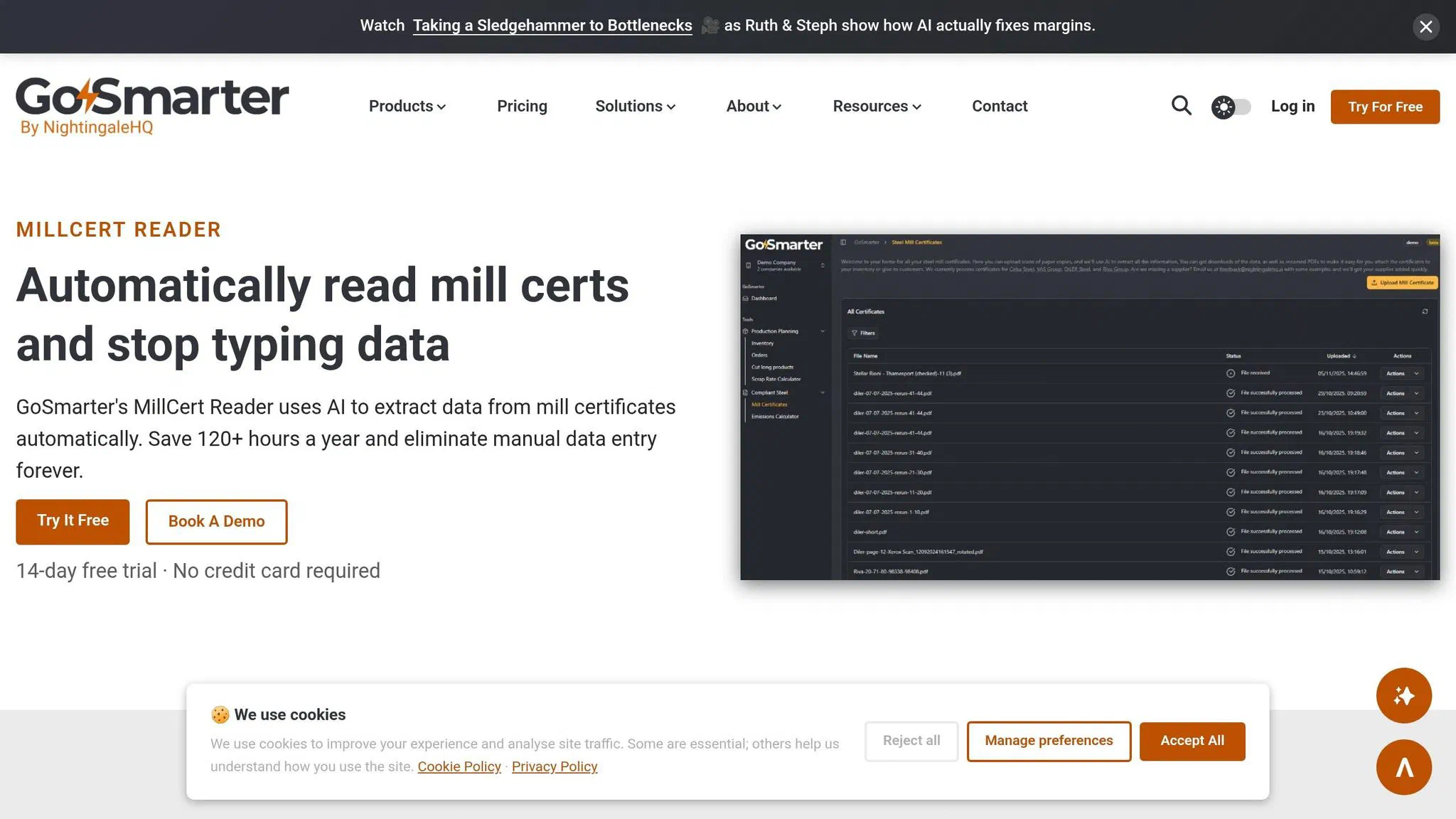
The MillCert Reader is a game-changer for handling mill certificates. Using AI-powered OCR, it pulls chemical and mechanical data directly from messy PDF certificates, even those with multiple heats or in non-English formats. This tool saves production teams a staggering 120 hours per year - basically three entire workweeks - by cutting out manual data entry. It also renames files by heat code and links them to inventory records, keeping everything organised and accessible [11].
At £350/month rolling, or £280/month billed annually, the MillCert Reader not only saves time but also minimises risks like typos or misplaced decimals, ensuring your data is accurate every single time. It’s a small investment that quickly pays for itself in efficiency and peace of mind.
Metals Manager: Live Stock, Live Commitments
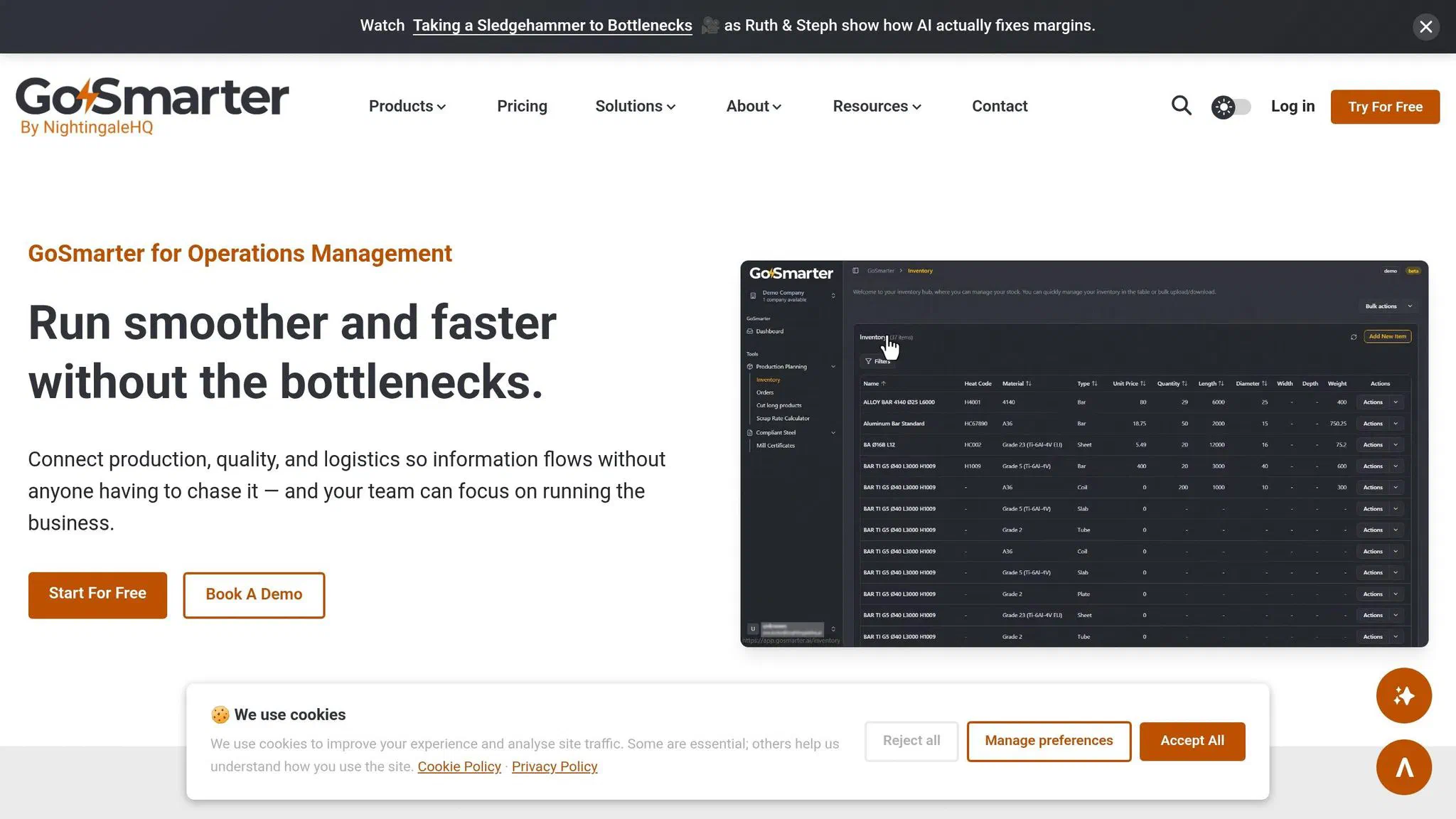
Tired of endless manual adjustments in spreadsheets? The Metals Manager gives you real-time stock visibility tied to every cert, order, and cutting plan. When a rush order lands or a delivery is delayed, you see immediately what you have, what’s committed, and what you can cut - no phone calls, no stale spreadsheets. It connects to your existing ERP or runs standalone. Get live by the end of the day from a CSV upload.
Cutting Plans: Cut Waste, Protect Margins
The Cutting Plans tool tackles one of the toughest challenges in metal manufacturing: the 1D Cutting Stock Problem. By calculating the most efficient cutting patterns, it slashes offcuts and protects your bottom line. In a trial with Midland Steel, this tool reduced their scrap rate to 2.5% - a 50% relative reduction - a result no manual method could achieve [11].
But it doesn’t stop there. Cutting Plans also tracks CO₂ emissions before you even start cutting, helping manufacturers meet ESG goals and sustainability requirements. With rebar waste accounting for 3–5% of global steel production - equivalent to 20 million tonnes of steel and 28.3 million tonnes of CO₂ annually - this tool turns waste reduction into a competitive edge. Plus, you get a 7-day free trial, and basic scrap calculators are always free to use.
Conclusion: Stop Planning Like It’s 1985
Key Takeaways for Better Production Planning
Back in the 1980s, spreadsheets were revolutionary. Today? They’re outdated. They freeze data in time, leaving planners to manually chase updates and juggle constraints. This inefficiency doesn’t just waste time - it eats away at your profit margins. Compare that with AI-driven tools, which handle these tasks in just five minutes 1. Relying on old methods is like trying to win a race with a flat tyre.
Modern AI solutions bring a whole new level of precision and adaptability. No more guessing or patching up schedules. These tools automatically adjust for machine capacities, material delays, or last-minute order changes, ensuring your plans remain realistic and achievable. The result? Up to 50% less waste, better operational oversight, and healthier margins. Instead of constantly reacting to problems, you can shift to planning ahead.
Your Next Step: Try GoSmarter Today
If your team spends more time wrestling with Excel than actually improving production, it’s time for a fresh approach. GoSmarter offers tools designed to fit into your existing setup without the headache of a lengthy implementation process. MillCert Reader sits on the Workshop tier, from £280/month billed annually, and Cutting Plans comes with a 7-day free trial. No need to rip out your legacy ERP - just add the intelligence that turns chaos into clarity.
Don’t let manual errors and wasted resources drain your profits. Here’s where to go next:
- Start with certs: Try MillCert Reader - most teams are live within a day.
- Cut the scrap: Run a cutting plan - get a 7-day free trial.
- See the full story: How Midland Steel cut scrap by 50% - a real result, not a marketing number.
It’s time to leave the 1980s behind and get your factory working as hard as you do. Visit GoSmarter to explore the full platform.
FAQs
What data do I need to start using AI for production planning?
How does AI handle last-minute changes like machine breakdowns or rush orders?
AI handles those unexpected hiccups - like a sudden machine breakdown or a rush order - with remarkable precision. It taps into real-time data and uses predictive analytics to tweak production schedules on the fly. Compare this to spreadsheets, which demand constant manual updates and can’t keep up with rapid changes.
Take predictive maintenance as an example. By forecasting potential breakdowns before they happen, AI ensures production runs stay smooth, downtime is slashed, and operations avoid costly conflicts. It’s like having a crystal ball for your factory, keeping everything running efficiently and with fewer disruptions.
How quickly can GoSmarter be integrated with our existing ERP and shop-floor systems?
Further Reading
1: Taktora vs Spreadsheets: Why Excel Fails Production Scheduling | Taktora.AI
2: 7 Signs You’ve Outgrown Spreadsheets for Production | WorkCell
3: Why Spreadsheets Are Killing Your Production Schedule | Taktora.AI
4: The “Excel Trap”: Why Running Your Factory on Spreadsheets is a Liability
5: AI vs. Spreadsheets – The Future of Supply Chain
6: https://optihaven.com/blog/from-excel-to-ai-scheduling-in-manufacturing
7: Stop Using Excel for Production Planning (Here’s Why) | ProductionPlannerPro
About the Author

Editor· Co-Founder & CEO
Ruth Kearney is Co-Founder and CEO of GoSmarter AI — driving commercial growth and strategic partnerships to help metals manufacturers adopt AI and digital tools that actually deliver on the shop floor.