AI vs. Spreadsheets: Predictive Analytics for Factories
- BlogSmarter AI
- Edited by Steph Locke
- Blog
- July 29, 2026
- Updated:
Table of Contents Show Hide
Your spreadsheet cannot run a live factory. It can log the mess after the fact, but it will not help you stop downtime, scrap, or schedule chaos before they hit your margin.
You know the pain. Stale data, broken formulas, version fights, and someone retyping numbers from a Portable Document Format (PDF) file at 16:45.
I see the split clearly. Spreadsheets show what already went wrong. Predictive analytics helps you act while the shift still has time left. For metals manufacturers, that means fewer bad cuts, fewer reruns, and less cash burnt on scrap. GoSmarter, built by Nightingale HQ, does the grubby work. It reads mill certs, links heat numbers to stock, and turns a morning of cutting-plan rework into a five-minute review.
What you get from this:
- Where spreadsheets fail first in day-to-day production control
- How predictive analytics spots trouble early, from downtime risk to scrap patterns
- Why metals plants feel the pain harder, with traceability, grade control, and £ per tonne on the line
- Which process to fix first if you want a fast win
Here’s the short version. Static sheets belong in static work. Your factory is not static. Let’s get into it.
Data-Driven Manufacturing Optimisation with Artificial Intelligence
Why spreadsheets keep letting production teams down
Spreadsheets are fine for one-off planning and small logs. They fall apart as daily control tools because factory data moves too fast.
They work for quick fixes, not day-to-day factory control
A spreadsheet gives you a snapshot. That’s it. The moment anything changes, that sheet starts ageing.
At scale, the cracks show fast. Spreadsheet formulas cannot sort complex cut and schedule choices well enough. If you need to optimise cutting plans for 80 or more orders across 150-plus bars, you are dealing with billions of possible combinations [2]. Excel was never built for that kind of job. So planning turns into catch-up work.
The moment data changes, the spreadsheet is already out of date
A spreadsheet cannot pull a live signal from machines, sensors or Enterprise Resource Planning (ERP) exports on its own. Someone has to spot the change and type it in. By then, the plan is already wrong.
That leaves teams doing the worst kind of work:
- checking what the spreadsheet says
- checking what the factory says
- trying to work out which one to trust
You should be running production, not babysitting a workbook.
One formula mistake can cost more than the software ever would
Manual data entry carries a human error rate that studies typically put between 1% and 3% [4]. In a metals plant, that is not some neat little stat. It can mean a bad scrap rate, a broken formula, or the wrong material going to the wrong job.
Version drift makes the mess worse. Files called plan_v7_FINAL_new2.xlsx are normal in plants where different departments work from different copies of the same data [4]. If one person controls the master workbook, everything slows down when they are off [4].
This is the bit old software never admits. Manual planning keeps data stale and scrap high. GoSmarter, built by Nightingale HQ, automates the ugly parts so visibility stays live and waste stays lower.
That is where predictive analytics starts to beat spreadsheets on the shop floor.
Where artificial intelligence (AI) beats spreadsheets on the shop floor
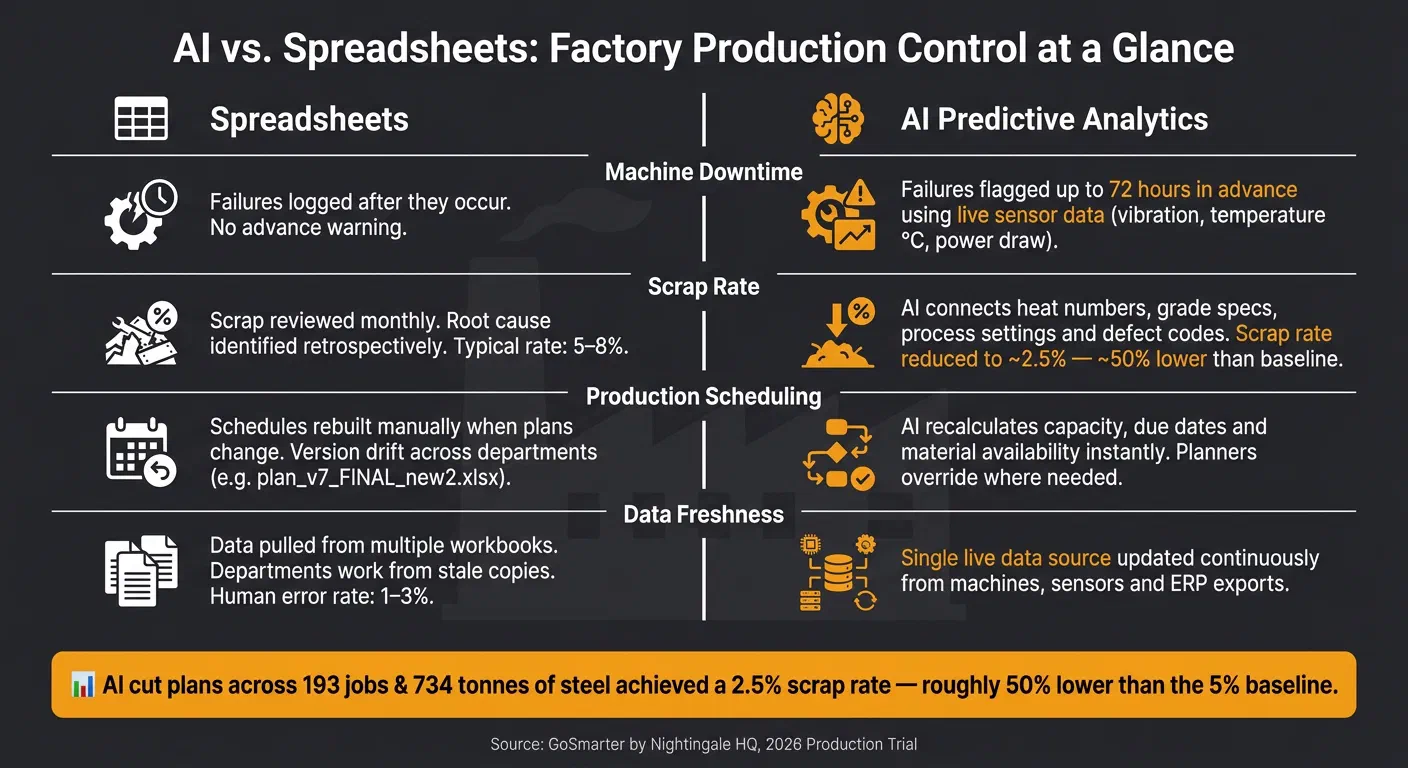
Spreadsheets show what happened. AI helps you deal with what happens next.
| The Manual Way | The Automated Way |
|---|---|
| Maintenance logged in spreadsheets; failures reviewed after they occur | Live sensor data, vibration, temperature (°C) and power draw, analysed in real time; failures flagged up to 72 hours in advance [7] |
| Scrap reviewed monthly from production summaries; root cause identified retrospectively | AI connects process settings, material data and defect patterns; scrap rates tracked by heat number or line |
| Schedules rebuilt manually when a machine goes down or a delivery slips | AI recalculates capacity, due dates and material availability; planners override where needed |
| Data pulled from multiple workbooks; departments work from stale copies | Single live data source updated continuously from machines, sensors and Enterprise Resource Planning (ERP) exports |
That shift from static records to live decisions changes day-to-day control on the shop floor.
Catching machine downtime before it happens
Predictive maintenance uses equipment data to estimate when a machine will fail, before it actually does. AI models combine historical records with live signals: vibration levels, motor temperature in °C, power use, cycle counts and run hours. When those readings drift from normal ranges across several shifts, the system flags the risk.
By the time an operator logs an anomaly and someone checks a spreadsheet, the window to step in has often gone. AI analytics platforms can flag failure risk up to 72 hours before breakdown, with alerts within milliseconds [7]. A spreadsheet formula can’t do that.
Reducing scrap before it hits your margin
In metals, scrap is not a rounding error. Manual cut planning often produces scrap rates of 5–8% [2]. That is not just lost material. It is wasted energy, labour and transport baked into every tonne that never becomes a finished product.
AI changes the maths. It connects inputs that spreadsheets usually split apart:
- heat numbers
- grade specifications
- process settings
- offcut lengths
- defect codes
Instead of reviewing scrap figures at month end, AI models can spot which combinations of material, setup and line conditions are most likely to create rejects. Then they flag the risk before the cut.
In a two-week production trial in 2026, Midland Steel, a UK rebar and long products manufacturer, used GoSmarter, built by Nightingale HQ, for AI cutting plans across 193 jobs and 734 tonnes of steel. The scrap rate came in at 2.5%, roughly 50% lower than the previous baseline of around 5% [5][6][8][9]. Every wasted tonne in a metals plant means lost material cost, plus the energy, labour and transport you already spent.
Reworking production schedules when plans change
“The plan is always wrong by lunchtime. Jobs change. Material isn’t where the spreadsheet said it was.” [3]
Every production planner knows this. Static schedules fall apart the moment the factory starts moving.
When a machine goes down mid-shift, a delivery slips by a day, or a changeover overruns, a spreadsheet-based plan turns into a manual clean-up job. Someone rebuilds it by hand. Someone checks the knock-on effects across jobs. Someone hopes another department has not edited an old copy and called it the latest version.
AI scheduling recalculates fast. It updates capacity, due dates and material availability, then shows the planner new options without making them start again. You still keep control. If a machine comes out for maintenance, the planner flags it and the algorithm recalculates the remaining work around it. The plan stays current through the shift.
In metals, that matters more because every delay hits tonnes, cuts and margin.
Why this matters more in metals than in most factories
Most factories have data problems. In metals, each mistake also carries weight, grade, and a £ per tonne hit.
Predictive analytics only matters here if you keep traceability and grade control live. If you cannot track the material, the maths means nothing.
Mill certificates, heat numbers, and paper trails are not a side job
Every coil, bar, and billet arrives with a mill certificate. It carries the heat number, test results, chemistry, and delivery condition, such as +N or +QT. In plenty of plants, people still print those PDFs, file them, and cross-reference them by hand. That slows traceability and gives errors room to creep in.
If someone misreads a heat number, or loses it in manual cross-referencing, the traceability chain breaks. That matters for EN 10204 compliance [10]. A spreadsheet still relies on someone matching entries by hand. Miss one line, and the whole chain falls apart.
A single production manager can save over 120 hours a year by automating mill certificate data extraction [1]. That is time people now spend typing numbers from PDFs into cells. The daft part is those numbers already sit in the document.
When every tonne and every cut has a £ value
Scrap steel usually gives you back only 40p in the pound [2]. So every kilogram that does not end up in finished product locks in a 60% loss on material you already paid for.
On a 1,000-tonne order, even a small yield gain can protect margin fast.
That is why your system needs to connect certificate data, planning, and despatch in one live record.
What purpose-built AI looks like in a metals plant
Generic software sold to manufacturing often falls apart in metals. It misses the stuff that makes the trade messy: multi-heat certificates, grade compliance rules such as BS 4449 or S355, offcut tracking, and the need to link every cut back to its source heat number at despatch [2][10].
GoSmarter, built by Nightingale HQ, tackles that mess head-on. Its MillCert Reader pulls certificate data from PDFs and links each heat to stock at goods-in. Its scheduler and scrap optimiser build compliant cut lists and keep traceability from certificate to despatch, without ripping out your Enterprise Resource Planning (ERP) system.
It handles the traceability and scheduling work spreadsheets were never built for. In metals, mistakes are measured in tonnes, not typos.
Conclusion: pick one process where spreadsheets waste the most time and start there
Spreadsheets work for static jobs. Factories do not. The second a machine fails mid-shift, or a delivery turns up short, your spreadsheet stops telling the truth. It shows what was true, not what is true. On a live shop floor, that gap costs money.
AI turns live factory data into decisions spreadsheets simply cannot make in time. The scrap gap alone can hurt.
In metals, the first crack usually shows up in certificate capture or production scheduling. That’s where spreadsheets fall apart most often. One person guards the macros. Data goes stale before the shift ends. Someone still types numbers from a PDF into a cell like it’s a normal way to run a factory.
GoSmarter, built by Nightingale HQ, automates both. Teams stop retyping data and start acting on it. Its MillCert Reader pulls data from PDF certificates and links each heat number to stock on its own.
Pick the process that breaks first. Fix that one. Then measure what changed.
FAQs
How does predictive analytics work in a factory?
Predictive analytics in a factory pulls messy, split-up live data into one working model. That means sensor feeds, production logs, and stock system data all in the same place. Then AI checks the patterns, spots trouble early, and warns you before a machine packs in or a process slips.
It also uses demand curves and live shop-floor limits, like machine capacity and material availability, to sort out production plans and stock levels. You get fewer stoppages, less waste, and fewer quality problems.
What should a metals plant automate first?
Start small. Fix the one operational headache that slows you down most. Don’t try to rebuild the whole shop floor in one go. That’s how good projects turn into expensive software theatre.
You can start with one job that wastes hours every week:
- Automate mill certificate processing to cut manual data entry
- Use AI-driven cutting optimisation to reduce scrap
- Improve inventory traceability so you can see stock clearly and stay on top of compliance
Pick the bit that causes the most friction now. Sort that first.
Can AI fit around our current ERP system?
Yes. AI can slot into your current Enterprise Resource Planning (ERP) system without a rip-and-replace job or a six-month slog.
GoSmarter, built by Nightingale HQ, sits on top of what you already use. It handles the jobs most ERPs make a mess of, like mill certificate processing and cutting optimisation.
You do not need to bin Sage, Microsoft Dynamics, SAP Business One, Infor or Epicor. GoSmarter exports clean, structured data through CSV or a REST API, so your team can push the right data into the systems you already run.
Related reading
- Top Tools for Edge Analytics in Steel Plants
Unplanned downtime, scrap and manual certificate re-entry: edge tools that cut latency, reduce scrap and automate traceability in steel plants.
24 min read
- Digital Twins in Metals Manufacturing: A Complete Guide
Digital twins cut steel scrap from 5-8% to under 2.5%. Learn the standards, data foundations and pilot plan that make one work on your line.
24 min read
- Give Engineers Their Time Back: Automate Mill Cert Entry
Engineers lose 20-30% of their time to manual rekeying and missing mill certs. Learn how automation speeds audits and cuts scrap.
16 min read
Tags:
About the Author

Editor· Co-founder & Head of Product
Steph Locke is Co-founder and Head of Product at GoSmarter AI — former Microsoft Data & AI MVP building practical tools to cut paperwork and automate compliance for metals manufacturers.