AI vs. Spreadsheets: Carbon Reporting in Metals
- BlogSmarter AI
- Edited by Steph Locke
- Blog
- May 19, 2026
- Updated:
Table of Contents Show Hide
AI carbon reporting for metals replaces fragile spreadsheets with automated, batch-level emissions data that is faster to verify and safer for Carbon Border Adjustment Mechanism (CBAM) compliance. If you are still stitching together invoices, utility bills, and production logs in Excel, you are carrying avoidable compliance risk, inflated admin, and carbon costs that can jump by 40–60% when you fall back to default values under the EU’s Carbon Border Adjustment Mechanism.
GoSmarter fixes the mess by automating data extraction, applying industry standards, and linking emissions to specific production batches. It supports your carbon and Environmental, Social and Governance (ESG) reporting workflows. It is a metals-specific data automation layer, not a full ESG suite.
What you get:
- Accurate data: AI spots errors and flags anomalies before they cause problems.
- Time saved: Cut reporting time from hours to minutes with automated processes.
- Compliance-ready reports: Meet CBAM and customer demands with traceable, verified data.
- Batch-level precision: Track emissions heat by heat, not averaged across the plant.
Stop letting spreadsheets hold you back. Here’s how to fix it.
How Spreadsheets Handle Carbon Reporting Today
The Manual Workflow: From Data Collection to Report
Carbon reporting begins with sustainability managers pulling together a patchwork of documents - think invoices, utility bills, and Enterprise Resource Planning (ERP) system exports - all arriving in different formats. For instance, fuel purchase records might need converting from one unit to another, while supplier data often requires a different approach, like turning “tonnes carbon dioxide equivalent (CO₂e) per million £” into “kg CO₂e per unit” 1.
Once the data is gathered and normalised, emission factors from databases like the Intergovernmental Panel on Climate Change (IPCC), the United States Environmental Protection Agency (EPA), or the UK Department for Business, Energy and Industrial Strategy (BEIS) are manually applied. For integrated steel plants, this process gets even trickier with on-the-spot carbon mass balance calculations - using coke consumption figures and limestone calcination data. After crunching the numbers, the results are presented in static charts and tables for compliance or internal reporting. Then, the entire cycle starts all over again the next month.
Here’s what a typical reporting cycle looks like:
| Step | Spreadsheet Activity | Common Data Sources |
|---|---|---|
| Collection | Gathering activity data manually | Invoices, ERP exports, PDFs, utility bills |
| Processing | Standardising units and currencies | Supplier surveys, procurement records |
| Calculation | Applying emission factors | IPCC, EPA, or BEIS databases |
| Analysis | Carbon mass balance calculations | Production logs, fuel purchase records |
| Reporting | Creating static charts and tables | Manual entry into reporting templates |
The entire process takes at least two manual hours per week just for basic updates 2. It’s a structured approach, but undeniably tedious. This kind of manual workflow makes it clear why spreadsheets struggle to keep up with the growing complexity of carbon reporting.
What Spreadsheets Do Well and Where They Fall Short
Spreadsheets shine in their simplicity and low cost, especially for smaller operations managing basic greenhouse gas inventories or Scope 1 and 2 emissions. They’re familiar tools that don’t require specialised training, making them a go-to for initial reporting needs.
But their limits start to show as operations scale or processes become more variable. Take a blast furnace, for example. Its efficiency isn’t constant, and CO₂ output can vary by 15–25% per tonne of liquid steel depending on how it’s running 3. A spreadsheet built on monthly fuel records can’t account for this variability - whether the furnace is running at 85% or 98% efficiency, the spreadsheet won’t know the difference.
Errors are another major issue 4. A misplaced decimal or incorrect formula doesn’t just mess up internal reports; it can lead to compliance failures and financial penalties. Then there’s the risk of “knowledge drain” - when the person maintaining the spreadsheet leaves, the logic behind it often leaves with them 2. And good luck tracing back numbers in a spreadsheet with no clear audit log 2.
When Spreadsheets Are Still Good Enough
For straightforward operations - say, basic Scope 1 and 2 reporting - spreadsheets can do the job. They work as an entry-level tool to map out data and get a feel for its flow before committing to more advanced systems 4.
However, the cracks start to show when things get more complex. Reporting across multiple facilities, incorporating Scope 3 data, or responding to customer demands for batch-specific carbon data? That’s when spreadsheets become more than just inconvenient - they become a compliance risk.
Take the Carbon Border Adjustment Mechanism (CBAM) as an example. From 2026, metals exporters without verified process-level data could be hit with default emission values, which might inflate their carbon costs by 40–60% compared to companies with proper monitoring 3. At this point, sticking with spreadsheets isn’t just inefficient - it could cost you a fortune. That’s why moving beyond spreadsheets is becoming less of a choice and more of a necessity as reporting demands grow tougher.
How AI Changes Carbon Reporting for Metals
What AI Brings to Carbon Reporting
The problem with using spreadsheets for carbon reporting isn’t just the effort - it’s the fact that they’re not built for the job. Spreadsheets are fine for simple, flat data. But carbon reporting in metals? That’s a whole different level of complexity, with multi-layered data coming from every corner of the operation.
AI changes the game. It pulls data directly from ERP systems, energy meters, procurement records, and even PDFs, then cleans it up, standardises it, and does the calculations for you. Machine-learning models handle messy supplier formats, flag missing values, and match heat numbers across systems. What used to take hours of manual work now happens automatically.
The platform embeds calculation logic aligned with standards like ISO 14067 and the GHG Protocol. Automatic updates and audit logs keep everything traceable, so no one’s stuck recalculating or hunting for errors. It even spots anomalies - like energy consumption doubling for a heat - and flags them before they make it into a report. A 2022 Boston Consulting Group (BCG) survey of over 1,600 companies found that AI-driven emissions management boosted data-collection efficiency by 40% and improved emissions data accuracy by up to 30–40% compared to manual methods 3. Instead of static monthly reports, you get real-time dashboards where every CO₂e figure is tied to its source - whether it’s a certificate, meter reading, or transaction - with a time-stamped log of every change.
This isn’t just automation; it’s a complete rethink of how carbon reporting works, paving the way for metals-specific challenges.
How AI Handles Metals-Specific Reporting Challenges
Generic carbon tools? They don’t cut it in a steel or aluminium plant. They don’t know the first thing about heat numbers, mill certificates, or the difference between blast furnace (BF–BOF) and electric arc furnace (EAF) production. Metals-specific AI, however, is built for the job. It handles the precision needed for scrap tracking and batch traceability with ease.
Take mill certificates, for example - those multi-page PDFs crammed with heat numbers, chemistry, mechanical properties, and production details. AI-powered optical character recognition (OCR) and document-understanding models turn these into structured, searchable data in seconds. Heat numbers, grades, carbon equivalent (CEQ) values, and supplier details? Pulled automatically and linked to inventory records and works orders. A QC Manager at a UK steel stockholder summed it up:
“Our tool saves hours every month by automatically pulling key data from mill certificates. Renaming documents in seconds used to be painfully manual - now it just happens.” 5
Scrap tracking is another headache AI solves. By pulling data from production systems, weight scales, and ERP, it matches scrap to specific heats or jobs using timestamps, machine IDs, and product routes. This matters because, as the World Steel Association points out, recycled steel from EAFs has a much smaller carbon footprint than virgin steel from blast furnaces - but only if scrap content is tracked heat by heat, not averaged across the plant.
And then there’s the challenge of linking heats to finished products. Spreadsheets break down when trying to map the many-to-many relationships between heats, intermediate coils, and final parts. AI builds a relational graph from Manufacturing Execution System (MES), ERP, and mill certificate data, updating it automatically when rework or route changes occur. The result? A traceable carbon footprint that links a finished component back to its original heat and supplier - exactly what you need for Environmental Product Declarations (EPDs) or CBAM compliance.
With these capabilities, GoSmarter delivers a solution tailored to the metals industry.
How GoSmarter Powers Carbon Reporting in Metals
GoSmarter isn’t just another ESG tool; it’s purpose-built for metals manufacturers. Designed for the realities of the shop floor, it handles the thousands of PDF mill certificates, complex scrap flows, and mounting pressure for verified, product-level carbon data.
The MillCert Reader uses AI-driven OCR to pull heat numbers, grades, chemical compositions, and carbon values straight from mill certificates. It links this data to inventory records and customer orders, while validation rules catch issues like non-conforming carbon content or missing impact tests at goods-in, not mid-production. Every piece of data is logged in a traceable audit trail that meets EN 10204, ISO 9001, and CBAM standards. For teams that used to spend 30–60 minutes processing each certificate, cutting that down to 1–2 minutes per certificate adds up fast - one production manager saved over 120 hours a year through automation alone 5.
GoSmarter’s Cutting Plans takes it further, tracking offcuts and scrap at the batch level. This provides accurate material and yield data for carbon calculations, ditching the reliance on plant-wide averages. And because it integrates directly with existing ERP systems - without requiring a complete overhaul - metals manufacturers can generate cleaner, more reliable carbon data without the usual headaches.
Spreadsheets vs. AI: A Direct Carbon Reporting Comparison
Key Differences at a Glance
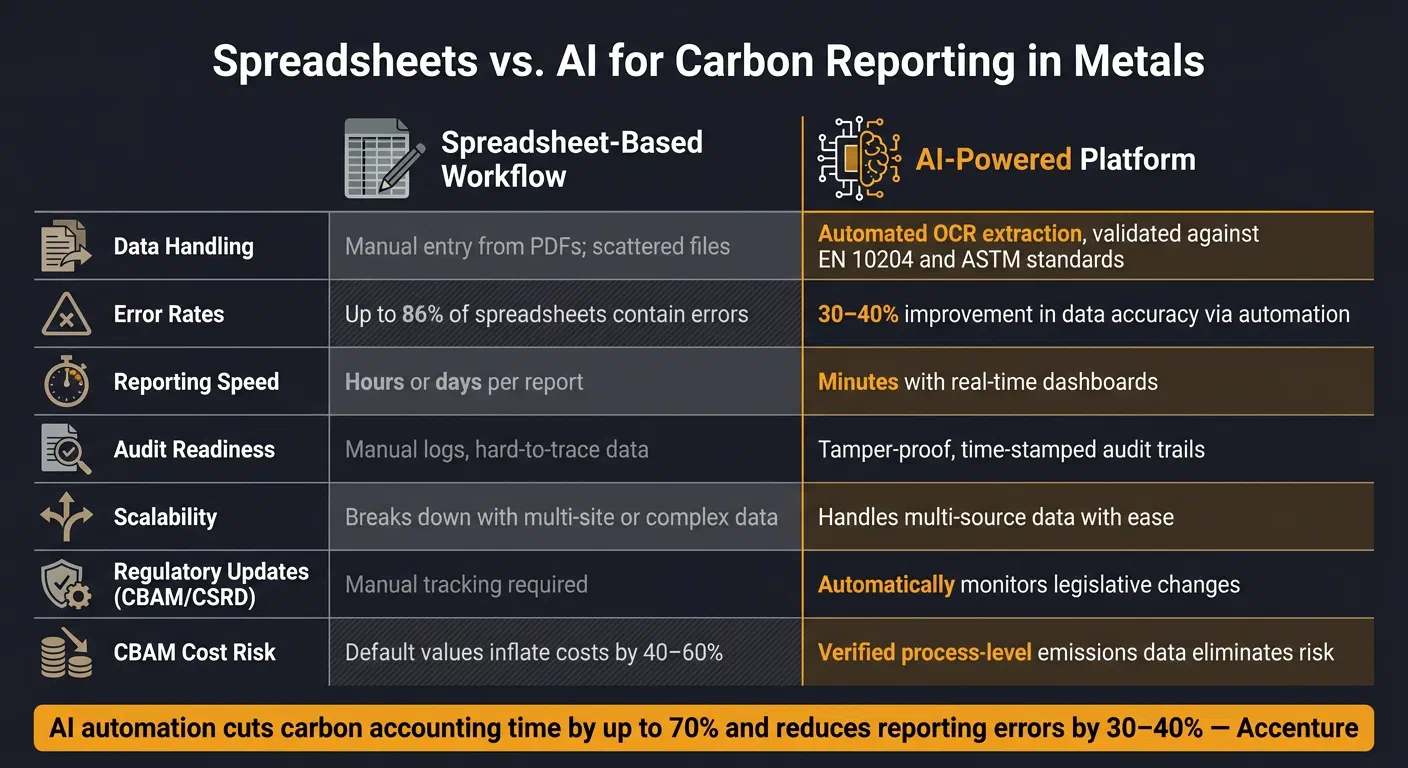
When it comes to carbon reporting, the differences between spreadsheets and AI-powered platforms aren’t just technical - they affect everything from accuracy to cost control. Here’s a quick breakdown:
| Feature | Spreadsheet-Based Workflow | AI-Powered Platform |
|---|---|---|
| Data Handling | Manual entry from PDFs; scattered files | Automated OCR extraction, validated against standards like EN 10204 and ASTM |
| Error Rates | Prone to mistakes | Reliable due to automation |
| Reporting Speed | Hours or days per report | Minutes with real-time dashboards |
| Audit Readiness | Manual logs, hard-to-trace data | Tamper-proof, time-stamped audit trails |
| Scalability | Crumbles with multi-site or complex data | Handles multi-source data with ease |
| Regulatory Updates | Manual tracking of updates like CBAM, Corporate Sustainability Reporting Directive (CSRD) | Automatically monitors legislative changes |
| CBAM Readiness | Risks costly default values | Uses verified, process-level emissions data 3 |
These differences aren’t just academic - they directly shape how manufacturers manage their carbon footprint, compliance, and costs.
The Cost of Manual Errors vs. Automated Accuracy
With CBAM’s strict requirements, manual methods come with a hefty hidden price tag. Sure, spreadsheets don’t charge subscription fees, but the risks stack up fast: version mismatches, misplaced decimals, and errors that only surface when auditors come knocking.
“It is just relentless, overly manual, and I think I’ve raised lots of risks, issues and efficiency savings with it internally.” 1
For manufacturers, the stakes are high. Under CBAM, using default emissions values instead of verified data can inflate costs by 40–60% 3. If you’re a mid-sized steel stockholder processing hundreds of heats monthly, that difference hits hard.
The problem isn’t just cost; it’s accuracy. As Alex Jordan from iFactory points out:
“The fundamental problem is that purchase-record based emission calculations treat a blast furnace running at 85% efficiency identically to one running at 98% efficiency - missing the process variability that drives 15–25% swings in actual CO₂ output.” 3
AI platforms solve this by connecting directly to furnace sensors and ERP systems, capturing real-time data that reflects actual emissions. Spreadsheets, no matter how well-designed, simply can’t keep up.
Why Metals Manufacturers Are Switching to AI
This shift to AI isn’t about chasing trends - it’s about survival, often requiring specialised toolkits for smart manufacturing. Spreadsheets can’t handle the complexity of modern carbon reporting, especially for multi-site operations. Imagine managing several facilities, each with its own ERP, suppliers, and energy data. A spreadsheet model quickly turns into a logistical nightmare.
AI can help you pull data from diverse sources - utility bills, ERP systems, mill certificates, weight scales - and consolidate it into a clean, traceable dataset that supports your existing ESG reporting tools 6.
Scrap flows are another sticking point. Tracking recycled content heat by heat instead of averaging it across an entire plant is crucial for creating credible carbon certificates. This level of precision is non-negotiable for manufacturers supplying industries like automotive or wind energy, where “green steel” isn’t just a buzzword - it’s a requirement 3.
And then there’s regulation. With CBAM already here, CSRD expanding, and Scope 3 reporting becoming mandatory 6, manufacturers need data that’s granular, traceable, and audit-ready. AI doesn’t just save time - it ensures your reporting stands up to scrutiny.
Start Improving Your Carbon Reporting Today
You’ve seen the cracks in spreadsheet-based workflows - now it’s time to do something about it. Manual processes are too slow, too prone to mistakes, and too risky for the demands of modern carbon reporting. As regulations like CBAM and CSRD tighten their grip, relying on outdated methods isn’t just inefficient - it’s a liability. Delayed reporting, compliance risks, and inflated costs will only escalate as these requirements expand.
Enter GoSmarter, designed specifically for metals manufacturers stuck in this exact bind. It works with your existing systems - no need for disruptive IT overhauls. Upload your mill certificates, orders, and inventory. Let GoSmarter’s AI handle the heavy lifting. It extracts and validates the data automatically, giving your ESG reporting tools cleaner, more reliable inputs from day one. Industry research shows that AI-driven emissions management can boost data-collection efficiency and improve data accuracy versus manual methods 3.
And the results? They’re fast. Within 30–90 days, most manufacturers see automated data extraction from PDF mill certificates and supplier declarations, standardised emissions data across batches, and traceable, version-controlled calculations. No more relying on the one person who knows how the spreadsheet works. As Tony Woods, CEO of Midland Steel, puts it:
“Smart technology choices can have a direct, measurable impact on reducing carbon emissions in steel manufacturing.” 7
What’s the cost? GoSmarter’s Workshop tier starts at £280/month billed annually. This includes AI scanning of mill and material certificates, automatic inventory linking to heat codes, and full certificate retrieval by heat number. If your reporting needs are still simple and low-volume, spreadsheets might hold up for now. But as customers demand more detailed, product-level carbon data, the cost of sticking with old methods will only grow.
Want to see the difference AI can make? Start with a focused discovery session to identify where your manual processes are slowing you down. Then, try a limited-scope pilot - whether it’s for one plant, one product family, or your top ten customers. No live systems are touched. Just bring your existing data, and GoSmarter will show you exactly how many hours you could save, where errors are lurking, and how batch- or heat-level carbon visibility could transform your reporting.
FAQs
What data do I need to be CBAM-ready in 2026?
How does AI link CO₂e to a specific heat or batch?
How quickly can GoSmarter replace our spreadsheet workflow?
Is GoSmarter a complete ESG platform?
Further Reading
1: https://ditchcarbon.com/blog/beyond-the-spreadsheet-the-high-cost-of-manual-scope-3-reporting
2: How to switch from Excel spreadsheets to carbon accounting software | BigMile
3: Steel Plant Carbon Emissions & ESG Reporting with AI-driven
4: Carbon accounting: Excel vs. software platforms for scalable climate data management | Nexio Projects
5: Mill Certificate Reader | Automated Extraction | GoSmarter
6: AI and Sustainability: How Tech Transforms Carbon Accounting
Related reading
- Why PDF Mill Certificates Break Data Workflows
Re-keying PDF mill certificates breaks heat-number traceability. Learn how to validate, extract and link certificate fields to stock records.
9 min read
- How digital Kanban cuts sheet metal delays
Digital Kanban caps work in progress (WIP) at each sheet metal operation, so only ready jobs reach the laser and press brake. Start with a two-week …
13 min read
- AI Compliance Tracking: Cost vs. Benefits
Manual mill cert tracking is not free. Compare the labour, audit and error costs with AI tracking, and find your break-even in hours a month.
18 min read
About the Author

Editor· Co-founder & Head of Product
Steph Locke is Co-founder and Head of Product at GoSmarter AI — former Microsoft Data & AI MVP building practical tools to cut paperwork and automate compliance for metals manufacturers.