AI Training ROI: What to Measure
- BlogSmarter AI
- Edited by Ruth Kearney
- Blog
- April 26, 2026
- Updated:
Table of Contents Show Hide
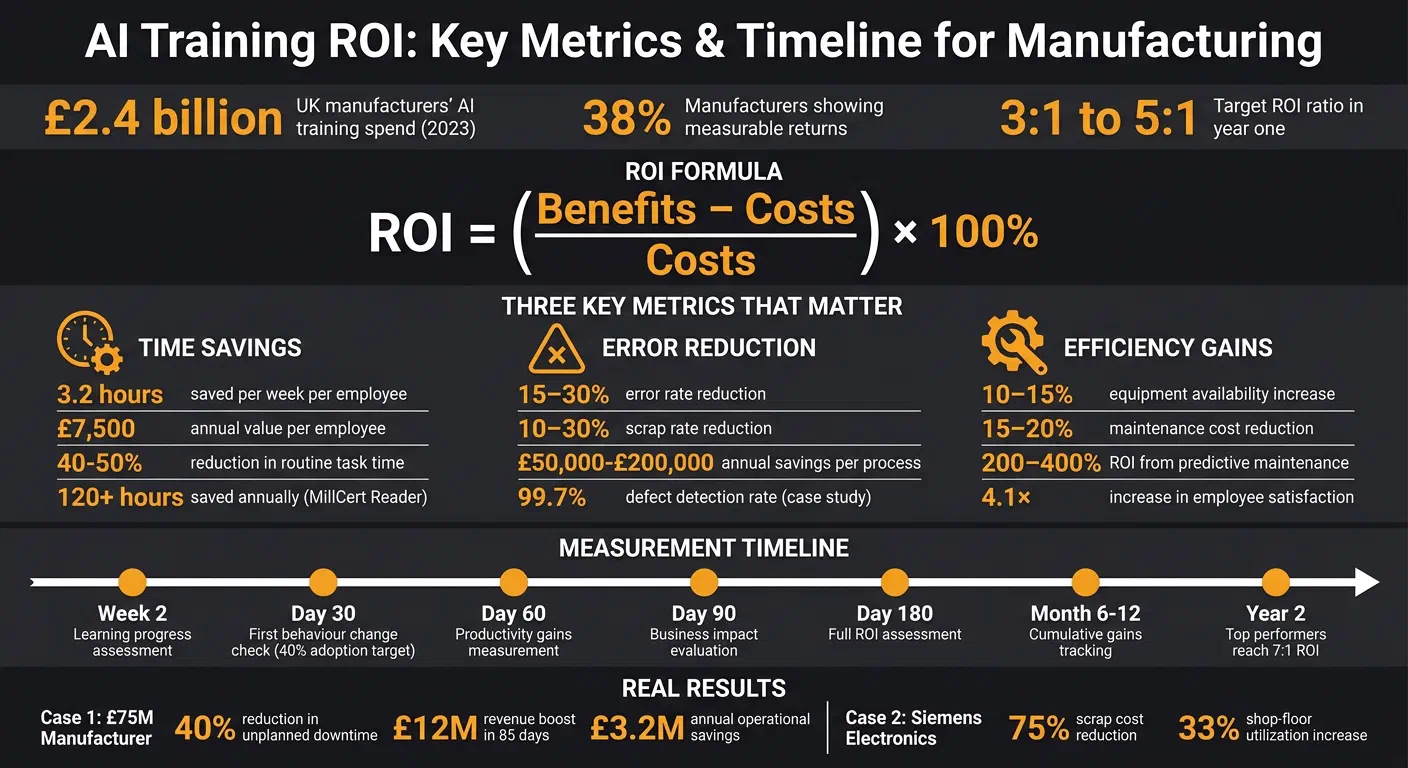
AI training delivers a 3:1 to 5:1 Return on Investment (ROI) in year one, but only if you measure the right things. UK manufacturers spent £2.4 billion on AI training last year. Only 38% can show measurable returns. “92% satisfaction” does not cut it when your Chief Financial Officer (CFO) demands hard numbers.
The gap is not the technology. It is what you track. Time savings, defect reductions, and productivity gains are what keep your margins intact. GoSmarter (built by Nightingale HQ) offers the MillCert Reader and Cutting Plans — tools that sit on top of your existing systems, not instead of them. No rip-and-replace required. They save hours, slash scrap, and make compliance effortless. See the AI ROI hub for metals manufacturers for the full breakdown.
What you’ll get:
- A simple ROI formula that works: (Benefits – Costs) / Costs × 100%
- Metrics that matter: time saved, errors reduced, and employee retention
- Real-world examples: £12M revenue boost in 85 days, 99.7% defect detection
- A clear framework to track ROI at 30, 60, and 90 days
Here’s how to stop burning money on training that doesn’t stick, and start showing results.
How to Calculate Your AI Training ROI
What is AI training ROI? AI training ROI (return on investment) is the measurable financial and operational gain your business achieves after training staff to use AI tools, expressed as a ratio of benefits to costs. A 3:1 ratio means every £1 spent on training returns £3 in time saved, errors avoided, or scrap reduced.
The Metrics That Matter Most
When it comes to AI in manufacturing, the real measure of success for AI training is how it impacts production, costs, and staff retention. These aren’t just abstract benefits; they show up directly on the shop floor and in the CFO’s reports.
Time Savings and Productivity Gains
One of the quickest wins from AI training is the time it gives back to your team. In mid-sized UK manufacturing firms, AI-trained employees save an average of 3.2 hours per week. That adds up to about £7,500 per year per employee when you factor in labour costs 1. To see these gains, focus on high-frequency tasks like processing mill certificates, scheduling production runs, or drafting technical proposals 23.
Start by logging how long these tasks take before training, how often they’re performed, and the hourly cost of labour. Then, check back at 30, 60, and 90 days to measure progress. Weekly tasks are the sweet spot for spotting quick improvements 2.
| Metric | Pre-Training Benchmark | Post-Training Improvement |
|---|---|---|
| Time on Routine Tasks | Baseline (100%) | 40–50% reduction 4 |
| Weekly Time Saved | 0 hours | 3.2 hours per employee 1 |
| Equipment Availability | Baseline (100%) | 10–15% increase 5 |
| Maintenance Costs | Baseline (100%) | 15–20% reduction 5 |
AI-powered predictive maintenance can cut maintenance costs by 15–20% while boosting equipment availability by 10–15%. Some manufacturers have reported a 200–400% ROI from predictive maintenance and quality control 15. Beyond saving time, these improvements lead to fewer errors and higher-quality output.
Error Rate Reductions
AI training can slash error rates by 15–30% 1. What does that mean in practice? Fewer scrapped materials, less time spent on rework, and reduced downtime. Manufacturers using AI for quality monitoring have seen scrap rates drop by 10–30%, saving anywhere from £50,000 to £200,000 annually per automated process 67.
To put a number on these benefits, calculate your current scrap costs, the value of wasted materials, and rework labour rates 27. Then, track changes at 30, 60, 90, and 180 days 1. For example, if you’re losing £500,000 a year to scrap, a 20% reduction could pay for itself quickly. Focus AI tools on bottleneck equipment or areas with high variability, where quality issues are hardest to pin down 6. Real-time monitoring can also help by linking defect rates to specific factors like material lots or environmental conditions, catching problems before they snowball 6.
These gains build the CFO’s case for AI training. Numbers on a page beat promises every time.
Employee Engagement and Retention
AI training doesn’t just improve processes - it makes jobs better. By cutting out the boring stuff like sorting PDFs or calculating scrap rates, AI lets engineers focus on solving real problems 3. This boost in job satisfaction has led to employee satisfaction scores increasing by a factor of 4.1 in some organisations 4.
In metals manufacturing, where experienced staff often carry decades of hard-earned knowledge, keeping your best people is crucial. Monitor how often employees use AI tools as a sign of engagement. If fewer than 40% of trained staff are using the tools three times a week by day 90, something’s not clicking. Confidence ratings after training also show whether it’s making a difference on the shop floor 1.
Investing in AI training isn’t just about cutting costs - it’s about keeping your team engaged and your business competitive. Invest in AI training and your best people stay. In metals manufacturing, that experience is irreplaceable.
Case Studies From Manufacturing
GoSmarter: Turning Manual Work Into Clean Data
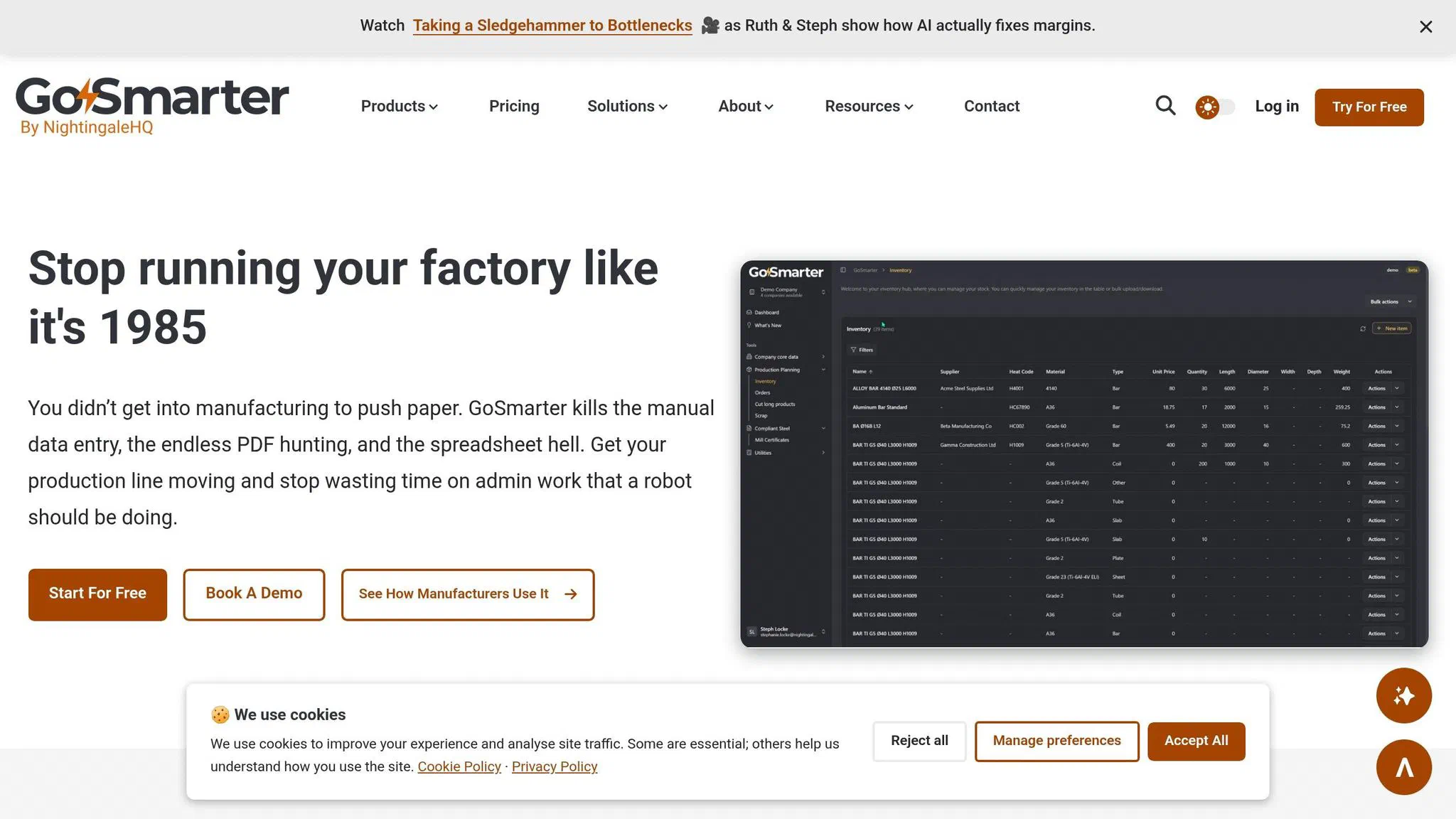
Midland Steel, a leading supplier of reinforcing steel in the UK and Ireland, adopted GoSmarter’s AI tools to cut down on manual work and improve production scheduling. A detailed digital review identified opportunities to eliminate repetitive tasks, paving the way for toolkits for smart manufacturing [8].
The MillCert Reader pulls critical data from mill test reports (MTRs) - like heat numbers, material grades, chemical compositions, and mechanical properties - with almost no errors. This saves production teams over 10 hours a month and ensures certificates are automatically matched to physical deliveries at goods-in, making compliance effortless [9, 13]. That cert data feeds straight into your live stock count, your cutting plans, and your On-Time In Full (OTIF) delivery tracking — one record, every tool, no re-keying required. Meanwhile, Cutting Plans slashes scrap waste by up to 50% and boosts on-time delivery by automating tricky calculations involving offcuts and scheduling. Engineers can then focus on solving production issues instead of battling with spreadsheets [8]. See how it fits into your production and compliance operations. These time savings, reduced waste, and improved delivery performance translate into clear, measurable ROI that even the most sceptical CFO would appreciate.
Scaling ROI Beyond the Pilot Phase
Some manufacturers have gone beyond pilot projects, scaling AI to unlock even greater efficiencies. But scaling AI isn’t as simple as deploying software - it requires buy-in from employees and smooth integration into existing workflows 8. It’s a tough challenge: only 16% of AI projects manage to scale successfully across an organisation 9.
Take Ma’aden, a mining company in Saudi Arabia. By automating tasks like email drafting, document creation, and data analysis, they save 2,200 hours every month (that’s 26,400 hours a year) 8. Similarly, Siemens Electronics Works Amberg cut scrap costs by 75% and increased shop-floor utilisation by 33% using AI for predictive maintenance and real-time quality checks 10. These results echo the earlier metrics showing how AI reduces error rates and boosts efficiency. However, it often takes 12 to 24 months for the full benefits to emerge as systems get integrated and teams adapt [7, 8].
Starting with high-frequency tasks - such as document creation, data analysis, or mill certificate handling - can deliver quick wins. For instance, a £75M manufacturer implemented AI to cut unplanned downtime by 40% and achieve a 99.7% defect detection rate. Within just 85 days, they saw a £12M revenue boost and saved £3.2M annually in operational costs 11. As Seymore C., Director of Operations, put it:
“The AI transformation exceeded all our expectations. Not only did we achieve a 40% reduction in downtime, but our quality control now catches 99.7% of defects automatically. The ROI was immediate and continues to compound.” 11
These results show how AI can deliver tangible gains when properly measured and scaled across manufacturing operations. The key? Start small, measure everything, and build from there.
How To Build A Measurement Framework For AI ROI
Link Metrics To Business Outcomes
One of the most common missteps manufacturers make is focusing on AI training metrics in isolation. Things like satisfaction scores or completion rates might look good on paper, but they don’t tell you whether your factory is actually running smoother. The key is to tie every training metric directly to a business outcome that Finance already cares about - like throughput per employee, scrap reduction, On-Time In Full (OTIF) delivery, or fewer rework cycles.
Start by setting a baseline before training even begins. Collect system logs and time-and-motion data for 2–4 weeks to measure volumes, error rates, and cycle times. This gives you a snapshot of where things stand 12. Next, pinpoint workflows where AI can make a clear difference - think mill certification, quality documentation, or customer queries. After training is complete, track how quickly employees adopt the AI tool. If fewer than 40% of trained staff are using it at least three times per week by day 90, your training hasn’t stuck 1.
To keep everything aligned with business goals, translate these metrics into financial terms that Finance can work with. For example:
- Calculate “Ramp Value” as (days saved × number of new hires × daily productivity value).
- Work out “Rework Avoidance” as (defects avoided × average correction cost) 12.
When converting time savings into monetary value, use fully loaded labour rates - typically 1.3× salary to include overheads 212. And don’t fall into the trap of double-counting; make sure every result is clearly tied to the right department 12.
This groundwork ensures you’ve got a solid foundation for tracking long-term results.
Set Up Long-Term Tracking
Short-term wins are great for proving initial impact, but the real value of AI compounds over time. Unfortunately, many manufacturers stop tracking too soon. A well-run AI programme should aim for an ROI ratio of 3:1 to 5:1 in the first year, with top performers hitting 7:1 by year two as new habits take hold 12. Some even manage 4–5× ROI after five years 6. The catch? A three-year payback doesn’t match up with a three-month review cycle 6. That’s why it’s critical to assess ROI at the 6- and 12-month marks to capture these cumulative gains.
Build a four-layer measurement framework to monitor progress:
- Layer 1: Immediate satisfaction.
- Layer 2: Learning progress at two weeks.
- Layer 3: Behaviour change between 30–90 days.
- Layer 4: Business impact at 90–180 days 1.
Forget vanity metrics like training satisfaction scores - they only correlate with real behaviour change about 23% of the time. Instead, focus on Layer 4 metrics like hours saved, scrap reduction, and decreased downtime 1. Toni Dos Santos, Co-Founder of Spicy Advisory, sums it up perfectly:
“The honeymoon period for AI training spend is over. ‘Everyone needs to learn AI’ is no longer a sufficient business case” 1.
Keep an eye on cumulative gains over time. For instance, if AI-trained employees save an average of 3.2 hours per week 1, that adds up to roughly 166 hours per person per year. Multiply that by your headcount and fully loaded labour rate to calculate the annual value. Track scrap reductions year-on-year, knowing that small improvements add up as production scales. Finally, automate usage tracking through your Enterprise Resource Planning (ERP) or Manufacturing Execution System (MES). This will give you real-time scorecards for your CFO, showing how much time, money, and waste you’ve saved compared to your baseline.
Start Measuring AI ROI Today
Start proving your AI ROI now - don’t wait for perfection. The biggest mistake manufacturers make is holding off deployment, waiting for a flawless business case. Here’s the reality: AI projects that fail to show ROI often stumble at the measurement stage, not because the tech doesn’t work 13. Every week you stick with manual processes, you’re burning money.
To get real results, start with GoSmarter’s free Business Case Calculator. No account needed. Plug in your scrap rates, wasted admin hours, and material losses. It’ll crunch the numbers, calculate ROI, and even generate a CFO-ready PDF. For a typical UK metals manufacturer, tools like MillCert Reader can save over 120 hours a year [14], and Cutting Plans can cut scrap by up to 50% [14]. With professional labour costing £25–£30 per hour (based on a £35,000 salary) 13, those savings add up fast.
Once you’ve got your baseline, test it out. Pilot one workflow - say, automating mill certificate processing. GoSmarter works on top of your existing systems. No ERP replacement, no IT project. GoSmarter connects via REST API with OAuth 2.0 and Microsoft Entra (formerly Azure AD) sign-on, and all data is hosted in UK Azure - it never trains on your production records. GoSmarter’s onboarding takes just 1–2 days, and our Quick Reference Guide helps you master common tasks, and you’ll start noticing time savings within two weeks [14]. By week 4, track how much it’s being used. By week 8, measure productivity gains. By week 12, you’ll have a full ROI report [14]. Most small and medium-sized enterprises (SMEs) break even in 8–12 weeks 2, and top performers see 3–5× ROI in the first year 2.
When you’re ready to scale, costs are simple and predictable. MillCert Reader is a Workshop tier feature, from £350/month rolling, or £280/month billed annually, Metals Manager is a Starter tier feature, from £180/month rolling, or £120/month billed annually, and Cutting Plans is a Production tier feature, from £950/month rolling, or £760/month billed annually [14]. No hidden fees, no per-seat charges. For context: at £280/month billed annually, MillCert Reader costs less than five hours of a production engineer’s time — against the 120+ hours a year it saves (measured by comparing pre-tool cert processing time against post-deployment logs using the same monthly transaction volumes). That puts payback well inside the first quarter. You can export your stock records or cut plans as comma-separated values (CSV) files whenever you like - your data stays yours, even if you cancel [14].
Stop waiting. Set your baseline this week, activate a tool next week, and you’ll have solid ROI numbers for your CFO before the quarter’s out.
FAQs
Which metrics prove AI training ROI to a CFO?
How do I baseline time, scrap and rework before training?
How can I track AI tool adoption without manual reporting?
To keep tabs on how AI tools are being adopted without manual effort, set up measurement frameworks that pull key metrics straight from your systems. Pay attention to:
- Time spent on tasks: Compare how long jobs took before and after AI was introduced.
- Usage frequency: Track how often AI-assisted workflows are being used.
- Error rates or rework: Monitor how often mistakes or do-overs occur.
This approach gives you real-time data on adoption and performance, cutting out the hassle of manual reporting. Plus, it provides clear evidence of ROI and operational gains.
What digital tools offer immediate ROI for metals manufacturers?
Further Reading
1: How to Measure AI Training ROI in a UK Business: The Metrics That Actually Convince Your CFO and Board | Spicy Advisory
2: How to Calculate AI Training ROI | Worksheet for UK SMEs | Elansio
3: Invest in GoSmarter AI | Metals Manufacturing Technology
4: AI Training ROI (2026) — Proven Formula: $3.70 per $1 Invested
5: AI in Manufacturing ROI: How to Measure and Maximize Returns - Atlantic | Tomorrow’s Office
6: The ROI of AI in Manufacturing | WorkCell
7: AI Automation ROI: Measuring Success in UK Businesses (March 2026) | Caversham Digital Knowledge Lab
8: https://wearenotch.com/blog/ai-roi-case-studies
9: 10 ROI of AI case studies show real-world results
10: AI in Manufacturing: 5 Inspiring Real-World Success Stories
11: Manufacturing AI Case Study - $12M Revenue Increase
12: How to Measure AI Training ROI: A CHRO’s Guide to Business Impact
About the Author

Editor· Co-Founder & CEO
Ruth Kearney is Co-Founder and CEO of GoSmarter AI — driving commercial growth and strategic partnerships to help metals manufacturers adopt AI and digital tools that actually deliver on the shop floor.