AI Tools for Compliance-Driven Document Operations in Metals
- Steph Locke
- Blog
- April 6, 2026
Table of contents Show Hide
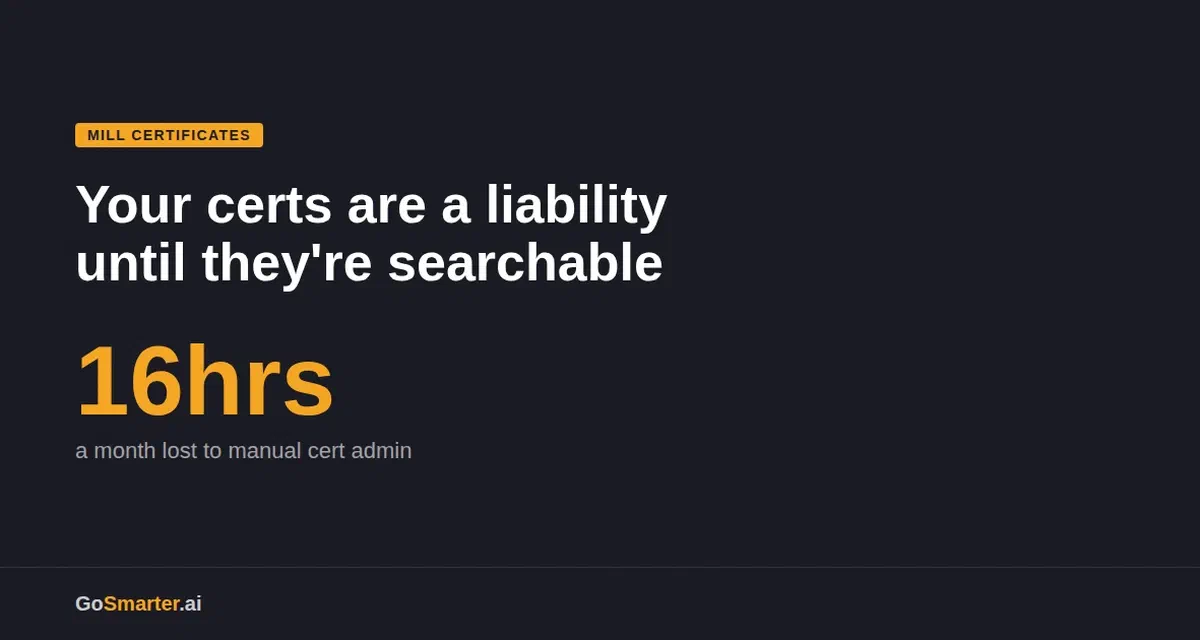
Your material test certificates are a compliance liability the moment they land as a PDF in someone’s shared inbox.
A medium-sized metals service centre handling 200 deliveries a month (even at a conservative 5 minutes per cert to open, read, type, save, and link to the right record) burns through 16 hours of staff time on cert admin alone. Every month. Before anything goes wrong. Then add the time spent hunting for a missing cert before an audit, arguing with a supplier over a mis-entered heat number, or chasing a customer approval because the grade on the cert does not match the order.
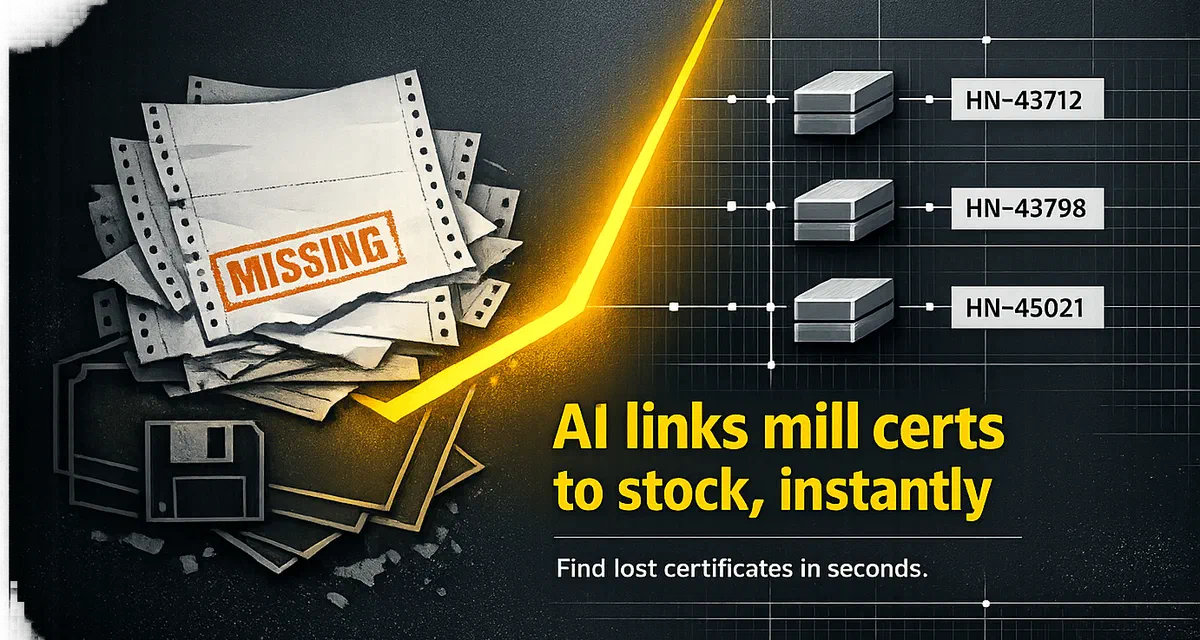
AI tools for compliance-driven document operations fix the foundation of the problem: they read the document, extract the data, validate it, and file it where it belongs. No human in the loop for every single certificate. GoSmarter’s MillCert Reader is built specifically for this in metals, handling the format chaos of real-world mill certs that would defeat a generic OCR tool.
Here is what this guide covers:
- What compliance-driven document operations actually mean at a metals manufacturer
- Why the manual process fails at two specific and predictable points
- What AI tools actually do mechanically — not marketing copy, the mechanics
- How GoSmarter’s MillCert Reader handles it without replacing your existing stack
- What changes operationally when you automate
Here’s how to fix it.
What Compliance-Driven Document Operations Mean in Metals
In a metals business, “compliance-driven document operations” is not a consultant’s phrase. It describes a specific, daily reality: every piece of material you buy, process, or sell must be traceable to a document that proves it is what you say it is.
The core document is the Material Test Certificate (MTC) — also called a mill cert or mill test report. An MTC records the heat number, chemical composition, and mechanical test results for a specific batch of material. Under EN 10204, the European standard for inspection documents for metallic products, you will deal with either a 3.1 certificate (validated by the manufacturer’s authorised quality representative) or a 3.2 certificate (validated by an accredited independent inspector). Which type you need depends on your customer’s specification or the structural application the material goes into.
Beyond MTCs, compliance document operations in metals typically cover:
- Delivery documentation — delivery notes that must reconcile with the cert, the purchase order, and your incoming goods inspection
- Production Part Approval Process packs — required by automotive customers before you can supply into their production line
- Inspection records — dimensional and visual inspection results linked to specific batches
- Non-conformance reports — documenting material that falls outside specification and the corrective actions taken
- Customer-specific declarations — chemical composition forms, conflict minerals declarations, REACH compliance statements
All of this needs to live somewhere retrievable, survive your next Quality Management System (QMS) audit, and be producible on demand when a customer disputes a delivery or a regulator asks an inconvenient question. If you are ISO 9001-certified, document control is not optional. It is audited.
Your Enterprise Resource Planning (ERP) system probably has a document attachment function. Most manufacturers use it inconsistently. That is the polite version.
Why Manual Cert Management Keeps Failing
The Audit Fire Drill
Every quality manager in metals knows the feeling: audit date confirmed, panic starts. Three people spend the afternoon before the auditor arrives reconstructing a paper trail that should have been automatic. Heat numbers get cross-referenced by hand. Someone finds a cert for the wrong grade. Someone else finds a cert with no matching heat number at all.
This is not a people problem. It is a process problem. When certs arrive as PDFs in an email, get saved by whoever opens them first, in whatever folder name made sense to them that day, the system was always going to fail. You cannot build reliable traceability on a foundation of inconsistent individual behaviour.
The Data Entry Gap
The second failure point is the gap between what the cert says and what your ERP says. A cert arrives. Someone reads it, types the key values — heat number, grade, yield strength, elongation percentage — into the ERP or a spreadsheet. Errors creep in. Certs for similar grades look almost identical. When the data is wrong, the error does not surface until a customer dispute or a failed incoming inspection.
A service centre processing 200 deliveries a month handles over 1,000 individual certificate field values in manual data entry each month. Independent research on manual data entry tasks puts typical error rates at 1–4%. At 1,000 fields, that is 10 to 40 wrong values in your system every single month, silently waiting to cause a problem.
What AI Tools Actually Do
AI tools for compliance-driven document operations are not magic. They apply a specific combination of techniques to a specific problem.
Optical character recognition (OCR) reads the text from a PDF or scanned cert image. Basic OCR tools have existed for decades. The problem in metals is that cert formats vary enormously. A cert from SSAB looks nothing like one from a Chinese cold-roller, a Turkish rebar mill, or a domestic bright bar producer. Standard OCR chokes on rotated text, scanned tables, unusual fonts, and anything that deviates from a clean digital PDF.
Machine learning-based extraction goes further. Instead of just reading the characters, it understands what they mean. It identifies the heat number even when it appears in a different position, in a different format, or under a differently labelled column header. It reads the mechanical properties table even when the column order changes between suppliers. It handles the variability that defeats standard OCR.
Validation and matching closes the loop. The AI does not just extract the data. It checks it. Does the grade on the cert match what was ordered? Does the heat number already exist in the system against a different grade? Are the mechanical properties within the required specification range? Anything that fails a check gets flagged for human review, not silently filed with an incorrect value.
This is what GoSmarter’s MillCert Reader does. It ingests the cert, extracts the structured data, validates it against your order and specification, and pushes the result into your workflow. No one transcribes a number wrong at 4:30 on a Friday afternoon.
How GoSmarter’s MillCert Reader Handles It
Reading Certs Without the Formatting Fight
MillCert Reader handles the format variability that defeats standard OCR tools. It is trained on real mill cert layouts from hundreds of suppliers, including European mills, North American producers, and Asian cold-rollers, covering scanned documents and PDFs with inconsistent layouts, faint ink, and varying table structures.
You upload the cert directly, or connect an email inbox so certs are processed automatically on arrival. The tool reads the document. Chemical composition, mechanical test results, heat number, product form, grade designation: all extracted and structured in seconds. What used to be a 5-minute per-cert task becomes a background process.
Linking Certs to the Right Material
Extraction on its own is not enough. The data needs to be in the right place. MillCert Reader links each cert to the corresponding purchase order line, so when you look up a batch of material, the cert is already attached. It is not buried in a folder somewhere.
If you are running an existing ERP or document management system, GoSmarter connects to it. You do not have to rebuild your stack to get this working. For teams building tighter compliance practices, this is where the real time saving lands: no more “where is the cert for that heat?” It is attached to the material record, automatically, every time.
The Difference Between Filing Certs and Owning Your Compliance
There is a meaningful gap between “we have the certs somewhere” and “we can produce the cert for any batch within 30 seconds.” The first gets you through most audits most of the time. The second is what your highest-value customers in aerospace, automotive, and structural fabrication are increasingly requiring as a condition of supply.
| The Manual Way | With MillCert Reader |
|---|---|
| Cert arrives by email, saved wherever feels right | Cert ingested automatically, linked to purchase order |
| Data typed into ERP by hand | Data extracted and validated in seconds |
| Audit prep takes half a day | Audit trail is always current |
| Error rate of 1–4% on manual field entry | Machine-read data with spec validation flags |
| Cert on the shared drive, if you can find it | Cert attached to material record, searchable by heat number |
| Grade mismatch found at inspection | Grade validated at goods-in, mismatch flagged immediately |
Metals manufacturers who have automated their compliance document workflows consistently report the same shift: quality managers spend less time preparing evidence for audits and more time preventing non-conformances. That is the real return. Not just faster filing, but a QMS that functions under pressure rather than breaking at the exact moment it matters most.
For a broader look at cutting document burden across your whole operation, see 7 Ways to Reduce Paperwork in Metal Manufacturing.
Start Here: What to Do This Week
You do not need to replace your ERP. You do not need a six-month IT project. The fastest path to audit-ready cert management starts with one step: get your incoming mill certs out of shared inboxes and into an automated extraction pipeline.
Run GoSmarter’s MillCert Reader on your next batch of incoming certs. See what comes back structured and linked against what currently gets typed by hand or filed in a folder nobody can reliably find. The difference is visible on day one.
Frequently Asked Questions
What is a compliance-driven document operation in metals manufacturing?
Can AI tools read non-standard or poorly scanned mill certificates?
Do I need to replace my ERP to use AI document tools for compliance?
How does automated cert management help with ISO 9001 audits?
What is the difference between a 3.1 and a 3.2 certificate under EN 10204?
About the Author

Co-founder & Head of Product
Steph Locke is Co-founder and Head of Product at GoSmarter AI — former Microsoft Data & AI MVP building practical tools to cut paperwork and automate compliance for metals manufacturers.