AI in Supplier Performance: Benefits Explained
- BlogSmarter AI
- Edited by Steph Locke
- Blog
- August 19, 2026
- Updated:
Table of Contents Show Hide
The pain is plain. Late deliveries, missing certs, bad heat-code links and blocked material chew through labour, scrap and margin.
I see the upside when you cut the admin loop out. GoSmarter, built by Nightingale HQ, uses AI-powered Optical Character Recognition (OCR) on mill certs and supplier records so you can track supplier performance as work moves, not after the mess lands. That gives buyers, quality teams and production managers one view of delivery, paperwork and traceability without the usual spreadsheet circus.
You get:
- Live supplier key performance indicators (KPIs) instead of late scorecards
- Missing-cert warnings before production books the batch
- Heat-code traceability linked to stock and jobs
- Less re-keying from PDF mill certificates
- Faster audit prep when someone asks for proof now, not next week
- More control over release, schedule changes and supplier follow-up
If your team still checks supplier performance by digging through inboxes and Excel tabs, you are not managing risk. You are just tidying up after it.
Here’s how to fix it.
AI-Enabled Supplier On-Time Performance Framework
How AI Turns Supplier Data Into Something Usable
Once the alerts are in place, you still need to turn raw supplier records into KPIs you can use. The data already sits there in purchase orders, delivery records, goods received notes, inspection reports, non-conformance reports, supplier contracts and mill certificates. The problem is speed. If you can’t sort it fast enough, it won’t help with shop-floor calls on schedule control, traceability or material release.
AI reads those supplier records, links them by purchase order (PO), heat number or part number, and updates KPIs on its own. It doesn’t replace procurement judgement. It cuts out the slog of finding, cleaning and reconciling data. That’s the bit people hate. The payoff comes when you spot repeat issues that a hand-built scorecard tends to bury.
- Recurring delays tied to a specific material grade
- Repeated certificate omissions from one supplier
- Drift in on-time delivery, defect rate, response time to non-conformance reports and certificate completeness
Certificates are where this hits hardest in metals manufacturing. Mill certificates often arrive as messy PDFs. One mill lays them out one way. Another does the opposite. Manual checking is slow, dull and easy to mess up. Teams can save over 120 hours a year by switching from manual certificate data entry to AI automation [1][2].
For metals teams, this is where GoSmarter, built by Nightingale HQ, earns its keep. Its MillCert Reader uses AI document processing to pull out grade, heat number, chemistry values and mechanical test results from PDF mill certificates, whatever layout the supplier has dreamed up this week. The system matches that data to the PO and links it to the batch by heat number. You get a traceable chain from supplier to stock location to production batch. The software builds it. Your team doesn’t have to stitch it together by hand.
Metals Manager takes it a step further. It links inventory to heat codes on its own, so when a quality issue or compliance question lands on your desk, you can pull the right certificate straight away. That turns supplier documents into searchable, production-ready data. The same heat-number spine also feeds GoSmarter’s Scrap Calculator and Cutting Plans. One record serves every tool, instead of three separate re-keying jobs.
How to Stop Chasing Certs, Emails and Late Updates by Hand
Where the Admin Time Goes
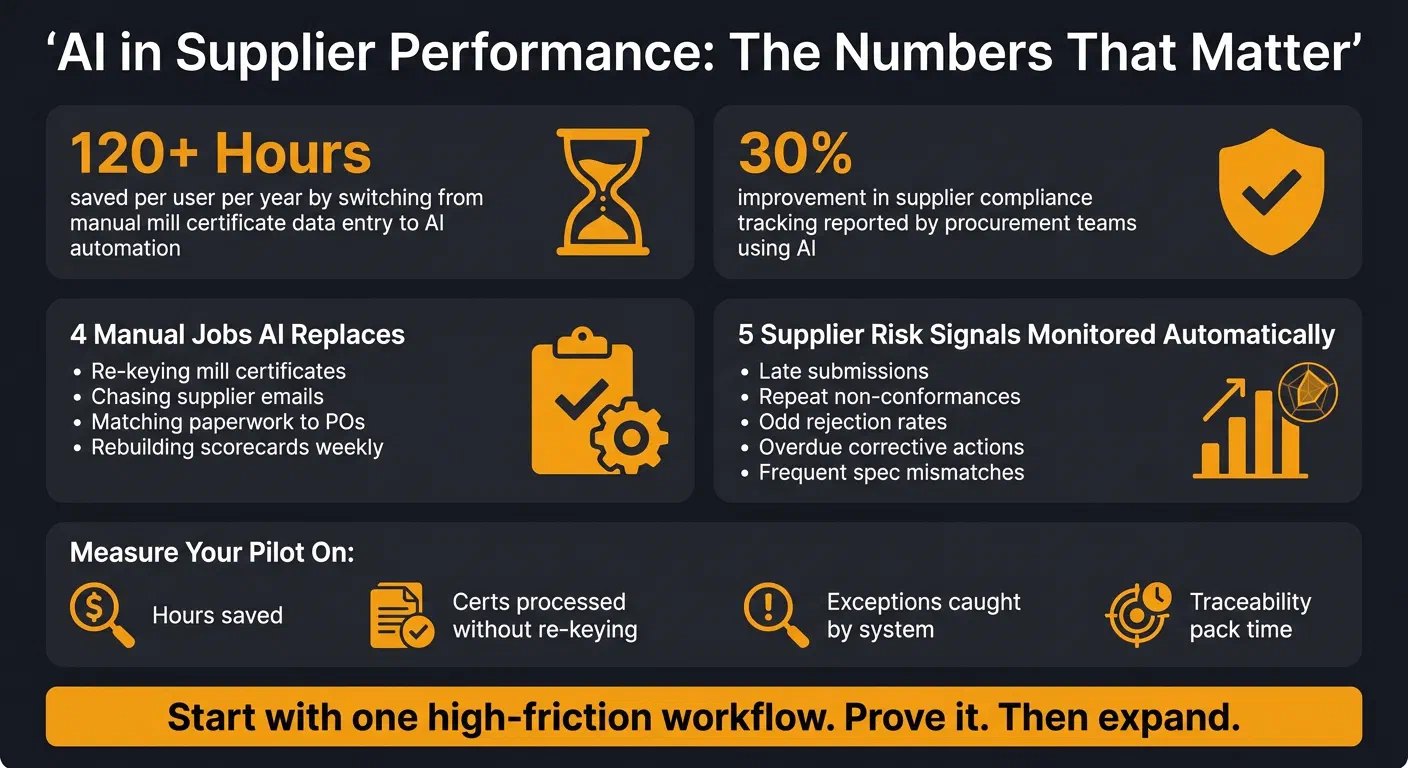
Supplier performance admin usually falls into four dull jobs: re-keying certs, chasing emails, matching paperwork and rebuilding scorecards. Spreadsheets make it worse. You copy and paste. You fight version control. You chase the latest file in your inbox. Meanwhile, holds drag on, sourcing calls slow down, and production resequencing turns into a last-minute scramble.
Mill certs eat the most time, creating hidden costs through manual data entry and verification. Every mill has its own format. Every country seems to have its own way of laying things out. Product lines differ too. So your team checks them by hand, line by line, and that’s where mistakes creep in. Switching from manual certificate data entry to AI automation saves over 120 hours per year per user [4]. That’s time your engineers can spend on actual engineering, not typing numbers out of PDFs. Once the cert data comes out on its own, that same data feed can update live supplier KPIs.
What Changes When the Dashboard Updates Itself
This kills the weekly admin loop. Supplier reporting stops being a Friday afternoon rebuild and starts acting like a live process. When extraction and cleansing run on their own, scorecards update themselves instead of someone rebuilding them from scratch.
- Live on-time delivery rates show as orders move
- Missing cert flags pop up on their own, so your team stops chasing them by hand
- Defect trends show straight away by supplier and material
GoSmarter, built by Nightingale HQ, uses MillCert Reader to pull grade, heat number, chemistry and mechanical results from PDF mill certs. It then links that data to the purchase order and stock record. Linked to Metals Manager, each stock record connects digitally to its certificate. So when a compliance question lands, you don’t start digging through folders and emails. The answer is already there.
You spend less time on admin. Your supplier data stays cleaner. You spot compliance gaps before production starts. And the same live workflow shows missing certs before they turn into audit trouble.
How AI Catches Compliance and Supplier Risk Before It Hits Production
Stop Getting Caught Out by Missing Certs and Audit Gaps
Supplier trouble usually starts with paperwork. Not the steel itself. A batch can sail through goods-in, look fine on the floor, then someone spots the problem later: the mill certificate is missing, half-filled, or tied to the wrong EN grade. By then, you’ve already booked the material to a job. Now you’re quarantining stock, chasing the supplier, and reshuffling the schedule. That mess costs more than the admin you thought you’d saved. GoSmarter fixes the failure mode without ripping out your ERP, spreadsheets or email inbox. It sits on top of what you already run.
Supplier KPIs only count if they help you catch bad paperwork before it hits production. That’s the point. Here, AI moves from data extraction to a checkpoint. It reads the certificate at receipt, flags missing fields, and shows you straight away if the grade or heat number doesn’t match the order. Your team makes the call on the material. The software stops you having to hunt for the mismatch by hand.
It doesn’t stop at single certificates either. Once that certificate data is structured, you can build your own view of the supplier signals that matter to you:
- late submissions
- repeat certificate omissions
- spec mismatches by supplier
A supplier can still look fine on delivery numbers while paperwork problems pile up in the background. Then the trouble shows up during an audit or a customer quality investigation. That’s when spreadsheets bite back. When quality, delivery, and documentation data all sit in one structured record, you stop missing the pattern.
- AI reads certificates and flags mismatches at receipt, before you book stock in
- The same structured data lets you build a supplier view across quality, delivery, and documentation
- Compliance gaps show up as soon as the certificate lands, not when an auditor is already in the building
Why Compliance Data Also Affects Margin
Missing paperwork doesn’t just annoy quality teams. It can stop material release full stop. If a batch passes inspection but lacks a valid certificate, you quarantine it until the paperwork lands. That delays production, forces resequencing, and can leave you paying for rush replacement stock. The hit lands in margin, not just in a quality report [1][2].
The same structured data also helps with Carbon Border Adjustment Mechanism (CBAM) and Environmental, Social, and Governance (ESG) reporting. You capture supplier emissions data in a format you can actually use from the start. Automated workflows cut the risk of missing fields, messy supplier submissions, and duplicate manual entry. That’s the sort of admin sludge that wrecks reporting.
On the IT side, GoSmarter connects via a REST API. GoSmarter stores your data on Microsoft Azure in UK data centres. Azure holds ISO 27001 certification. We use uploaded certificates, de-identified, to improve our own extraction models. We never share them with other customers or third-party AI providers. Microsoft does not train on your data.
Once you structure compliance data, you can find it faster, trust it more, and act on it without the usual scavenger hunt. GoSmarter, built by Nightingale HQ, Metals Manager links inventory straight to heat codes and stores the related certificate PDFs for instant retrieval. So when a customer audit lands, a last-minute spec query turns up, or a reporting deadline starts breathing down your neck, the answer is already there. You stop chasing records by hand. You release material faster. You cut production holds. You clean up supplier scoring.
Start With One Supplier Pain Point and Run It Through GoSmarter
Pick the Messiest Supplier Data First
Once live supplier alerts are running, don’t try to fix the whole circus in one go. That’s how good projects turn into bloated software theatre. The plants that see results fastest pick one workflow with heavy admin and clear risk, prove it works, then widen the scope.
In UK metals manufacturing, that usually means PDF mill certificates. They land in batches. They come from different suppliers. They all look slightly different, because of course they do. Then someone has to read them, type the key fields back in, check grade and heat number against the order, and dump the file somewhere it can, in theory, be found later. At that sort of volume, cert handling burns engineer time and adds nothing to the job.
A sensible pilot is simple. Take recent incoming certificates from a small group of key suppliers and run them through GoSmarter’s MillCert Reader, built by Nightingale HQ, instead of handling them by hand. MillCert Reader pulls out the fields you need and flags mismatches for review. If fields are missing, or the order doesn’t match, you see it straight away. Then compare the before-and-after numbers:
- processing time
- re-keying
- exceptions
That gives you a clean test. No guesswork. No hand-waving. Just numbers you can use to back the case for a wider rollout. It’s the same evidence-first approach Midland Steel used to plan its own digital rollout.
If you’ve already got an audit in the diary, Metals Manager is often the faster win. Import recent mill certs and works orders, then use Metals Manager to check traceability before the audit. Retrieval time drops hard. You get end-to-end mill cert traceability, visible in seconds instead of hours.
Measure the pilot on outputs you can actually use: hours saved, certs processed without re-keying, exceptions caught by the system, and traceability pack time. Turn those into a £ figure with your own labour rates and rework costs. That gives you the baseline for the next call: extend it to more suppliers, more product lines, or the next ugly pain point on the list. Those figures also give you the baseline for the wider supplier scorecard.
Key Takeaways on AI in Supplier Performance
Manual supplier reporting is too slow. It tells you what went wrong after the hit lands. By then, the late delivery has already slipped the schedule, the cert is still missing, and the material is sat there blocked. You are not preventing the problem. You are writing up the mess afterwards. That costs money, and you can avoid it.
This matters because the same data should do two jobs. It should track supplier performance, and it should help you control release. AI turns scattered supplier records into live key performance indicators (KPIs) without the usual manual matching. It links purchase order (PO), heat number and certificate data into one view you can actually use. One industry analysis reported procurement teams using AI seeing up to a 30% improvement in supplier compliance tracking [5]. Results vary by baseline data quality and rollout scope. That feeds straight into schedule control and release decisions.
Here’s what that looks like in pounds. At a loaded labour cost of £30 an hour, the 120 hours a year MillCert Reader saves works out to roughly £3,600 in recovered admin time. Against a subscription that starts at £280/month billed annually, that’s payback inside the first quarter for most teams.
The same live data also protects compliance and margin. In metals manufacturing, automated certificate checks help you move stock without playing paperwork roulette. They protect compliance, and they speed up release. Digitising mill certificates alone can reclaim over 120 hours of admin time each year per user [1][3]. Catch missing certs before material release, and production keeps moving instead of waiting on someone to chase a PDF.
Do not start with a giant rollout. Start with one high-friction supplier workflow. Pick the bit everyone moans about because it is messy, slow and full of manual checks. Prove it works. Then expand.
Track:
- hours saved
- issues caught
- time to find the certs you need
Turn that into a GBP figure with your own labour rates. That gives you the case for the next rollout, whether that means more suppliers, more product lines, or the next admin headache on the list.
GoSmarter, built by Nightingale HQ, turns PDF mill certificates and supplier records into structured, auditable data.
FAQs
How does AI improve supplier performance tracking?
AI sharpens supplier performance tracking by pulling data out of the paperwork and checking it for you. It turns mill certificates from a PDF headache into data you can actually search, sort, and use.
Using Optical Character Recognition (OCR) and natural language processing, GoSmarter, built by Nightingale HQ, reads mill certificates and converts them into structured data. Your team can then cross-check material details against purchase orders and standards such as BS EN 10204. If something does not match, you catch it at goods-in, not three steps later when the job is already in motion.
That matters because manual checks miss things. Not because your team lacks skill, but because paperwork is slow, messy, and easy to get wrong when people are under pressure.
Over time, that verified data gives you a clearer picture of supplier consistency. You stop relying on gut feel or scattered notes. You track quality with hard metrics that come from checked certificate data.
Can AI catch missing mill certificates before release?
Yes. GoSmarter’s MillCert Reader, built by Nightingale HQ, checks incoming documents at the goods-in stage. It spots missing fields, odd certificate layouts, and data mismatches. That includes cases where the certificate grade does not match your purchase order.
That matters because bad paperwork has a nasty habit of slipping downstream. This tool flags non-conformances straight away, so you can stop suspect material before it hits production. It also helps you keep records complete and compliant before release.
What is the best first workflow to automate?
The best first workflow to automate is capturing and processing mill test certificates (MTCs) at goods-in. It is a sensible place to start. The job is simple, you can get it live within one day, and you stop wasting time on manual data entry.
With GoSmarter, built by Nightingale HQ, and its MillCert Reader, you can digitise incoming certificates, pull out key data like heat numbers and grades, and build a digital audit trail for traceability and compliance.
This is the kind of admin that clogs up the day. The metal matters. The paperwork doesn’t. So let the software read the clumsy PDFs while your team gets on with the work.
Drill deeper
- AI-Powered Risk Mitigation for Metals Supply Chains
Go here for supplier risk beyond paperwork: heat codes, inventory and scrap.
15 min read
About the Author

Editor· Co-founder & Head of Product
Steph Locke is Co-founder and Head of Product at GoSmarter AI — former Microsoft Data & AI MVP building practical tools to cut paperwork and automate compliance for metals manufacturers.