AI-Powered Energy Savings: Case Studies in Metals
- GoSmarter AI
- Blog
- February 18, 2026
- Updated:
Table of contents Show Hide
Your factory is burning cash - and you might not even know it. Energy costs in metal manufacturing are eating into margins, with outdated methods leaving up to 30% of potential savings on the table. If you’re still relying on spreadsheets and monthly utility bills to track energy use, you’re stuck in the dark ages.
Here’s the truth: AI isn’t here to replace your team; it’s here to stop the waste. From optimising furnace operations to predicting energy demand spikes, AI tools are slashing costs, cutting emissions, and making production smoother. Steel plants have saved millions annually, while aluminium casthouses are closing efficiency gaps with real-time data.
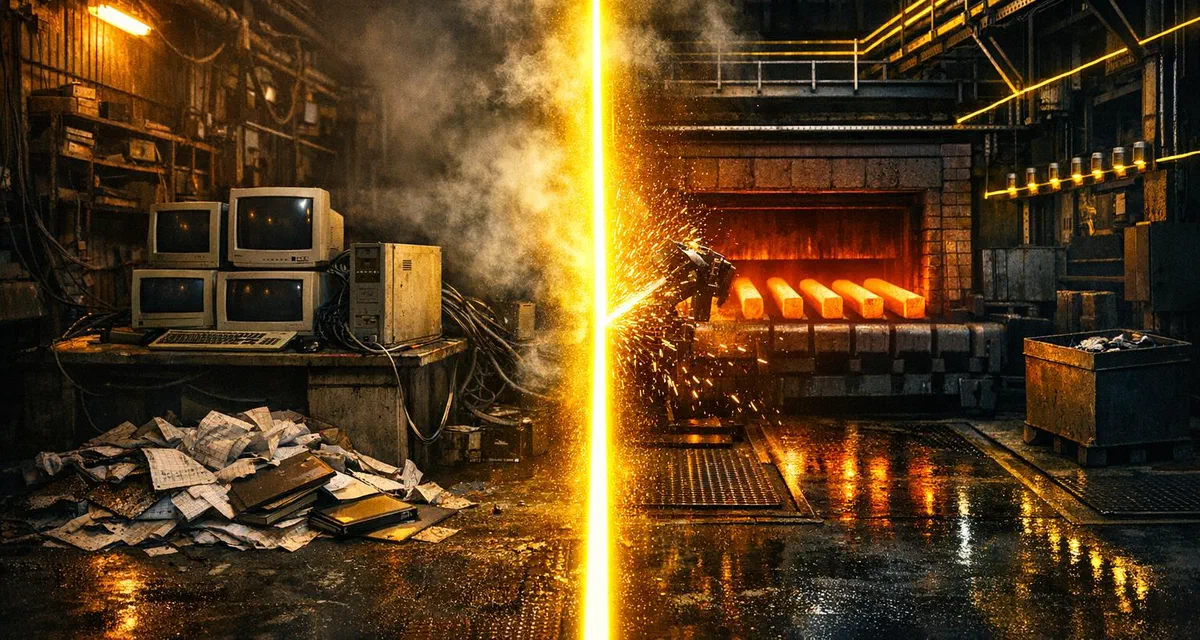
What’s the difference between the old way and the smart way?
| The Old Way | The Smart Way |
|---|---|
| Guessing when a furnace is overheating | Real-time AI alerts when steel hits target temp |
| Monthly utility bills with no insights | Instant dashboards showing waste in kWh |
| Manual checks missing subtle inefficiencies | AI finds issues like burner wear in minutes |
If you’re tired of sky-high energy bills and inefficiencies slowing you down, it’s time to rethink your approach. Let’s break down how AI is transforming metals manufacturing - and how you can start saving today.
Case Study 1: Steel Manufacturing - Furnace Operations
The Problem: Inefficient Furnace Processes
Furnaces are a major cost driver in steel production. Electric arc furnaces, for instance, consume anywhere from 350 to 700 kWh per tonne of steel, while blast furnaces often suffer from inconsistent coke usage due to reliance on manual monitoring and operator judgement [1]. Many facilities still depend on outdated methods like shift handovers or monthly utility reviews to identify inefficiencies. By the time someone notices that Furnace #2 is burning 15% more fuel than Furnace #1 under identical conditions, weeks of costly fuel waste have already occurred [5]. Traditional systems often fail to catch subtle problems, such as worn burner tips, poorly calibrated air–fuel ratios, or the precise timing when steel reaches its ideal temperature. This oversight can leave 15–30% of potential savings untapped [1].
The AI Solution: Real-Time Monitoring and Process Control
AI has revolutionised furnace operations by providing real-time monitoring and control. In November 2024, Spartan UK’s Gateshead plate mill introduced Deep.Meta’s “Deep.Optimiser” platform. This system, powered by a digital twin built on 40 years of production data, alerted operators the moment steel hit its optimal temperature. This eliminated guesswork and avoided unnecessary heating [4]. Similarly, in April 2024, ArcelorMittal Asturias in Spain deployed an AI-driven image-based system on a 1.2 MW industrial burner. Using colour cameras and neural networks, it estimated flue gas oxygen levels with 97% accuracy, ensuring efficient use of low-calorific blast furnace gas [7]. Over in Wu’an, China, Puyang Steel integrated infrared thermal imaging and 6-axis robotic arms into its No. 2 Converter in 2023. The AI system analysed molten steel composition in real time, automatically initiating slag removal.
“Previously, we relied on experience to determine slag removal timing. Now, the AI analyses molten steel composition in real‑time, triggering automatic operations 15 minutes faster per heat.” [6]
These advancements have delivered measurable improvements in efficiency and performance.
The Results: Energy and Emission Reductions
The impact of AI on furnace operations has been striking. At Spartan UK, energy use dropped by 24 kWh per tonne of steel, while CO₂ emissions during reheating fell by 5% [4]. ArcelorMittal’s system cut energy consumption by 52.8 kWh per tonne and reduced CO₂ equivalent emissions by 13.2 kg per tonne of steel [7]. Meanwhile, Puyang Steel’s faster slag removal process resulted in ¥4 million in annual alloy savings (around £440,000) across three production lines [6]. On a broader scale, AI-driven furnace management has led to an 18% drop in CO₂ emissions and a 16% reduction in overall energy intensity [5]. One integrated steel producer, after implementing AI across its blast furnaces and rolling mills, saved £3.3 million annually by lowering energy intensity from 22.5 GJ/tonne to 18.9 GJ/tonne - achieving full payback in just 14 months [5].
These results highlight a major shift in steel manufacturing, combining cost savings with a more efficient and environmentally conscious approach.
Case Study 2: Aluminium Casting - Predictive Analytics
The Problem: Energy Loss in Casting Operations
Aluminium casthouses are notorious for their high energy demands. Processes like high-pressure diecasting, annealing, and continuous casting often run inefficiently, especially at elevated temperatures. At Ryobi Aluminium Casting in Carrickfergus, Northern Ireland, engineers uncovered a 13% energy efficiency gap between two diecast machines that were supposed to perform identically [12]. The issue? Data was scattered and unanalysed, leaving no centralised system to compare energy use against production output. Similarly, annealing furnaces used for heat-treating aluminium coils were set to fixed temperatures, ignoring real-time conditions. Without precise monitoring, operators kept heat levels unnecessarily high, wasting fuel [8]. These inefficiencies highlighted an urgent need for smarter energy management.
The AI Solution: Predictive Chemistry and Recovery Models
AI stepped in to revolutionise the way energy was managed. At EPFL and Novelis Switzerland, a machine-learning tool was trained on CFD and experimental data to predict heat transfer coefficients in an ACL furnace. This enabled the optimisation of a flue gas recycling strategy, using exhaust gases from hotter furnace zones to preheat cooler ones, significantly reducing fuel waste [8].
In the US, Arconic collaborated with Lawrence Livermore National Laboratory to apply machine learning to Direct Chill (DC) casting. By combining casting simulation data with numerical optimisation, they could predict defects like end cracks in a fraction of the time. Tasks that used to take days were now completed in minutes, allowing Arconic to produce ingots with fewer defects and less need for energy-draining recasting [9].
At Ryobi, engineers developed a custom dashboard that unified electricity usage data, production output, and tariff information. This made it easier to identify inefficiencies and act on them [12].
“Our factories generate vast amounts of data with the potential to unlock efficiency, cost savings and innovation. [But to achieve this] we needed a one stop shop for all our data, a modern, bespoke digital tool where we could visualise the opportunities to be more efficient, profitable and environmentally responsible.” [12]
- Ciarán Maxwell, Low Carbon Project Lead, Ryobi
These advancements demonstrate how AI can modernise aluminium casting, aligning economic goals with environmental responsibilities.
The Results: Lower Fuel Use, Lower Costs
The impact of these AI strategies has been substantial. Novelis’s flue gas recycling system reduced fuel consumption in aluminium annealing furnaces by 20.7% [8]. Arconic’s predictive modelling cut the ingot scrapping rate, potentially saving the US aluminium industry an estimated $60 million annually (around £47 million) in energy costs [9]. At Ryobi, Ciarán Maxwell anticipates a 20% reduction in overall energy consumption within the first year, freeing up funds to invest in renewable technology [12].
AI also boosted production quality. Specialised aluminium casting saw yields jump from 82% to 97%, an 18.3% improvement, while high-volume rod casting reduced scrap rates by 75%, dropping from 6% to just 1.5% [10]. Defect detection became faster and more accurate, with a 96% success rate compared to 72% with manual checks, and inspection times fell from 10 seconds to just 2 seconds [10].
For perspective, even a 1% reduction in scrap at a typical high-pressure diecasting facility can prevent 600,000 kg of CO₂ emissions annually [11]. These advancements are not only about cutting costs - they represent a shift towards cleaner, more efficient operations.
AI in Energy Management and Procurement
Energy Forecasting with AI
Predicting furnace demand spikes has become far more precise with the help of advanced AI models like Random Forest, k-NN, and Gradient-boosting. These tools analyse historical consumption patterns to achieve forecasting accuracy exceeding 97% [1][13]. This means operators can foresee cost peaks 4 to 20 weeks in advance [6][15], making it possible to shift energy-intensive operations, such as Electric Arc Furnace melting, to off-peak hours when tariffs are lower.
Dynamic Demand Response systems take this a step further by automatically adjusting production schedules based on fluctuating tariffs and the availability of renewable energy [13]. For instance, a steel manufacturer using C3 AI at a hot roll mill reduced utility demand charges by 40 MW per month over five months, while also increasing on-site power use by 1.8%. This combination led to an impressive $14 million in annual energy savings [2]. Similarly, between 2024 and 2025, a 2.4-million-tonne integrated steel manufacturer implemented Oxmaint’s AI platform, achieving $4.2 million in annual savings with a payback period of just 14 months [5].
AI also supports smarter procurement strategies by tracking a “Green Electricity Index” (GEI), enabling manufacturers to weigh both cost and the share of renewable energy in their energy mix [13]. Together, these forecasting and procurement capabilities create a solid foundation for on-site energy optimisation, reducing waste and costs.
On-Site Energy Optimisation
Once energy demand is accurately forecasted, AI fine-tunes operations on-site for maximum efficiency. Real-time monitoring reveals equipment issues, such as damaged furnace doors or worn-out burner tips, that would otherwise go unnoticed during manual checks [14][5]. A compelling example comes from ArcelorMittal’s Industeel factory in France, which saved €340,000 in just 12 months by deploying an Energy Management & Optimisation System (EMOS). This system processed 3,000 data points per second to monitor reheating furnaces, enabling operators to quickly identify and fix problems causing energy inefficiencies [14].
“Within the first month of real-time monitoring, we discovered our #2 reheating furnace was consuming 15% more fuel than #1 under identical conditions. That single finding paid for three months of the system cost.” [5]
- Plant Energy Manager, Integrated Steel Manufacturer
AI also synchronises reheat furnaces with rolling mill operations to minimise thermal losses and reduce demand spikes [1]. At Xinjin Steel in Wu’an City, China, an AI-driven system employing LSTM time-series algorithms for 4-hour advance forecasting optimised chemical dosing in water treatment. This improvement saved 3.8 million kWh annually - enough to power 1,200 households for a year [6].
Through intelligent scheduling, peak demand charges can be reduced by 18–22% [1], while predictive load optimisation can lower overall energy costs by 15–25% [1]. For mid-sized integrated steel plants, these strategies translate to annual savings of $2 million to $5 million (approximately £1.6 million to £3.9 million) [1].
Comparing Results Across Operations
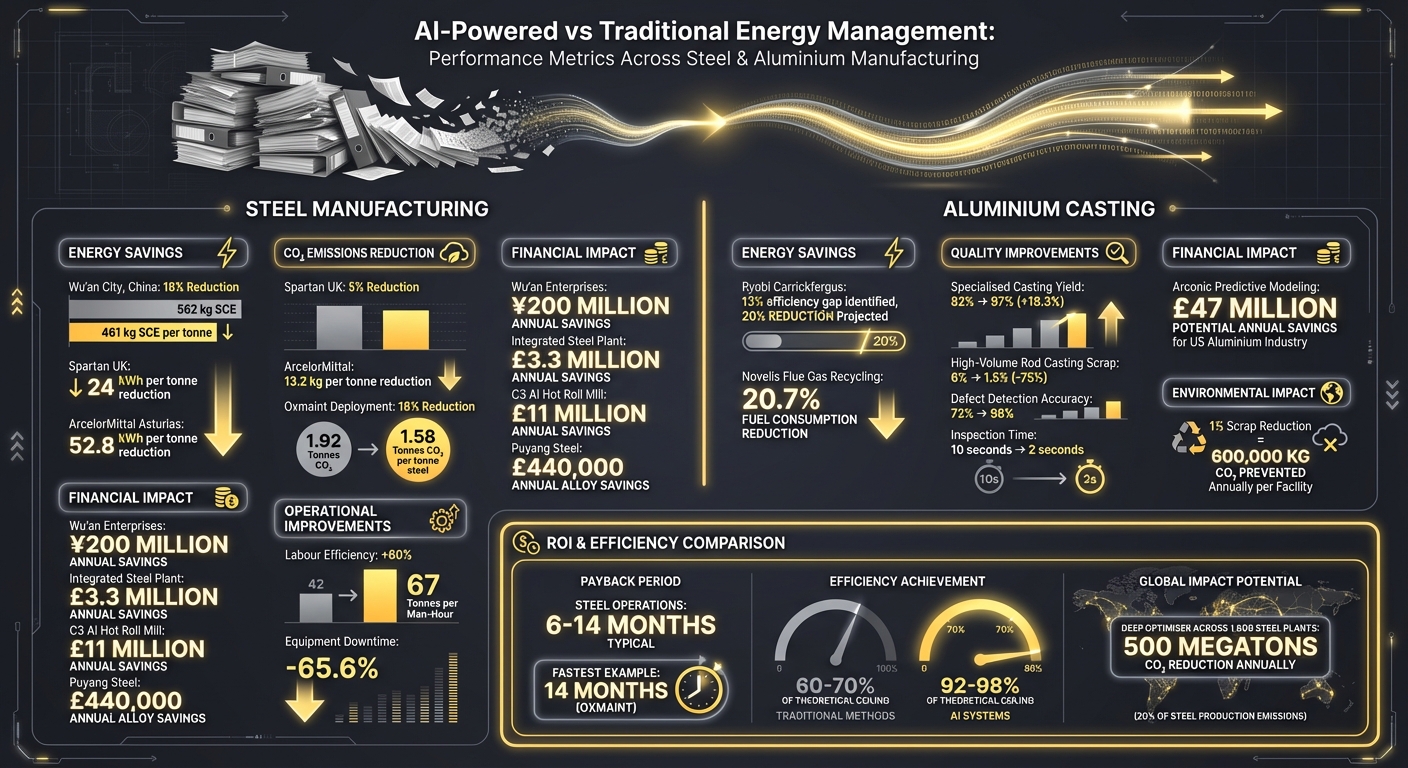
AI vs Traditional Energy Management in Metal Manufacturing: Key Performance Metrics
Steel vs Aluminium: Key Metrics
AI is proving its worth in energy savings across both steel and aluminium industries, though the focus and scale of improvements vary. In Wu’an City, China, 12 major steel enterprises managed to cut energy use per tonne by 18%, dropping from 562 kg SCE to 461 kg SCE, while also saving over ¥200 million annually [6]. Spartan UK’s Gateshead plate mill provides another example, achieving a 24 kWh per tonne energy reduction and a 5% cut in CO₂ emissions through AI-driven optimisation [4][12].
For aluminium casting, the results are equally promising. Ryobi’s Carrickfergus facility used AI-powered dashboards to uncover a 13% energy efficiency gap between two identical diecasting machines. Ciarán Maxwell, Ryobi’s Low Carbon Project Lead, anticipates that full implementation could “reduce our overall energy consumption by up to 20% in the first year” [12]. While steel operations focus on furnace optimisation and slag removal, aluminium manufacturers target machine-level benchmarking and improving high-pressure diecasting efficiency [4][6][12].
The benefits extend beyond energy savings. Steel plants in Wu’an saw labour efficiency jump by 60% - from 42 to 67 tonnes per man-hour - and equipment downtime drop by 65.6%. Meanwhile, Ryobi’s optimised diecasting machines achieved an 11% improvement in Overall Equipment Effectiveness (OEE) [6][12]. On a global scale, deploying the Deep.Optimiser platform across 1,600 steel plants could slash CO₂ emissions by 500 megatons annually, representing a 20% reduction in the total emissions tied to steel production [4][12].
These results highlight both the financial appeal and environmental advantages of AI-driven solutions.
ROI Timelines and Environmental Benefits
AI investments in heavy industry deliver not only operational efficiencies but also quick financial returns and environmental improvements. In the steel sector, payback periods typically range from 6 to 14 months, making these systems one of the fastest-returning investments available [1][5]. For example, a 2.4-million-tonne integrated steel manufacturer using Oxmaint’s AI platform saved £3.3 million annually, achieving payback in just 14 months [5]. Similarly, at a hot roll mill, C3 AI’s energy management system delivered £11 million in yearly savings by cutting utility demand charges by 40 MW per month over five months [2]. Mid-sized integrated steel plants report annual savings between £1.6 million and £3.9 million through intelligent scheduling and predictive load management [1].
The environmental impact is just as impressive. Oxmaint’s deployment reduced CO₂ emissions by 18%, lowering output from 1.92 tonnes to 1.58 tonnes of CO₂ per tonne of steel [5]. Xinjin Steel’s AI-powered water treatment system saved 3.8 million kWh annually - enough energy to power 1,200 households for a year [6]. As Tarun Mathur, ABB’s Global Digital Lead for Metals, puts it:
“AI is making sustainability and decarbonisation more profitable by linking carbon reduction with operations excellence” [3].
These examples show that AI isn’t just about improving efficiency - it’s also a powerful tool for aligning profitability with sustainability.
Conclusion: Modernise Your Operations
The examples above leave no doubt: AI-driven energy optimisation delivers real, measurable benefits for metals manufacturers. These advancements not only sharpen your competitive edge but also deliver a return on investment in as little as six to 14 months [1][5].
The contrast between manual processes and AI-powered systems is stark. While traditional energy management methods hit only 60–70% of the theoretical efficiency ceiling, AI systems consistently achieve 92–98% [1]. A veteran operator at Spartan UK, with three decades of shop floor experience, shared with Deep.Meta founder Osas Omoigiade that the AI tool increased efficiency fivefold while significantly reducing human errors [4]. This is the difference between educated guesses and precise, data-backed decisions.
Getting Started with AI
You don’t need to overhaul your entire setup to get started. Begin with a four-week audit to assess your energy consumers and metering infrastructure, creating a baseline normalised to production [5]. From there, focus on quick, high-impact fixes in the first 90 days - such as sealing compressed air leaks, addressing furnace imbalances, and benchmarking machine performance - to gain early support from your team [5]. Using real-time dashboards can also make energy efficiency a shared point of pride on the shop floor [5].
For metals manufacturers, platforms like GoSmarter are tailored to handle the tedious and time-consuming parts of production. Whether it’s digitising mill certificates, refining scrap rates, or managing production schedules, these AI tools turn mountains of data into clear, actionable insights - helping factories run smoother, cleaner, and without unwelcome surprises. The tools are here. The results are proven. Taking these steps ensures you stay ahead in a fast-changing industry.
FAQs
What data is needed to start AI energy optimisation in a steel or aluminium plant?
To kick off AI-driven energy optimisation, you’ll need a wealth of detailed data covering energy use, process parameters, and production variables. For instance, tracking real-time energy consumption during operations like melting or rolling provides essential insights. Equally important is data on raw material properties, such as the quality of scrap being used.
High-frequency sensor readings - monitoring factors like temperature and pressure - are vital too. This level of detail helps pinpoint inefficiencies, balance energy loads, and fine-tune processes for better energy performance.
How quickly can AI energy projects pay back in a typical metals operation?
How do we connect AI insights to real actions on furnaces and casting lines?
About the Author

AI Blog Assistant
BlogSmarter AI is GoSmarter's AI research and content assistant — surfacing practical insights from industry data and producing compelling blog posts for metals manufacturers.