AI for Mill Test Report Traceability
- BlogSmarter AI
- Edited by Ruth Kearney
- Blog
- April 22, 2026
- Updated:
Table of Contents Show Hide
Manual Mill Test Report (MTR) processing is one of the most expensive admin problems in UK metals manufacturing. Engineers spend 20–40% of their time retyping data from PDFs instead of doing actual engineering work. Every typo risks a compliance failure, a production halt, or a costly recall.
GoSmarter’s MillCert Reader — built by Nightingale HQ — fixes this mess. It uses AI to extract and validate MTR data in under 10 seconds, cutting errors by 98% and saving thousands in labour costs. No more digging through folders or re-entering the same numbers.
What is a Mill Test Report?
A Mill Test Report (MTR) — also called a Mill Test Certificate (MTC) — is a quality assurance document that a metal producer provides with every shipment. It certifies the material’s chemical composition, mechanical properties (tensile strength, yield strength, impact values), heat number, and conformance to the relevant standard (e.g. BS EN 10204). Without an MTR, you have no verifiable proof that the steel, aluminium, or alloy you’ve received meets the specification you ordered.
What Automated MTR Processing Delivers
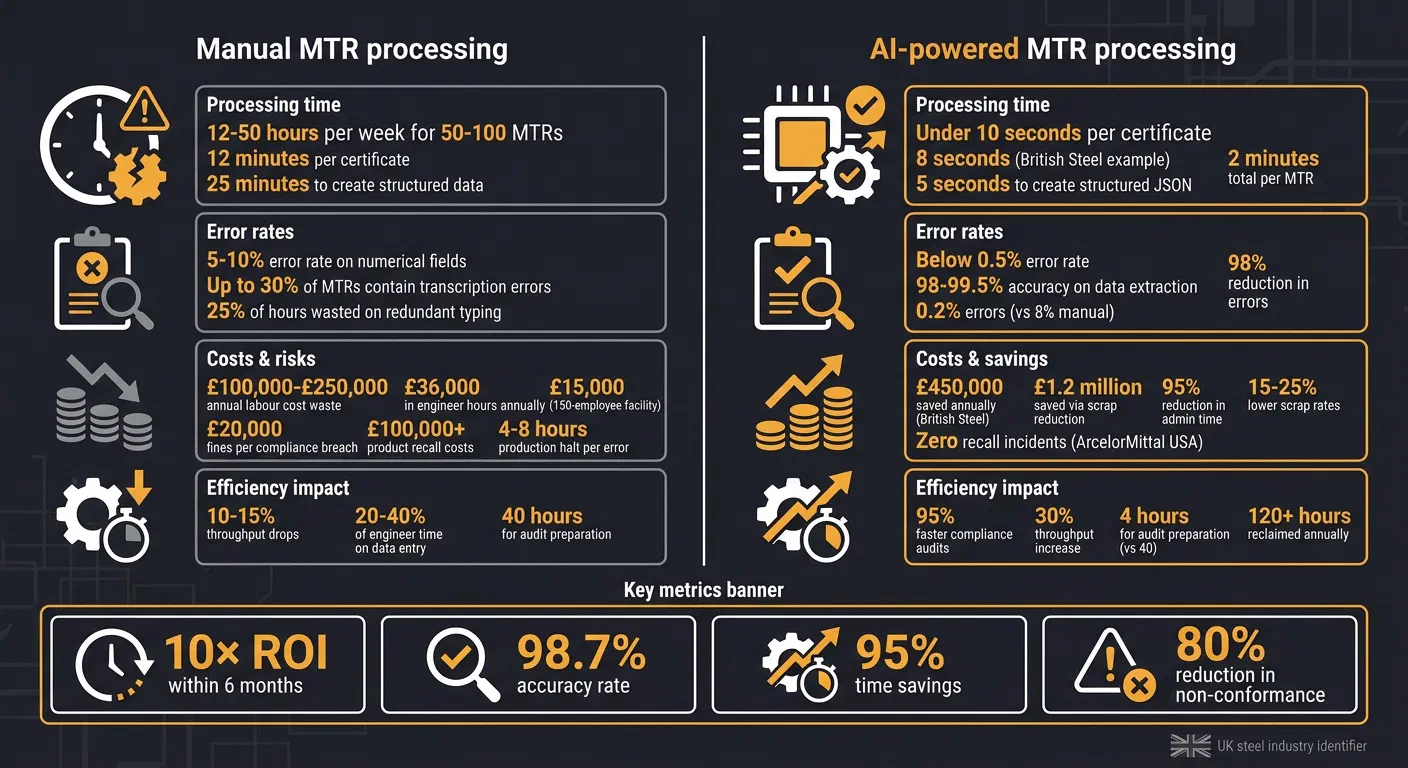
- Faster processing: From 12 minutes per cert to under 10 seconds.
- Fewer errors: Error rates drop from 10% to below 0.5%.
- Audit-ready records: Instant traceability for every material batch.
- Cost savings: Slash admin time by 95% and reduce scrap rates by up to 25%.
See It in Action: AI Reading a Mill Test Report
Why Manual Mill Test Report Processing Slows Down Production
Handling Mill Test Reports manually is a productivity killer. Engineers in the UK spend 20–40% of their time entering data from PDFs rather than focusing on design or improving production processes. For a plant processing 50–100 MTRs daily, this adds up to 12–50 hours a week — essentially one full-time engineer stuck doing admin. In a facility with 200 employees, this inefficiency inflates labour costs by £100,000–£250,000 annually in wasted time.
The knock-on effects are just as frustrating. Materials can’t move until MTRs are verified, which means a single error can halt production for 4–8 hours. Across the UK, steel processors report throughput drops of 10–15%, with work-in-progress inventory costs climbing sharply. Industry data suggests that a significant proportion of downstream delays in UK steel processing are tied to MTR bottlenecks. These delays aren’t just annoying — they’re expensive.
The Real Costs of Manual MTR Handling
The financial pain doesn’t stop at labour costs. Take a Midlands steel fabricator with 150 employees: they spent 1,200 engineer-hours annually on MTRs, costing £36,000 (at £30/hour), plus an extra £15,000 in overtime to hit deadlines. Worse, internal audits found that 25% of those hours were wasted on redundant typing, driving up operational costs and eating into 5% of their margins — this, in an industry already squeezed by rising energy bills.
The opportunity costs are just as damaging. When skilled engineers spend their time on data entry instead of design, innovation slows down, customer requests take longer, and the business loses its edge. Manual filing systems are a nightmare for audits too. Staff end up wasting time digging through folders under pressure, adding to the chaos.
Compliance Risks from Human Error
Manual MTR handling isn’t just slow — it’s risky. Industry surveys show that up to 30% of MTRs contain transcription errors. Mistakes like flipping digits in heat numbers (e.g., 0.18% vs 0.81% carbon), missing key fields like impact test results, or misreading supplier-specific PDFs lead to rework, quarantined batches, and production slowdowns of 5–20%. Fixing these issues often takes 1–2 days per incident, throwing schedules into disarray.
The compliance fallout can be brutal. Errors violate standards like BS EN 10204, triggering non-conformance issues during audits by UKAS-accredited bodies. Fines can reach £20,000 per breach under HSE regulations, and product recalls can cost upwards of £100,000. For example:
- In 2023, a fabricator was fined £15,000 after faulty traceability led to structural failures.
- A Welsh aluminium processor faced a £250,000 recall in 2024 due to unverified alloy grades, resulting in an 18% revenue loss.
- One major UK steel producer halted production for two weeks on a large structural project after MTR transcription errors misstated alloy composition. The result: rejected batches, significant rework costs, and an 18% schedule overrun.
“A certificate that is filed under the wrong heat number, or where a chemical property has been mis-keyed, is a compliance risk and potentially a quality failure waiting to happen.” – GoSmarter Newsroom
With stricter UK Conformity Assessed (UKCA) regulations and growing demands for net-zero carbon reporting, the stakes are only getting higher. Manual systems simply can’t keep up with the complexity of post-Brexit supply chains. Compliance failures are an acute threat for smaller UK metals businesses — and stricter reporting requirements make the risk harder to ignore. Automating MTR processing isn’t a luxury — it’s a necessity to protect margins, maintain compliance, and stay competitive.
How AI Reads Mill Test Reports Faster Than Manual Entry
AI-powered MTR processing blends Optical Character Recognition (OCR) and Natural Language Processing (NLP), specifically designed for the metals industry. OCR handles the heavy lifting of converting scanned images or PDFs into machine-readable text. NLP steps in to make sense of this text, pulling out structured data like chemical compositions (e.g., carbon 0.15–0.25%, manganese 0.60–0.90%), heat numbers, alloy grades, and supplier details. Unlike generic OCR software that stumbles over industry-specific terms, metals-focused AI knows that “Rp0.2” is yield strength and “CEQ” means carbon equivalence. This precision ensures the data extracted is fast and accurate.
This tech isn’t just theoretical — it’s tested and proven. One major UK steel producer rolled out an AI-driven MTR system that slashed processing time from 12 minutes to 8 seconds per report, handling 5,000 MTRs monthly. The operations team reported 98.7% accuracy in extracting heat numbers and compositions, cutting errors by 89%. The result: real-time inventory tracking and significant annual savings on labour. A major North American steel producer implemented a similar platform in 2023, reducing manual hours from 2,500 to just 50 per month while achieving 99.2% field accuracy. The outcome: 95% faster compliance audits and zero recall incidents over an entire year.
From PDFs to Usable Data in Seconds
AI doesn’t just read complex MTRs — it makes sense of the chaos. Whether it’s inconsistent layouts, multi-language text, rotated scans, or low-res faxes, AI systems process them all. Advanced OCR engines clean up the images by deskewing and reducing noise, while layout-aware NLP dynamically recognises tables. The result? A five-page MTR processed in 10 seconds with 99% accuracy. Machine learning models trained on thousands of MTRs keep improving, hitting over 99% accuracy for standard fields like alloy grades (e.g., ASTM A36), mechanical properties (e.g., tensile strength 400–550 MPa), and dimensions (e.g., Plate 10mm x 2,000mm).
Even multi-heat certificates — which cover multiple production batches — are no problem. AI separates the data rows correctly instead of blending them into a single record. For instance, a scanned PDF showing “C: 0.18%, Si: 0.25%, Heat: HX20230115, Supplier: Tata Steel” is transformed into structured JSON like this:
{
  "chemical_composition": { "C": "0.18%", "Si": "0.25%" },
  "heat_number": "HX20230115",
  "supplier": "Tata Steel",
  "dimensions": "Plate 10mm x 2000mm"
}
This structured output is ready for Enterprise Resource Planning (ERP) integration in just 5 seconds, compared to the 25 minutes it would take manually.
Removing Transcription Errors with AI
Manual MTR entry is prone to mistakes, with error rates for numerical fields like carbon content averaging 5–10%, according to industry audits. Common blunders include:
- Transposed digits (e.g., entering heat number 123456 as 126345)
- Misreading units (e.g., confusing MPa with psi)
- Missing fields (e.g., skipping phosphorus limits like P ≤ 0.035%)
AI tools eliminate these issues by using contextual NLP to double-check extracted values against alloy specifications. OCR confidence scoring flags any uncertain readings, while trained models hit 98–99.5% accuracy on MTR data extraction. These tools also validate data against BS EN 10204 standards, ensuring compliance. In one benchmark, AI processed 100 MTRs in 8 minutes (4.8 seconds each), compared to 40 hours manually (24 minutes each). Errors dropped from 8% to just 0.2%, and the system paid for itself within three months by avoiding costly recalls — each of which could cost upwards of £50,000.
GoSmarter’s MillCert Reader is a standout example, combining OCR and NLP specifically for metals MTRs. It converts PDFs into structured JSON in seconds with 99% accuracy for UK/EN-standard documents. The platform also validates extracted values against expected ranges for the material grade, flagging discrepancies immediately. This means non-conforming materials are caught at the point of receipt — not halfway through production. A QC Manager at a UK steel stockholder summed it up perfectly:
“Our tool saves hours every month by automatically pulling key data from mill certificates. Renaming documents in seconds used to be painfully manual — now it just happens.”
Maintaining Compliance and Traceability with AI
Automatic Validation Against Industry Standards
AI takes the guesswork out of validating Mill Test Reports by cross-checking them against strict industry standards. Say an MTR claims a material is S355JR structural steel. AI will compare the reported chemical composition and mechanical properties to the expected ranges for that grade. For example, if the yield strength is listed as 350 MPa but EN 10025 requires a minimum of 355 MPa, the system flags the 5 MPa shortfall, marking the material as non-compliant before it even reaches production.
By aligning with standards like ISO 9001 and IATF 16949 (International Automotive Task Force), AI helps catch these discrepancies early, slashing the chance of non-conformance. Manual checks can lead to error rates as high as 30% in supply chains, but AI-driven validation drops this to below 1%. For UK manufacturers, poor MTR handling can cost anywhere from £500,000 to £2 million annually due to compliance failures, with 25% of audit findings in the automotive sector tied to traceability gaps. AI also speeds up audit prep significantly — what used to take 40 hours can now be done in just four.
Take GoSmarter’s MillCert Reader as an example. It validates extracted data against the expected ranges for each grade, flagging any mismatches instantly. Teams juggling over 200 certificates a month can reclaim 8 to 12 hours of admin time per week within the first month of using automation. That’s a process improvement of up to 60% compared to manual handling. The result? A faster, more accurate validation process that sets the stage for a clean, audit-ready digital record.
Building an Audit-Ready Digital Record
Once validation is complete, the next step is creating a digital compliance trail. AI turns scattered PDFs into a secure, searchable archive, linking every MTR to its supplier, heat number, and inventory record. For example, if a heat number like “HX20230115” appears on an ArcelorMittal certificate, the system automatically ties it to inventory records, establishing a clear chain of custody from the supplier to the finished product. This AI-driven linkage ensures that certificate data stays with each piece of material through to the customer order.
This approach enables full forward and backward traceability, crucial for compliance with sustainability reporting under the UK Environment Act 2021. Every step is timestamped (DD/MM/YYYY format) and recorded using SI units like MPa and mm, following UK conventions. Need to pull up an audit record? It’s ready in minutes. One UK aluminium fabricator integrated 10,000 MTRs into GoSmarter’s system. During a 2025 IATF audit, they retrieved full traceability for a recalled batch in just two minutes, avoiding £50,000 in fines and cutting audit prep time from 40 hours to four.
The system also generates structured JSON/XML exports that include validation logs and digital signatures, ensuring compliance with UK GDPR and ISO 9001. Regulators can trace a component’s origin in under five minutes. This level of automation has led to a 95% drop in non-conformance issues, with recall costs plummeting from £200,000 to £20,000 annually and compliance violations reduced by 80%. No more surprises when the auditor shows up.
The Measurable Benefits of Automating MTR Processing
From Days to Minutes: Time Savings in Practice
Processing MTRs manually can take 4 to 8 hours per report, leaving engineers buried in data entry instead of focusing on production. With AI, this process drops to under 2 minutes per certificate, saving up to 95% of the time when handling over 100 reports daily. One major UK steel group adopted an AI-powered OCR platform, cutting processing time from 6 hours to just 90 seconds per report for 500 weekly certificates. The team cleaned 10,000 old PDFs and integrated the system with SAP, achieving a 92% time reduction and zero non-conformances within six months.
In another case, a Midlands aluminium fabricator reduced approval delays from 3 days to same-day processing, increasing throughput by 30%. Meanwhile, users of GoSmarter’s MillCert Reader reclaim over 120 hours of admin time annually — that’s the equivalent of three extra working weeks. These time savings don’t just improve productivity. They remove the cert bottleneck that stalls material release and pushes back delivery schedules, directly improving on-time-in-full (OTIF) performance across your operation.
Reducing Recall Risks with Accurate Traceability
Errors in manual MTR processing can lead to recalls costing the UK metals industry anywhere from £10 million to £50 million per incident, considering scrap, downtime, and fines. AI validation cuts error rates from 5–10% to below 0.5%, reducing non-conformance risks by 80%. For instance, in one UK implementation, an AI traceability solution handling 2,000 monthly MTRs dropped manual entry errors from 7% to 0.2%. Recall risks fell by an estimated 30%, with potential fine exposure reduced significantly.
When recalls do happen, speed matters. AI creates secure digital audit trails that link MTR data to batches, narrowing recall isolation from weeks to just hours and reducing inventory losses by 70%. A 2025 report highlighted a Welsh titanium supplier that resolved a compliance query in just 4 hours (compared to 10 days manually), avoiding £750,000 in penalties. Similarly, a Sheffield forge prevented a £2.5 million recall by catching a non-conformance in alloy composition before production using real-time AI validation against EN standards. These tools solve immediate operational headaches and protect profits over the long run.
Sustainability and Margin Protection Advantages
AI-driven traceability doesn’t just cut errors — it also reduces waste. By validating material grades instantly, automated systems can lower scrap rates by 15% to 25%. For example, one alloy blend’s scrap rate dropped from 12% to 9%. A Birmingham fabricator saved £1.2 million annually through a 20% reduction in scrap rates, boosting EBITDA by 5%. In a separate UK metals rollout, AI cut scrap by 15%, saving hundreds of thousands annually — and every tonne of scrap avoided is roughly 1.8 tonnes of CO₂e that doesn’t get emitted.
On the environmental side, AI simplifies the extraction of embedded carbon data from MTRs, ensuring accurate Carbon Border Adjustment Mechanism (CBAM) declarations with less than a 1% error rate. This helps companies avoid fines of £100 to £500 per tonne. By 2025, UK steel producers using these systems achieved 100% compliance in audits and cut reporting time from 20 hours to just 30 minutes per shipment. One Scottish GoSmarter user reported 12% margin growth alongside CBAM-ready reporting, turning compliance into a competitive edge. As Steph Locke, Co-founder and Head of Product at GoSmarter, puts it:
“AI actually fixes margins… by taking a sledgehammer to bottlenecks.”
These implementations deliver a 10× ROI within six months, with material release times cut by 90%, error rates dropping to 0.1%, and overall efficiency improving by 35%.
How to Start Using AI for Mill Test Reports
Try GoSmarter’s MillCert Reader
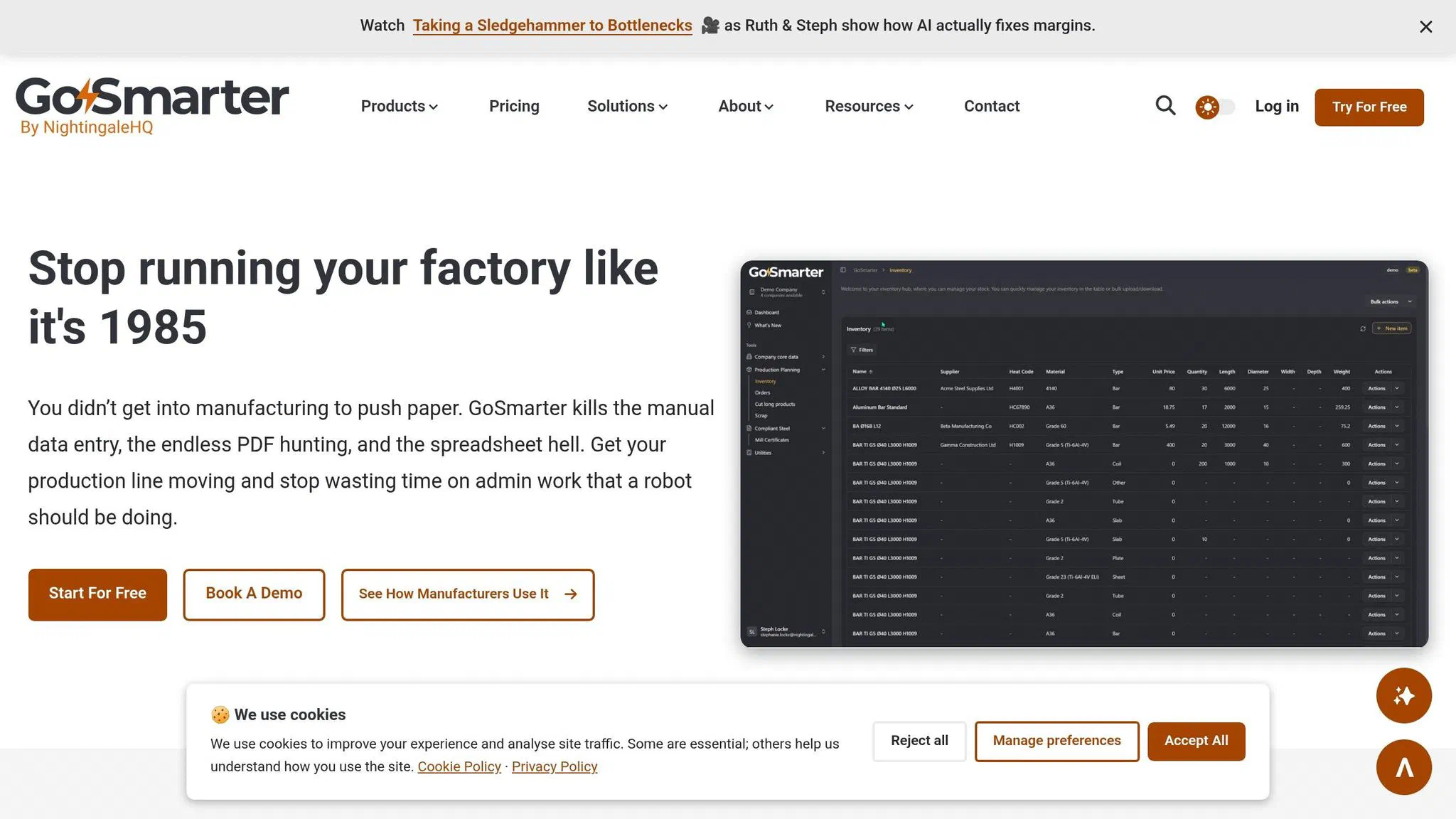
Starting with AI-powered MTR processing is straightforward. GoSmarter’s MillCert Reader is a browser-based tool. Start Your Free Trial → — no downloads or installations — and get a 7-day free trial. Within an hour, you can be processing actual certificates.
If you’re weighing up more than one tool, our comparison of mill certificate automation software covers what each one actually handles.
Here’s how it works: drag and drop a folder of scanned or digital PDFs. The AI takes over, extracting the data and renaming files by heat code automatically. Most teams process their first batch in under an hour and are fully operational within a day or two.
Got a backlog? No problem. Upload thousands of old certificates to create a searchable archive by heat number, grade, mill, or date. The tool supports EN 10204 Types 2.1, 2.2, 3.1, and 3.2, ASTM formats, and other international standards. It even handles certificates in German, French, Spanish, and other European languages by translating data into standard English fields. Pricing sits on the Workshop tier, from £350/month rolling, or £280/month billed annually.
Connect to Your Existing Systems
Once you’re processing MTRs efficiently, the next step is integrating the tool with your existing systems. GoSmarter’s MillCert Reader works on top of the systems you already use — no rip-and-replace required. Export structured CSV files for direct upload into ERP systems like Infor, Epicor, Microsoft Dynamics, Sage, and SAP Business One. Prefer automation? Use the REST API to push data straight into your ERP or Quality Management System in real time. The API uses OAuth 2.0 / Microsoft Entra for authentication. All data is processed and stored on UK-hosted Azure infrastructure, and GoSmarter does not train its AI models on your certificate data.
A phased rollout works best. Start with the MillCert Reader as a standalone tool to see the immediate return on investment. Once the workflow is running, connect it to inventory or production systems. This approach avoids the delays and headaches of custom development often required by generic OCR tools, which struggle with complex certificates and metals-specific terms like Rp0.2 or CEQ.
MillCert Reader is one part of GoSmarter’s toolkit for metals operations. Once your cert data is flowing cleanly, you can connect it to the Cutting Optimiser to feed accurate material data directly into cutting plans — reducing yield loss and improving throughput across your shop floor. Clean cert data means better stock accuracy, and better stock accuracy means fewer fire-drill orders and fewer wrong-material incidents.
Most teams recover their subscription costs in the first month, saving over 120 hours of admin time annually — that’s three extra working weeks to focus on what actually matters.
FAQs
Which MTR fields can AI reliably extract?
How does AI validate MTRs against EN standards?
How do I link MTR data to ERP stock records?
Tools like GoSmarter’s MillCert Reader make the process straightforward. It pulls critical details from mill certificates — like heat numbers, material grades, and properties — and feeds them straight into your inventory system via CSV export or REST API.
By automating this step, you skip the manual data entry, cut down on mistakes, and keep your records accurate. Your ERP system stays up to date, giving you real-time traceability without the hassle.
Can AI detect anomalies in mill cert data — like certs that don't match the order?
Which certificate formats and international standards does the AI support?
About the Author

Editor· Co-Founder & CEO
Ruth Kearney is Co-Founder and CEO of GoSmarter AI — driving commercial growth and strategic partnerships to help metals manufacturers adopt AI and digital tools that actually deliver on the shop floor.