AI and IoT: Smarter Data for Metal Fabrication
- BlogSmarter AI
- Edited by Ruth Kearney
- Blog
- April 28, 2026
- Updated:
Table of Contents Show Hide
Artificial Intelligence (AI) and the Internet of Things (IoT) are solving one of metals fabrication’s oldest problems: sensor data that sits in silos, teams that spend their day firefighting, and manual processes that miss the patterns right in front of them.
Integrated AI-IoT systems cut unplanned downtime by up to 68%, reduce defect rates by 30–40%, and turn raw sensor data into actionable insight in milliseconds. If your sensors don’t talk to each other, here is how to change that.
What this means in practice:
- Cut unplanned downtime by up to 68% with predictive alerts.
- Reduce defect rates by 30–40% using AI-driven inspections.
- Save energy and materials with optimised processes.
- Get real-time insights across your plant without manual guesswork.
Here is how to stop drowning in disconnected data and start running a tighter operation.
What is an AI-IoT system in metal fabrication? It is a network of sensors fitted to your equipment — measuring temperature, vibration, pressure, and motor current — connected to an AI platform that spots patterns, predicts failures weeks ahead, and flags quality issues the moment they appear. No manual log books. No reactive scrambling.
AI-IoT Systems: What They Deliver
Data Collection Accuracy
AI-IoT systems bring disconnected sensor networks together. Many factories still rely on isolated sensors that don’t communicate. Integration platforms solve this by merging these fragmented data streams into a single, real-time network, creating a reliable source for AI analytics and digital twins 1.
Reliable connectivity is key. Systems like WirelessHART and ISA100.11a use frequency hopping to dodge electromagnetic interference from heavy machinery like furnaces and welders, achieving an impressive 99.7% uptime. On top of that, edge servers handle data processing in less than 50 milliseconds and can store up to 72 hours of high-resolution sensor data during network outages, ensuring nothing gets lost 1.
“We had 1,400 sensors across the plant and none of them talked to each other. iFactory’s OPC-UA integration connected everything into one dashboard in 8 weeks.” - Head of Instrumentation & Automation, 3.2 MTPA Integrated Steel Plant, Germany 1
This unified data setup lays the groundwork for smoother, more efficient operations.
Process Efficiency
AI-IoT systems transform factories from firefighting mode to forward-thinking operations. Predictive alerts flag potential failures weeks in advance. This gives you time to schedule maintenance instead of scrambling during a breakdown. This approach cuts unplanned downtime by 22–47%.
A great example is Chin Fong Machine Industrial, which adopted ASUS IoT AISVision in 2022. By automating visual inspections of reflective metal parts, they eliminated human fatigue issues and slashed project development time by up to 80% compared to older AI methods. General Manager Sheng-Ming Tseng explained:
“We’ve implemented IoT and AI-based technologies as the framework to integrate stamping and forging operations and management issues” 2.
AI-driven quality control reduces defect rates by 30–40% and achieves first-time quality rates above 90%. Tools for production scheduling can increase Overall Equipment Effectiveness (OEE) by around 3%, translating to about 30 extra minutes of production time daily. Algorithmic scheduling also cuts planning labour by over 50%.
Improving processes is not just about maintenance. Cutting waste matters just as much.
Waste Reduction
AI-powered tools like nesting algorithms and scrap analysis maximise material use. GoSmarter’s Cutting Optimiser, built by Nightingale HQ specifically for metals operations, reduces offcuts by 20–50%. Traditional methods only tap into a small fraction of production data, while AI-IoT systems use the full data stream to minimise thermal losses and material waste 3.
Take Puyang Steel in Wu’an, China, for example. In 2023, they combined infrared thermal imaging with robotic arms on their No. 2 Converter. AI analysed molten steel composition in real time, speeding up slag removal by 15 minutes and saving ¥4 million annually in alloy costs. AI pattern-monitoring can also spot faults months before they happen by analysing vibration and motor current, preventing costly breakdowns and wasted resources.
Energy Optimisation
With a unified data network, AI monitoring can cut blast furnace energy use by up to 25% 3. Real-time dashboards and smart scheduling shift energy-heavy tasks to off-peak times, significantly reducing costs.
From September 2022 to August 2024, Spartan UK in Gateshead worked with Deep.Meta to deploy the “Deep.Optimiser” platform. Using a digital twin, operators were alerted as soon as steel hit its ideal temperature, saving 24 kWh per tonne and reducing CO₂ emissions by 5%. Similarly, in April 2024, ArcelorMittal Asturias in Spain used an AI-driven image-based system on a 1.2 MW industrial burner. The AI system estimated flue gas oxygen levels with 97% accuracy, cutting energy use by 52.8 kWh per tonne of steel. Over in Carrickfergus, Northern Ireland, Ryobi Aluminium Casting engineers used AI dashboards to uncover a 13% energy efficiency gap between two identical diecasting machines, aiming for a 20% overall reduction in energy use within the first year.
Where Conventional Methods Fall Short
Data Collection Accuracy
Every day, conventional metal fabrication processes churn out about 2.4 TB of sensor data, but the majority of it sits idle in disconnected systems3. Here’s the problem: vibration data might sit in one system, temperature readings in SCADA, and pressure logs somewhere else entirely. Without a unified way to bring all this together, engineers are left piecing it together manually. It is tedious and error-prone1.
To make matters worse, old-school data historians often operate on “overwrite-and-forget” policies. High-resolution data gets downsampled or outright deleted after just 30 to 90 days. This means when something goes wrong, the detailed data you need for a proper root-cause analysis is already gone.
“Most metal fabrication plants currently utilise less than 5% of their generated sensor data for actual decision-making”3.
Process Efficiency
Traditional metal fabrication methods are stuck in reactive, manual processes. Take capacity planning: it’s still spreadsheet-heavy and reactive. Maintenance teams rely on fixed schedules rather than actual equipment conditions, leading to two costly outcomes: parts being replaced too early, or breakdowns catching you off guard3. Both waste time and money.
Then there’s quality control. Manual inspection for casting defects only hits 72% accuracy, while automated systems can achieve 96%3. For high-volume rod casting, this difference matters enormously. Scrap rates in manual setups hover around 6%, far higher than what AI-driven systems can achieve. And without a proper context layer tying together metadata like asset state or shift information, tracking down the root of quality issues becomes a guessing game3.
Waste Reduction
Outdated methods don’t just slow you down. They hide savings in plain sight. Manual calculations often fail to expose inefficiencies. At Ryobi Aluminium Casting in Carrickfergus, for example, unanalysed data masked a 13% energy efficiency gap between two identical diecasting machines. Ciarán Maxwell, Low Carbon Project Lead at Ryobi, put it best:
“Our factories generate vast amounts of data with the potential to unlock efficiency… [But] we needed a one stop shop for all our data.”
Traditional plants rely on operator instincts and manual calculations. They are using less than a fraction of the data available to them.
Energy Optimisation
Energy waste is another blind spot in conventional setups. Without real-time monitoring, inefficiencies go unnoticed. One plant, for instance, discovered that their #2 reheating furnace was guzzling 15% more fuel than its identical counterpart. That only came to light after implementing real-time tracking3.
Manual energy audits are no better. They’re labour-intensive and only provide a snapshot of baseline energy use3. Spreadsheet-based benchmarking adds another layer of frustration, requiring engineers to manually export, clean, and compare data. It is slow and error-prone.
While these traditional methods can keep things running, they barely scratch the surface of what’s possible with modern AI-IoT systems. They leave you stuck with limited data, reactive processes, and missed opportunities to optimise operations.
AI in Metals Fabrication: See It in Action
AI-IoT vs Conventional Methods: The Numbers
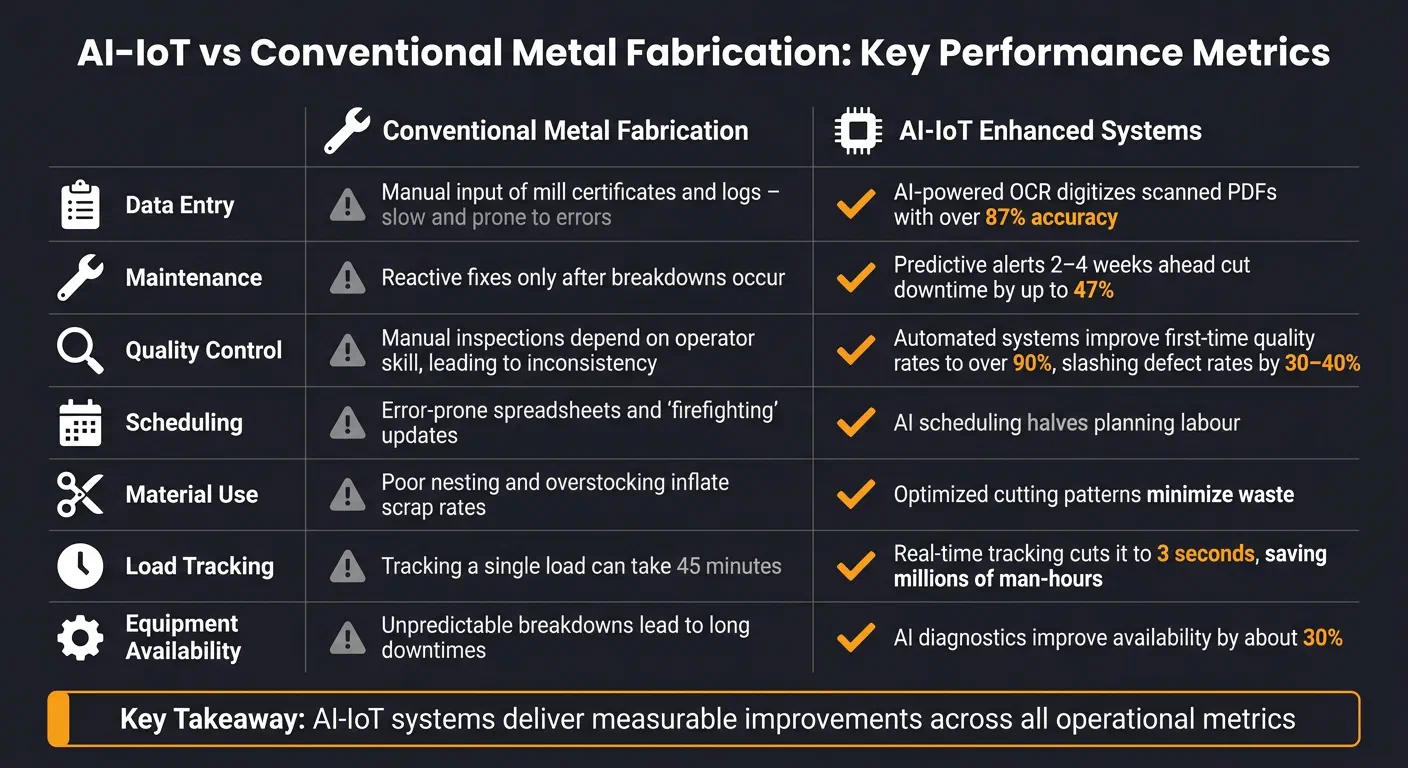
Let’s break down how conventional metal fabrication stacks up against AI-IoT enhanced systems. Here’s a quick comparison:
| Feature | Conventional Metal Fabrication | AI-IoT Enhanced Systems |
|---|---|---|
| Data Entry | Manual input of mill certificates and logs – slow and prone to errors. | AI-powered Optical Character Recognition (OCR) digitises scanned PDFs with over 87% accuracy. GoSmarter’s Mill Certificate Reader applies this to mill cert processing specifically. |
| Maintenance | Reactive fixes only after breakdowns occur. | Predictive alerts 2–4 weeks ahead cut downtime by up to 47%. |
| Quality Control | Manual inspections depend on operator skill, leading to inconsistency. | Automated systems improve first-time quality rates to over 90%, slashing defect rates by 30–40%. |
| Scheduling | Error-prone spreadsheets and “firefighting” updates. | AI scheduling halves planning labour. |
| Material Use | Poor nesting and overstocking inflate scrap rates. | Optimised cutting patterns minimise waste. |
| Load Tracking | Tracking a single load can take 45 minutes (e.g., JSW Steel). | Real-time tracking cuts it to 3 seconds, saving millions of man-hours. |
| Equipment Availability | Unpredictable breakdowns lead to long downtimes. | AI diagnostics improve availability by about 30%. |
These aren’t just theoretical gains. Take Beshay Steel in Egypt: switching from reactive to predictive maintenance reportedly slashed unplanned downtime by 47% and boosted Mean Time Between Failures by 62%, with annual savings of around £2.8 million and payback inside five months. Similarly, Spartan UK used algorithmic scheduling to cut material loss in reheat furnaces and ramp up throughput between September 2022 and August 2024.
The Catch: Challenges of AI-IoT Integration
For all its benefits, adopting AI-IoT in metal fabrication isn’t without hurdles. The biggest headaches include:
- Data Silos: Legacy systems often don’t play nice with modern AI tools, making data integration a pain. Using specialist toolkits for smart manufacturing can help bridge these gaps.
- Sensor Overload: Handling the sheer volume of sensor data can strain scalability.
- Harsh Environments: High electromagnetic interference from induction furnaces and extreme heat can shorten sensor lifespan.
- Infrastructure Needs: A large steel plant (3–5 MTPA) might need 2,000–8,000 sensors, requiring industrial-grade networks like WirelessHART or ISA100.11a instead of typical Wi-Fi.
Conventional methods avoid these issues but at a cost. Manual inspections, for instance, are slower and less reliable, especially in high-volume settings or when dealing with reflective metals.
The Trade-Off
While conventional approaches might save you money upfront, they’re riddled with inefficiencies that pile up over time. AI-IoT systems demand an initial investment and careful planning, especially in sensor selection. The payoff is clear. You get better equipment availability, higher quality control, and streamlined operations, freeing up capacity that would otherwise be wasted on outdated, reactive processes.
What This Means for Your Metals Operation
Traditional metal fabrication relies on manual admin, reactive maintenance, and scheduling that is basically organised guessing. AI-IoT systems replace all of that. They deliver predictive alerts, automatic data capture, and smarter material use. The numbers back this up: integrated IoT sensor networks cut unplanned downtime by up to 68% 1.
You don’t need to rip out your entire Enterprise Resource Planning (ERP) system or flood your factory with sensors overnight. Start small. GoSmarter sits on top of your existing ERP, Excel, and email workflows — no rip-and-replace. Built specifically for metals manufacturing, the Cutting Optimiser reduces scrap by 20–50% and the Mill Certificate Reader turns PDF certs into structured data in seconds. Most teams are live in 1–2 days — that is first-quarter payback on scrap savings alone.
If you are still stuck with manual data entry, firefighting maintenance issues, and rigid scheduling, you are not just wasting time. You are losing money. AI-IoT is here now. The question is: how soon can you make the shift?
FAQs
Where should we start with AI and IoT in a metal fabrication plant?
Do we need to replace our existing Supervisory Control and Data Acquisition (SCADA) system, Enterprise Resource Planning (ERP), or sensors to use AI?
What ROI can a metals plant expect from AI and IoT in the first year?
What data is needed for predictive maintenance and AI quality checks?
In metal fabrication, predictive maintenance and AI-driven quality checks rely on specific data points to keep operations running smoothly. Key metrics include real-time readings of vibration, temperature, hydraulic pressure, motor currents, and oil condition. IoT sensors gather this information, flagging early signs of equipment wear or failure while supporting quality control efforts.
Bringing all this data into one system boosts analytics. It allows for precise predictions, reduces unexpected downtime, and helps maintain consistent production standards. In short, it’s about staying ahead of issues before they hit your bottom line.
Further Reading
1: Industrial IoT Sensor Network for Steel Plants: Deployment, Integration & analytics
2: ASUS IoT Accelerate AI implementation in Metal Processing Factory|IoT|ASUS Global
3: 50,000 Sensor Data Strategy: Building a Data Lake for Steel Plant Intelligence
About the Author

Editor· Co-Founder & CEO
Ruth Kearney is Co-Founder and CEO of GoSmarter AI — driving commercial growth and strategic partnerships to help metals manufacturers adopt AI and digital tools that actually deliver on the shop floor.