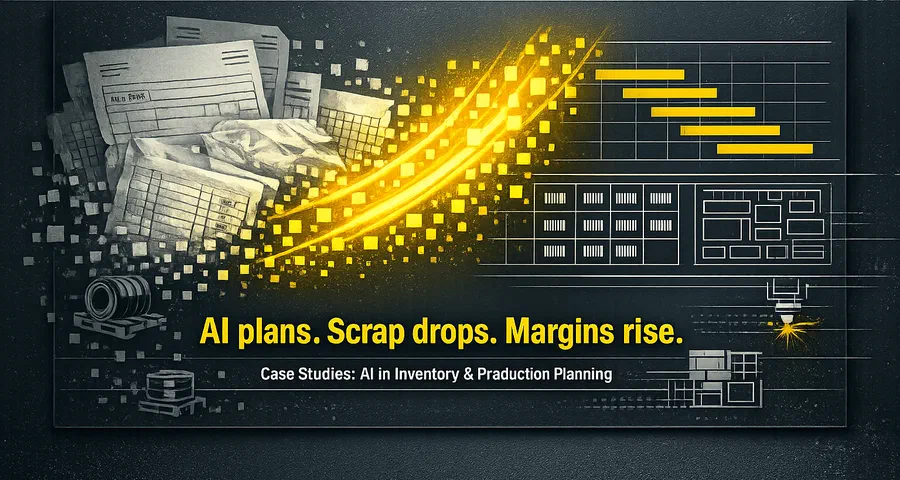
Case Studies: AI in Inventory and Production Planning
- GoSmarter AI
- Edited by Steph Locke
- Blog
- March 28, 2026
- Updated:
Table of Contents Show Hide
Stop running your factory like it’s stuck in 1985. If your production plans rely on guesswork and spreadsheets, you’re burning time and money. Manually digging through mill certificates, juggling disconnected systems, and scrambling to fix last-minute changes isn’t just frustrating - it’s holding your business back.
Here’s the fix: AI tools that tackle the mess for you. Imagine cutting your production planning time from a week to an hour, saving £4 million across your mills, or turning scrap piles into profit. That’s not a pipe dream - it’s already happening for manufacturers who’ve ditched outdated methods.
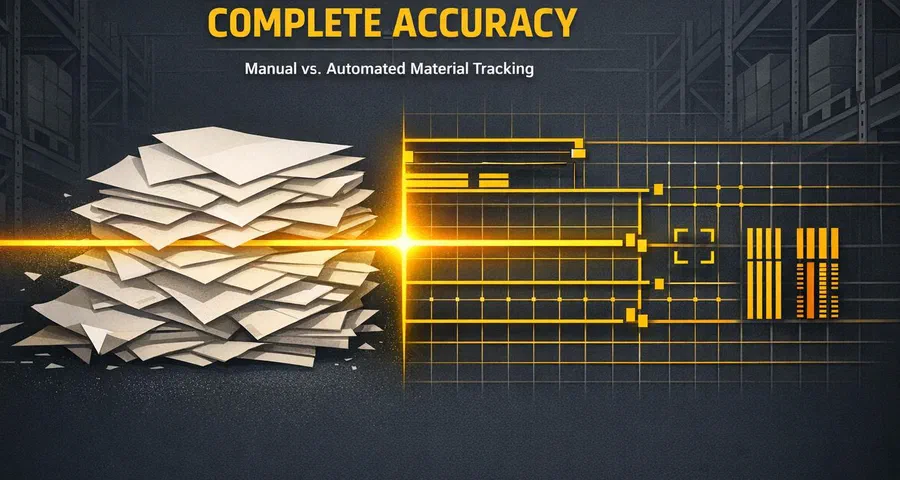
The Old Way vs. The Smart Way
| The Old Way | The Smart Way |
|---|---|
| 5–7 days to plan production | 1 hour with AI-driven scheduling |
| Manually sorting through mill certificates | Automated data extraction in seconds |
| Scrap waste piling up | AI-optimised cutting plans to reduce waste |
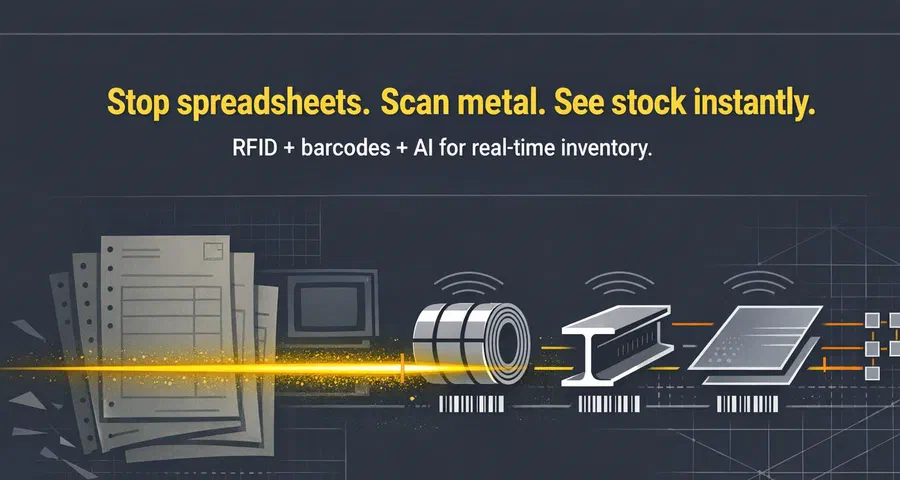
| Guessing inventory levels | Real-time stock visibility |
If you’re tired of wasting time and money, it’s time to rethink your approach. Let’s break down how AI is transforming inventory and production planning for metals manufacturers.
Case Study 1: Steel Manufacturer Cuts Planning Time by 99%
A major steel manufacturer, generating over £28 billion annually, was drowning in manual spreadsheets. Their production planning team took an exhausting five to seven days to prepare a single schedule, pulling data from multiple disconnected sources.
To address this, they partnered with C3 AI to develop a Production Schedule Optimisation application. Over 26 weeks, the team consolidated three years of historical data - including chemistries, inventory levels, and orders - into a unified data system. They also incorporated more than 300 variables and constraints that were previously unmanaged, such as transition rules, yield calculations, steel chemistries, and equipment limits 1. This AI-driven solution didn’t replace the planners. It gave them a proper interface — real-time scenario analysis, no spreadsheets required.
From Days to Minutes: 99% Faster Production Planning
The AI system revolutionised the scheduling process. What once took nearly a week could now be done in just one hour - a staggering 99% reduction in planning time 1. The system handled a continuous production process for over 400 different steel products across seven cast sizes. It juggled supply constraints against equipment limits to cut material waste. And when a furnace went down or a rush order landed, it adapted — no panic required.
“The application reduces the time to plan and schedule a cycle from 5–7 days to 1 hour, driving operational efficiencies” 1.
Beyond saving time, the optimiser boosted production efficiency, delivering approximately 1% more finished product - equating to an additional 1,000 tonnes annually for a single mill 1.
£4 Million Saved Through Better Inventory and Scheduling
The results weren’t just operational; they were financial. The implementation saved £800,000 annually for one mill, with projected savings of £3.2 million across the company’s three main mills 1. These savings came from smarter inventory management, reduced scrap rates, and precise scheduling that eliminated guesswork. With live data connections, schedules reflected real-time updates on raw material inventories and customer orders, preventing last-minute production disruptions.
Case Study 2: Sheet Metal Plant Cuts Scrap Waste with AI
Sheet metal production often leads to piles of offcuts - usable material that ends up as expensive waste. This happens because tracking systems are either outdated or non-existent. The process of manually sorting these scraps is slow, prone to errors, and relies heavily on workers’ ability to estimate dimensions and alloy grades. The problem? Many materials look almost identical but have entirely different properties.
Smarter Sorting with AI Image Recognition
AI image recognition steps in where manual methods fall short. Using optical sensors and XRF analysis, these systems can automatically identify scrap based on type, size, and chemical composition 2. Unlike traditional visual inspections that might miss subtle differences between similar alloys, AI digs deeper - right down to the chemical level. It categorises offcuts in real time, turning what used to be chaotic scrap piles into an organised, searchable inventory.
Machine learning plays a big role here. It adapts to new types of waste and fine-tunes sorting criteria without needing human input 3. This eliminates the guesswork and contamination issues that come with manual sorting, making the process faster and far more reliable.
Reducing Waste with AI-Driven Cutting Plans
AI doesn’t just stop at sorting - it also helps manufacturers use materials more efficiently. By employing autoencoders, AI analyses geometrical data to predict scrap generation before the cutting process even begins. These systems then create optimised nesting plans, pulling live data from inventory and orders to minimise offcuts and maximise material usage.
When a new order comes in, the AI matches it with available scraps, suggesting cutting patterns that make use of leftovers instead of cutting into fresh stock. Predictive models evaluate yield and composition, and when the predictions don’t align with actual results, the system retrains itself [2]. This constant feedback loop sharpens accuracy over time, shrinking waste and improving profitability.
Case Study 3: Metal Fabricator Improves Material Tracking with AI
For metal fabricators, managing material documentation can feel like wading through a swamp of paperwork. Every batch of material comes with a mill certificate in PDF format, outlining crucial details like chemical composition, mechanical properties, and heat numbers. These documents are vital for compliance, but dealing with them manually is slow and prone to errors. A single mis-typed heat number can lead to expensive compliance headaches. Automating this process not only eliminates errors but also allows for real-time production adjustments.
AI Streamlines Bill of Materials Management
Midland Steel, a rebar manufacturer with operations in the UK, Ireland, and Norway, faced these challenges head-on in 2025. Their production manager used to spend 10 hours every month manually extracting data from mill certificates and renaming files based on heat codes. This tedious process not only wasted time but also introduced compliance risks. By switching to MillCert Reader on the GoSmarter platform, they turned this around, saving 120 hours a year — three full working weeks, back in their pocket [2].
MillCert Reader automates the extraction of chemical and mechanical data from messy PDFs, renames files instantly, and links them to the right stock - all without the need for lengthy rollouts or IT specialists [2]. Their certs are now searchable, linked, and audit-ready — no chasing PDFs, no re-entry errors.
As their production manager put it:
“What used to take hours every week is done in seconds. It’s not just about speed - it’s helping us work smarter.” [2]
Once your cert data is live, scheduling stops being a guessing game.
Real-Time Production Tracking Transforms Scheduling
Once mill certificates are digitised and linked directly to stock, manufacturers gain the ability to optimise their scheduling processes. Tools like Metals Manager integrate digital certificates with inventory systems, giving production teams real-time insights into available materials and their specifications [2]. This integration eliminates the guesswork of outdated spreadsheets or clunky legacy ERPs.
With accurate, up-to-date data, fabricators can adapt production schedules on the fly - whether it’s to accommodate newly arrived materials, shifting orders, or unexpected delays. No more firefighting at 3pm because a schedule was built on stale data.
What Actually Worked (And Why)
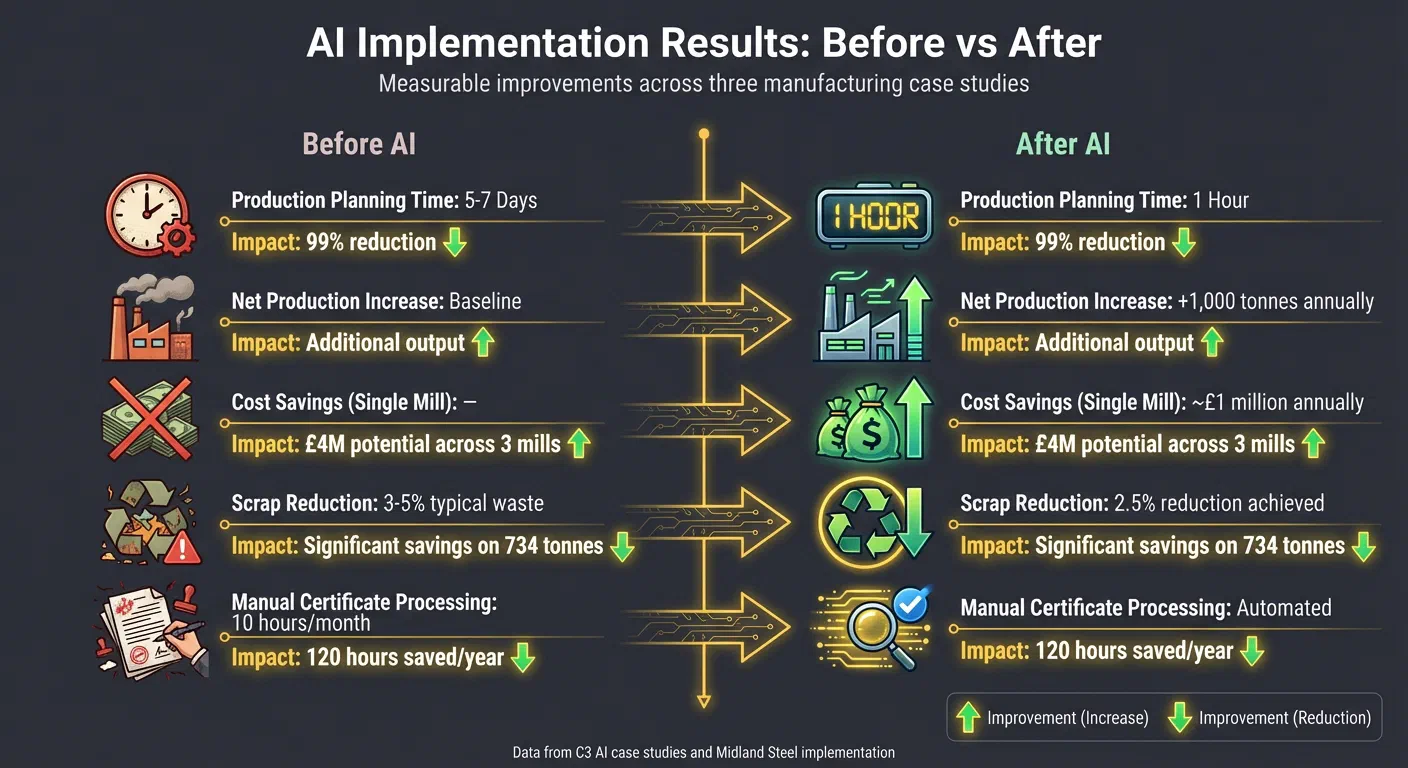
The pattern is the same in each case: pick one painful problem, point AI at it, and measure what changes. Nobody ripped out their ERP. Nobody hired a transformation team. They fixed the bit that was bleeding the most [2]1.
3 Strategies That Delivered Measurable Results
Three things actually moved the needle across all three cases:
- Predictive Inventory Signals: Integrating data from sources like inventory levels, steel compositions, and backlogged orders gave manufacturers a live overview of their resources and demands 1.
- Real-Time Scheduling Adjustments: AI-driven tools slashed traditional planning cycles from 5–7 days to just minutes. By recalculating schedules dynamically, these tools accounted for hundreds of variables, enabling quicker, more accurate decisions 1.
- Waste Reduction with Material Matching: In rebar manufacturing, where 3–5% scrap is common, AI tackled the 1D Cutting Stock Problem with precise modelling. During a two-week trial covering 734 tonnes and 193 jobs, Midland Steel reduced scrap by 2.5%, a seemingly small number that adds up significantly over time [6].
Before and After: Comparing the Numbers
One steel manufacturer cut planning time from days to one hour — a 99% improvement — while adding over 1,000 tonnes annually to production output. That’s roughly £1 million in value at a single mill, with up to £4 million projected across three sites 1.
At Midland Steel, automating mill certificate processing saved 10 hours a month — 120 hours a year — freed up for work that actually moves the business forward [2].
On scrap, the numbers tell a two-part story. The initial Midland Steel trial — a two-week proof of concept on 734 tonnes of live production data — delivered a 2.5% scrap reduction. Since then, the Cutting Plans product has matured; in full production use it has reduced scrap by up to 50%. That’s the gap between “first trial” and “production-ready tool,” and both numbers are real [6].
Tony Woods, CEO of Midland Steel, highlighted the broader impact:
“Smart technology can directly contribute to reducing carbon emissions in steel manufacturing. By integrating AI and digital tracking tools, we have significantly improved efficiency while aligning with our sustainability goals” [6].
| Metric | Before AI | After AI | Source |
|---|---|---|---|
| Production Planning Time | 5–7 Days | 1 Hour (99% reduction) | 1 |
| Net Production Increase | Baseline | +1,000 tonnes annually | 1 |
| Cost Savings (Single Mill) | Baseline | ~£1 million annually | 1 |
| Scrap Reduction | 3–5% typical waste | 2.5% reduction achieved | [6] |
| Manual Certificate Processing | 10 hours/month | Automated (120 hours saved/year) | [2] |
Stop Waiting. Your Competitors Aren’t.
The examples shared earlier highlight a reality many metals manufacturers already recognise: sticking with manual processes and outdated systems is costing you. Pick your poison:
- 10 hours a month retyping mill certificate data
- Days burned on production schedules that are wrong before they’re finished
- Scrap piles growing because your cutting plans are based on guesswork
The good news? AI-driven tools can tackle these challenges without overhauling your entire system. GoSmarter is built specifically for metals manufacturing — it works on top of your existing systems, whether that’s Excel, shared drives, or your ERP.
MillCert Reader (£280/month billed annually) automates certificate data extraction, saving production teams over 120 hours per year [1]. Cutting Plans (£760/month billed annually) generates optimised cut lists in minutes and has reduced scrap by up to 50% in full production use [1]. Metals Manager keeps your stock count accurate and certificate-linked in real time. Most teams are live within a day or two [1]. Nothing gets ripped out, and no IT project is required.
Tony Woods, CEO of Midland Steel, summed it up perfectly:
“Smart technology choices can have a direct, measurable impact on reducing carbon emissions in steel manufacturing. The integration of AI and digital tracking has significantly improved our operational efficiency” [1].
Your competitors are already running this. Every week you wait is another week of blurry PDFs, five-day planning cycles, and scrap that should have been steel. That’s not a technology problem — it’s a choice. Make a different one.
FAQs
What data is required to start AI scheduling?
How does AI handle last-minute changes on the shop floor?
How quickly can GoSmarter be live in our factory?
Further Reading
1: Large Steel Manufacturer Improves Production Efficiency with Advanced AI
2: What Is the Highest Paying Scrap Metal Right Now? | Okon Recycling
3: AI in Recycling, Scrap, Mining and Waste Management | ECAM
About the Authors

AI Blog Assistant
BlogSmarter AI is GoSmarter's AI research and content assistant — surfacing practical insights from industry data and producing compelling blog posts for metals manufacturers.

Editor· Co-founder & Head of Product
Steph Locke is Co-founder and Head of Product at GoSmarter AI — former Microsoft Data & AI MVP building practical tools to cut paperwork and automate compliance for metals manufacturers.