AI in Steel Manufacturing: From Advisors to Autonomous Plants
- BlogSmarter AI
- Edited by Ruth Kearney
- Blog
- March 31, 2026
- Updated:
Table of Contents Show Hide
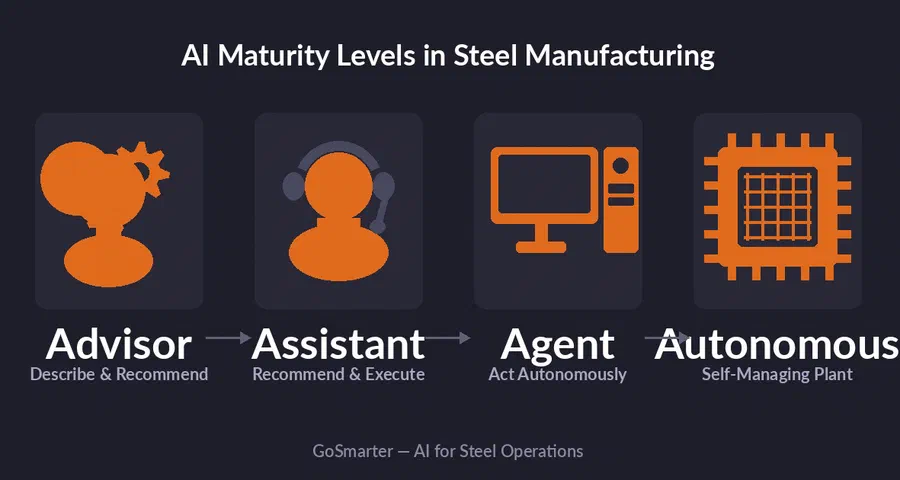
AI in steel manufacturing spans four distinct maturity levels: advisory dashboards at the bottom, autonomous plants at the top. The industry has been making things with heat and metal for over 3,000 years. Now it does it with AI. Not every steel company is at the same point on that journey. Some are running predictive dashboards. Some are letting algorithms run their furnaces. A handful are building plants that will operate without a human in the loop.
This post maps out the four levels of AI maturity in steel manufacturing, with real examples at each stage. Then it shows where the gap still is and what GoSmarter is doing about it.
The short version: Most mid-size steel processors and service centres sit at Level 1 or early Level 2: they have advisory dashboards on the furnace but their back office still runs on PDFs and spreadsheets. GoSmarter targets exactly that gap. MillCert Reader automates mill certificate processing (Level 2 AI Assistant). Cutting Plans optimises your cut list automatically and returns the plan that hits ≤2.5% scrap (Level 3 AI Agent). Combined ROI for a processor cutting 500+ tonnes per week: typically £6,000–£8,000 per week in recovered material, plus 10+ hours per month of admin time eliminated. Payback: first week of live use.
The Four Levels of AI in Steel Manufacturing
Think of AI adoption as a ladder. Each rung represents a different relationship between the machine and the decision. At the bottom, AI tells you what happened. At the top, AI does everything itself.
Level 1 — AI Advisor
The AI describes what is happening. It answers the question: “What went wrong, and why?”
At this level, AI systems ingest production data: temperatures, yields, energy draw, scrap rates. They surface patterns that humans would miss or spot too late. The output is a recommendation. The human still decides.
Real-world example: POSCO, the South Korean steel giant, deployed AI-powered quality control across its hot-rolling mills. The system monitors thousands of sensor readings per second and flags anomalies before they produce defective coils. Engineers review alerts and adjust parameters manually. It is a powerful decision-support tool, but the human is still in the chair.
Level 2 — AI Assistant
The AI recommends and helps you act. It answers the question: “What should I do next?”
The jump from Advisor to Assistant is the difference between a weather forecast and a sat-nav. The system does not just describe. It suggests a specific course of action. A human approves it. The system executes it.
Real-world example: thyssenkrupp Steel in Duisburg uses AI-driven process optimisation across its blast furnace operations. Algorithms generate injection rate targets, temperature set-points, and burden distribution recommendations in real time. Operators review and confirm. Cycle time from “recommendation generated” to “parameter changed” has dropped from hours to minutes.
Similarly, ArcelorMittal has piloted AI assistant tools that parse incoming order books, generate production sequencing plans, and present them to schedulers for sign-off. Manual planning that used to eat days now takes minutes.
Level 3 — AI Agent
The AI executes decisions within defined boundaries. It answers the question: “How do I complete this goal automatically, within the guardrails I’ve been given?”
An AI Agent does not wait for a human to approve every action. It has a defined objective: minimise scrap, hit a delivery window, keep furnace temperature in band. It takes actions autonomously to meet that goal. Humans set the guardrails; the agent works inside them.
Real-world example: Baowu, China’s largest steel producer, has deployed autonomous control agents across several of its steelmaking lines. Digital twins of the blast furnace receive real-time sensor data. They make micro-adjustments to gas flow, burden charging, and tap scheduling without waiting for operator sign-off. Baowu’s stated target: 80% of routine process control decisions into the autonomous layer. By the end of the decade.
Level 4 — Autonomous
The plant runs itself. It answers the question: “How do I manage the entire system end-to-end without human intervention?”
This is the frontier. A fully autonomous steelworks uses AI to plan, execute, monitor, and correct the entire production process. Raw material in. Finished product out. Humans design the objectives, maintain the equipment, and handle genuine exceptions. Everything else is automated.
Real-world example: SSAB’s HYBRIT project in Sweden is the closest thing to a Level 4 steelworks you will find today. The facility replaces the coke-based blast furnace with hydrogen-based direct reduction: a process that runs at more consistent temperatures and is far easier to automate than conventional ironmaking. SSAB is designing the full chain, from iron ore to finished steel, to operate with minimal manual intervention. Commercial-scale autonomy is still years away. But it is being built in from the start, not retrofitted later. That is the structural difference between Level 4 and everything below it.
The Numbers: What AI Is Actually Delivering in Steel
The industry data from recent deployments tells a clear story. Across Levels 2 and 3, metals producers that have moved beyond advisory dashboards are reporting real, measurable gains:
- Yield improvement: 2–5% per tonne across optimised rolling and forming lines
- Energy reduction: 10–20% per tonne in heat treatment and furnace operations
- Downtime reduction: 20–35% through predictive maintenance programmes
- Scrap reduction: 15–30% on cutting and forming lines using AI-driven planning
- Planning cycle time: Cut from days to hours (and in some cases, minutes) through AI-assisted scheduling
These are not vendor-published projections. They are from published case studies, academic papers, and industry reports. Sources include Siemens, Pittini Group, Sidenor, and Spartan UK. If you want the underlying research, see our post on what recent studies show about AI capacity planning for metals factories.
The Regional Landscape
Not every region is moving at the same speed.
Asia — Full Throttle
China and South Korea are running hardest at Levels 3 and 4. Baowu has the scale and the state backing to run bold experiments. POSCO has the engineering culture and the willingness to spend. Japan’s Nippon Steel and JFE Steel are both investing heavily in AI process control and quality analytics.
The Asian producers are building AI into new capacity from the ground up. That is a structural advantage. European and North American mills are retrofitting AI onto equipment that is 30, 40, or 50 years old.
United States — Moving, But Carefully
US mini-mills have been early adopters of data-driven operations. Nucor and Steel Dynamics are leading the way. Their electric arc furnace (EAF) model lends itself to instrumentation and optimisation in ways that blast furnace operations do not. But adoption is patchy. Greenfield AI investment is strong. Legacy plant upgrades are slower.
Europe — Ambitious, Constrained
European producers face a brutal combination: old plant, high energy costs, aggressive carbon targets, and stiff Asian competition. That is driving investment in AI, particularly in energy optimisation and emissions monitoring. But the capital constraints are real. The gap between what European mills say they’re doing and what’s actually running is wider than anywhere else.
thyssenkrupp and ArcelorMittal are the two European players doing serious work at Level 3. Most European mid-market mills are still at Level 1 or early Level 2.
AI Has Sorted the Furnace. The Back Office Is Still in 2005.
The bulk of industrial AI investment in steel manufacturing has been aimed at the furnace, the rolling mill, and the maintenance bay. And rightly so. That is where the tonnes are. That is where the energy and scrap costs live.
But that is only half of the business.
Every tonne of optimised steel has to be sold, certified, tracked, cut to order, invoiced, and documented. That back end, the operational and commercial machinery that turns steel into revenue, is still running like it is 2005. Sometimes 1995.
Think about what actually happens after the steel leaves the furnace:
- A customer sends a purchase order. Someone types it into the Enterprise Resource Planning (ERP) system.
- Mill certificates arrive as PDFs. Someone reads them, renames them, files them, and cross-checks the material data.
- A cutting order comes in. Someone builds a cutting plan on a spreadsheet.
- The sales team wants to know scrap rates and offcut availability. Someone pulls a report from four different systems.
- The compliance team needs certification data. Someone digs through an email chain.
The AI that is telling your blast furnace how to breathe is doing nothing to fix that. The operational layer is still human-bottlenecked: the admin, the certification, the commercial decisions, the cut plans. And for most mid-market steel processors and distributors, that is where the real pain is.
Where GoSmarter Adds Value
GoSmarter, built by Nightingale HQ, is not building autonomous furnace control systems. Baowu and thyssenkrupp have that covered. Enterprise platforms like Siemens Opcenter and AVEVA Manufacturing Execution System (MES) are built for the same large-scale process control problem. GoSmarter’s focus is different. What GoSmarter does is bring AI to the operational layer of steel service centres and metals processors. The bit that global steelmakers have not bothered with, because they are too busy optimising blast furnaces.
Here is how GoSmarter’s tools map onto the framework, starting at Level 2, where AI actually does something:
Level 2 — AI Assistant: MillCert Reader
MillCert Reader is a Level 2 AI tool. It does not just analyse. It acts.
Upload a mill certificate PDF. The AI reads it, extracts the material data, and renames the file to a consistent format automatically. No typing. No manual cross-checking. No filing chaos. A typical steel service centre or metals distributor receives hundreds of mill certs a month. The Production Manager typically spends 10+ hours per month manually processing them. MillCert Reader handles that automatically. Instantly and with traceability built in.
Faster cert turnaround means faster sign-off on shipments. That feeds directly into your On-Time In Full (OTIF) rate: the metric every customer is watching.
This is the AI Assistant model: the system recommends and executes a well-defined task. The human reviews the output and makes the business decision. The drudge work is gone.
Level 3 — AI Agent: Cutting Plans
Cutting Plans is a Level 3 AI Agent. Give it your order list and your available stock lengths. It handles bars, tube, flat plate, and other long products. Multi-grade, multi-dimension stock is optimised in one pass. It runs an optimisation algorithm against your cut list and returns the cutting plan that minimises waste. Target: ≤2.5% scrap.
It does not describe the problem. It does not suggest you think about it. It solves it. Automatically. Every time.
Baowu’s autonomous blast furnace agents do the same thing. Give them a goal: minimise waste. Give them constraints: available stock, cut tolerances. They return the optimal result. No human required to figure it out from scratch.
For a rebar processor cutting 500+ tonnes per week, getting scrap from 6% to 2.5% is not a marginal gain. That is roughly 17 to 18 tonnes of recovered material per week. At typical steel costs, that is £6,000–£8,000 per week back in your pocket: a six-figure annual saving from one algorithm running one job at a time. You will see the payback in the first week.
Most teams are live within two working days of signing up. No IT project required.
The Bigger Picture: One Operational Intelligence Layer
Production, compliance, and commercial are three teams that should be working from the same data. In most metals businesses they are not. Production has the cut plans. Compliance has the certs. Commercial has the order book. Nobody has a joined-up view.
GoSmarter’s platform is that connection layer. It ties production efficiency (Cutting Plans), compliance and documentation (MillCert Reader), and commercial decision-making into a single coherent picture. The same heat-number data that drives cert validation feeds directly into cutting optimisation and stock visibility — one record, every tool. It works on top of what you already have: CSV upload, email intake, or ERP integration. Nothing is ripped out.
You do not need to build a lights-out plant to get the benefits of AI. You need to stop letting your operations team drown in paperwork, your compliance team chase PDFs, and your sales team guess at scrap availability. Start there. The money comes back fast.
Frequently Asked Questions
What are the four levels of AI maturity in steel manufacturing?
What is the difference between an AI advisor and an AI agent in manufacturing?
Which steel companies are furthest ahead with AI automation?
Where does GoSmarter fit into the AI maturity framework?
Is GoSmarter built for mid-size steel service centres, or only large mills?
What ROI can a steel processor expect from AI-powered cutting optimisation?
What is the combined ROI from GoSmarter's MillCert Reader and Cutting Plans?
Do GoSmarter tools require replacing existing ERP or spreadsheet systems?
Should a Chief Operating Officer (COO) consider GoSmarter before committing to a full platform like Siemens or AVEVA?
Go Deeper
- How AI Optimises Steel Production Processes — the furnace and rolling mill side of the story
- AI Capacity Planning for Metals Factories — predictive maintenance and throughput case studies
- Tackling Scrap with the 1D Cutting Stock Problem — the maths behind Cutting Plans’ optimisation engine
- AI-Powered Energy Savings: Case Studies from Metals — energy reduction results from real producers
- MillCert Reader Product Page — see how automated mill certificate processing works
- Scrap, Waste, and Yield Optimisation — benchmarks and methods for cutting material losses
- Midland Steel: Digital Transformation Case Study — how a UK rebar supplier mapped its AI and digitisation journey
- GoSmarter Solutions — how GoSmarter fits across the full metals operation
About the Author

Editor· Co-Founder & CEO
Ruth Kearney is Co-Founder and CEO of GoSmarter AI — driving commercial growth and strategic partnerships to help metals manufacturers adopt AI and digital tools that actually deliver on the shop floor.