AI in Manufacturing (presentation, video, and quick guide)
- Steph Locke
- Learning , Archive
- April 24, 2020
- Updated:
Table of Contents Show Hide
Yesterday, we ran our first AI in Manufacturing webinar, in association with the Irish Centre of Business Excellence. You can grab the slides, read up on the topic, and/or watch the webinar below.
AI in manufacturing from Stephanie Locke
Overview of AI
Q. What is AI?
A. AI performs “cognitive” tasks in three key areas:
- Reasoning: Learning and forming conclusions from imperfect data
- Understanding: Interpreting the meaning of data including text, voice, and images
- Interacting: Engaging with people in natural ways, such as speech
Q. What's the difference between expert-driven and data-driven systems?
A. Experts understand the domain, has already learnt rules or developed them, and can provide rules to handle a different environment to the past. Data represents the domain, encodes information from past processes, and assumes future is like the past.
Q. How do artificial intelligence and machine learning relate?
A. Artificial intelligence covers the use of computers to perform cognitive tasks but there are a number of different branches that do not involve the use of data. The use of data to derive rules is the province of machine learning, a subset of artificial intelligence.
Q. Are robots an example of Artificial Intelligence?
A. It depends. If it was programmed to perform the same task repeatedly with limited or no assessment mealtime to perform said task, then probably not. If, for instance, it used computer vision to determine the type of object it needed to move and adjusted it's process to account for the object type it would be using AI.
AI in manufacturing use cases
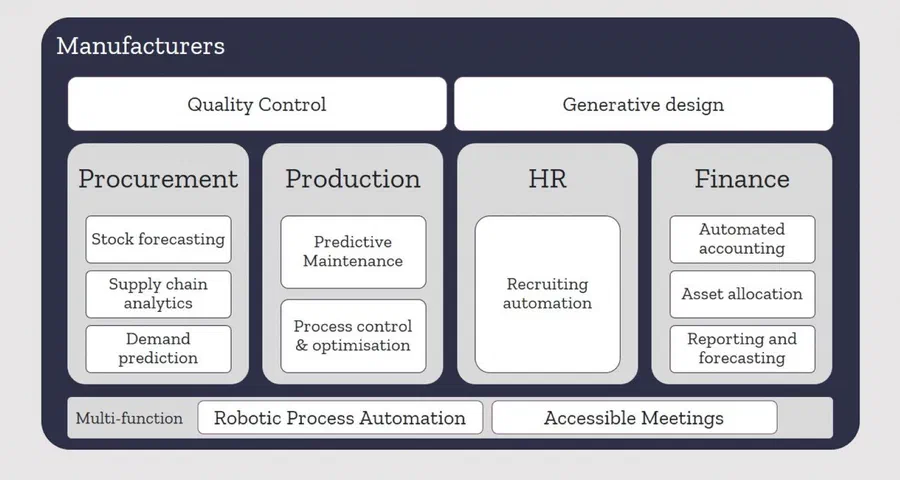
- Quality control: Manufacturers can use computer vision and machine learning based monitoring processes to identify problems or assess products for possible defects
- Generative design: Given constraints and a goal, generative design uses machine learning to iterate towards a viable solution
- Stock forecasting: Predict inventory levels over time to support procurement
- Supply chain analytics: Simulate, forecast, and prescribe supply chain activities
- Demand prediction: Use forecasting to predict future requirements for stock or products
- Predictive maintenance: Combine sensor data with maintenance logs to identify signals for machinery faults and reduce costs by fixing problems before they reach a critical stage
- Process control & optimisation: Use data from the factory floor to suggest improvements to the processes in place or control them at a finer level of detail
- Recruitment automation: Reduce the workload of HR in recruiting staff by providing CV analysis, interview transcripts and more
- Asset allocation: Use machine learning to manage investment and asset portfolios
- Automated business reporting and accounting: Use AI to better reconcile transactions across systems, and produce financial and business reports
- Robotic Process Automation: Reduce repetitive tasks for back-end staff with intelligent software agents
- Accessible meetings: Use AI to support an inclusive and multi-national meetings with live subtitling and real-time translation
- Bots: Use bots to provide new interfaces to customers, suppliers, and employees to reduce manual time used in processes
Get started with AI quickly
Long term, developing an AI strategy an important factor to success, but pilot projects with rapid benefits are generally helpful and more so during this time of lower economic activity generally.
The key is to start with a project that has clear demand because something is either costing revenue or has larger costs than are desirable. Identify such an area of demand and work with those impacted by the process/area. Determine if the use of data to provide information to assist people in arriving at decisions more effectively is all that is needed or if systems need to be more active.
With the demand identified, start a small proof of concept project to address the core goal. Ensure that the solution is well-instrumented so that you can identify how it is being used, any weaknesses, and the impact it is making.
The benefits of gathering your data, ensuring it is high quality, and that people are able to use it to make manual decisions is a huge long-term enabler of AI supporting your business. Getting your data into the hands of staff more quickly and putting them through some training on business intelligence tools and data analytics will pay early dividends on the project.
If you're company is not particularly data savvy, I recommend getting started by buying software that will handle the AI challenge for you. You can develop or implement increasingly more sophisticated solutions that build your own intellectual property as you gain more confidence with your data estate and using it for commercial advantage.
Further reading
- 7 Quick-win AI Projects paper
- The Historian and AI
- AI for Manufacturing — A technical perspective
- Industry IoT, smart factories and AI in manufacturing
- McKinsey on the future of quality control in pharmaceuticals
- Case study: Otis ONE - link no longer works
- Case study: ZEISS ventures - link no longer works
- Case study: Amgen's use of AI in quality control - link no longer works
- Case study: Edera Safety with Autodesk
- Case study: Speedy Hire inventory management
About the Author

Co-founder & Head of Product
Steph Locke is Co-founder and Head of Product at GoSmarter AI — former Microsoft Data & AI MVP building practical tools to cut paperwork and automate compliance for metals manufacturers.