AI Capacity Planning for Metals Factories
- BlogSmarter AI
- Edited by Steph Locke
- Blog
- February 21, 2026
- Updated:
Table of contents Show Hide
Let’s face it: manual capacity planning is a nightmare. Spreadsheets, outdated ERP systems, and constant firefighting aren’t just frustrating - they’re burning through your margins. Every delayed order, every pile of scrap, every missed maintenance window costs you time, money, and sanity.
Here’s the good news: AI fixes the mess. By using live data and machine learning, AI transforms clunky, static systems into real-time, predictive tools that actually work. No more guessing. No more scrambling. Just smarter decisions that keep production smooth, lean, and profitable.
The Old Way vs. The Smart Way
| The Old Way | The Smart Way |
|---|---|
| Manual updates prone to errors | AI adjusts schedules in real time |
| Missed maintenance leads to downtime | Predictive models prevent breakdowns |
| Bloated inventories and wasted scrap | Optimised cutting plans reduce material loss |
| Reactive troubleshooting | Proactive adjustments based on live data |
AI isn’t about replacing people - it’s about replacing the boring, time-wasting tasks that hold your team back. Let’s dive into how it works and why it’s already delivering results for metals manufacturers worldwide.
What Recent Studies Show About AI Capacity Planning
AI Reduces Downtime
Predictive maintenance is no longer a futuristic concept - it’s delivering measurable results today. Siemens, for instance, achieved a 30% boost in equipment availability by leveraging AI-driven diagnostics to monitor rotating equipment [7]. This kind of improvement can make a huge difference in hitting monthly production targets. Similarly, multi-agent reinforcement learning has been shown to cut tardiness during equipment failures by 10–18%, while deep reinforcement learning trims production makespan by 8–10% for unpredictable workorder arrivals [1].
Take the Pittini Group as an example: in 2025, they adopted a cloud-based digital twin of their production line, which allowed them to perform real-time preventative maintenance and optimise equipment conditions before issues arose [3]. This proactive approach helps avoid catastrophic failures, such as furnace shutdowns that could waste nearly 30 tonnes of steel [6]. These advancements aren’t just about avoiding downtime - they’re about creating smoother, more efficient operations that maximise output and minimise waste.
Higher Throughput and Lower Scrap Rates
AI implementations are also delivering better throughput and material efficiency. A standout example comes from Sidenor Electric Steelmaking Plant in Basauri, Spain, which introduced an AI system in March 2025 as part of the EU-funded ’s-X-AIPI’ project. This system monitors scrap properties in real time, using predictive machine learning to assess metallic yield and composition. It even retrains itself when discrepancies emerge between predictions and actual results [4].
Meanwhile, researchers at SHS Stahl-Holding-Saar in Germany developed an XGBoost-based model in February 2025. By analysing 115,000 heats, the model predicts tramp elements - like copper, chromium, and sulphur - in the basic oxygen furnace. This allows the plant to optimise scrap input and maintain melt quality without installing expensive sensors [5]. Closer to home, Spartan UK worked with Deep.Meta from September 2022 to August 2024 on a UKRI-funded project to optimise reheat furnaces and rolling mills. Their algorithmic scheduling reduced material loss from oxidation while boosting throughput [8].
Sustainability and Compliance Improvements
Beyond operational gains, AI is helping manufacturers address environmental challenges. Steel production is a major contributor to global emissions, accounting for roughly 8% of all man-made greenhouse gases, or over 3 billion tonnes of CO₂ annually [8]. By optimising the use of secondary raw materials in Electric Arc Furnaces, AI reduces reliance on primary steel production while ensuring chemical quality standards are met.
At Sidenor, predictive models based on historical data have been used to assess energy requirements, leading to measurable energy savings [4]. These innovations are also preparing manufacturers for stricter regulations, which will demand detailed emissions reporting and material origin tracking. Together, these advancements highlight how AI is reshaping capacity planning in metals manufacturing, paving the way for a more efficient and sustainable future.
How AI Improves Capacity Planning
AI takes the guesswork out of capacity planning by automating decision-making processes through insights drawn from historical data. This shift not only reduces dependence on manual systems but also retains critical expertise that might otherwise vanish when seasoned staff retire. It’s a game-changer for how businesses approach capacity planning.
Machine Learning for Forecasting
Machine learning simplifies complex scheduling tasks that used to require years of hands-on experience. A great example is Hitachi’s Machine Learning Constraint Programming (MLCP) system, which is used in steel mills. This system analyses historical planning data to automate production scheduling, handling a web of constraints like equipment limits, material grades, delivery deadlines, and customer-specific needs. Hitachi explains its impact clearly:
With MLCP, customers are able to produce high-quality plans quickly and overcome the problem of planning being so dependent on the expertise of particular individuals [10].
In another case, Bharat Forge Kilsta AB in Karlskoga, Sweden, introduced a Deep Reinforcement Learning (DRL) framework in 2025 to manage an induction heating furnace. This system tackled uneven heating issues, known as ‘zebra patterns’, by fine-tuning electrical power settings in real time. The result? Reduced material waste and fewer defects [9]. These examples highlight how AI helps manufacturers operate more efficiently while cutting down on waste.
AI OCR for Mill Certificates
AI doesn’t just help with forecasting; it also transforms how data is captured. Take mill certificates, for instance. These often arrive as scanned PDFs, faxed documents, or photocopies, requiring tedious manual data entry prone to errors. AI-powered OCR (Optical Character Recognition) steps in to digitise these documents with over 87% accuracy, slashing manual work and minimising mistakes [11].
Optimisation Algorithms for Cutting Patterns
Material costs can spiral out of control without efficient cutting patterns. This is where advanced deep learning techniques shine. Autoencoders, for example, can predict scrap generation in nesting-based manufacturing by converting part geometries into information vectors. This allows factories to estimate scrap levels even before the final layout is determined [12]. Testing on real-world sheet metal datasets showed a MAPE (Mean Absolute Percentage Error) of 24.8%, offering a solid foundation for better decision-making.
Additionally, XGBoost models are now being used to predict the chemical composition of scrap mixes in steelmaking. This enables manufacturers to optimise secondary raw material usage while maintaining the required melt quality [5]. The industry takeaway is simple: use machine learning to forecast “nestability” early, automate expert insights, and shift from reactive troubleshooting to proactive adjustments [2] [10] [12]. Together, these AI-driven solutions are reshaping capacity planning and boosting operational efficiency.
Measured Results from AI Implementation
Lead Time Reductions and Efficiency Gains
Steel manufacturers adopting AI-powered predictive maintenance have reported 22–47% cuts in unplanned downtime [13]. This can mean the difference between running at full capacity or facing costly delays. Advanced Production Scheduling (APS) tools add a 3% boost in Overall Equipment Effectiveness (OEE), equating to around 30 extra minutes of production time daily [14]. Over the course of a year, that seemingly small gain adds up to a significant increase in capacity.
On top of that, algorithmic scheduling slashes planning labour by more than 50% [14]. AI-driven quality control also makes a huge impact, reducing defect rates by 30–40% and pushing first-time quality rates above 90% [13]. Some companies have seen EBITDA improvements climb by as much as 8% thanks to smarter, data-driven decision-making [14]. Between 2015 and 2020, Tata Steel’s iROC system delivered an eye-watering 775% ROI and saved £1.4 billion [13].
These measurable outcomes highlight the potential for AI to unlock operational efficiencies and drive significant cost savings, as demonstrated in the examples below.
Before and After AI: Performance Metrics
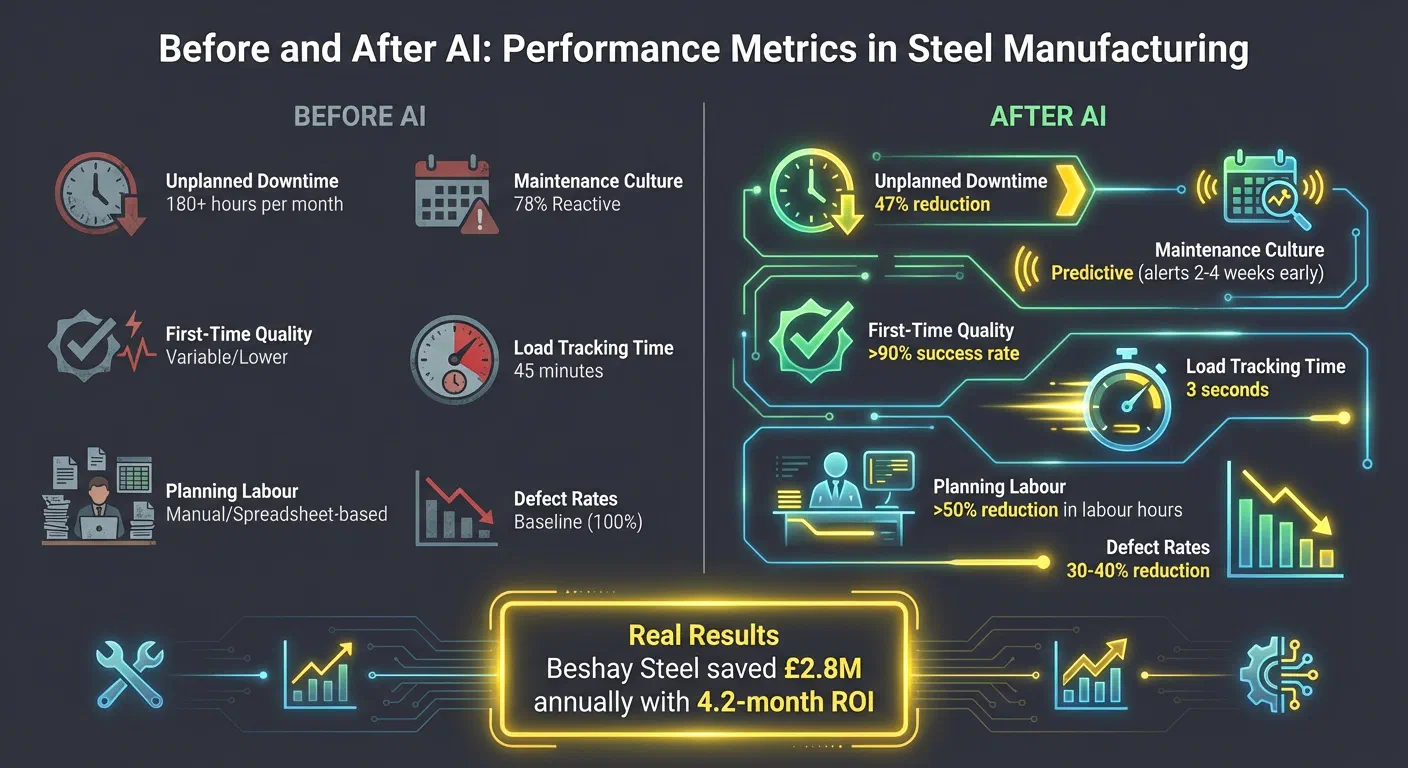
Real-world results showcase just how transformative AI can be. Take Beshay Steel, Egypt’s largest steel manufacturer. In 2025, they moved from a 78% reactive maintenance approach, dealing with over 180 hours of unplanned downtime monthly, to an AI-driven model. The transformation was dramatic: 47% less downtime, a 62% increase in Mean Time Between Failures (MTBF), and a 38% faster Mean Time to Repair (MTTR). These changes saved the company £2.8 million annually, with the investment paying for itself in just 4.2 months [13].
JSW Steel offers another compelling example. By digitising over 10 million supply chain transactions, they cut load tracking times from 45 minutes to just 3 seconds, saving a staggering 2 million man-hours annually [13].
| Metric | Before AI | After AI |
|---|---|---|
| Unplanned Downtime | 180+ hours per month | 47% reduction [13] |
| Maintenance Culture | 78% Reactive | Predictive (alerts 2–4 weeks early) [13] |
| First-Time Quality | Variable/Lower | >90% success rate [13] |
| Load Tracking Time | 45 minutes | 3 seconds [13] |
| Planning Labour | Manual/Spreadsheet-based | >50% reduction in labour hours [14] |
| Defect Rates | Baseline | 30–40% reduction [13] |
The shift from reactive to predictive maintenance, along with streamlined operations, fundamentally changes how factories operate. These examples show how moving away from manual processes towards AI-enhanced systems can revolutionise metals manufacturing, delivering both efficiency and profitability.
How AI Works with Existing Systems
AI Overlays for Legacy ERPs
A lot of metals manufacturers are stuck using ERP systems that feel like relics from another era - some dating back decades [16]. But here’s the good news: you don’t need to rip out your entire setup to get modern results. AI can act as an overlay, seamlessly working with your current infrastructure. It pulls data from sensors, PLCs, and spreadsheets, crunching everything into real-time insights without disrupting your operations [16,18].
Rather than scrapping your ERP, AI tools function as a bridge, connecting simulations, data pipelines, and APIs [15]. Using ETL processes and AI text mining, these tools consolidate scattered legacy data into a unified data lake [14]. And thanks to no-code platforms, engineers can integrate AI predictions directly into operator control systems like SCADA, OPC, and historians - no major IT overhaul required [2].
Digital twins take this a step further by simulating production scenarios in real time. They can test “what-if” scenarios and even reschedule operations automatically, eliminating the need for manual adjustments [1].
Scaling Production Capacity Without System Replacement
By building on these integration methods, manufacturers can boost production without needing to replace their systems entirely. Scalable AI solutions make it possible to improve capacity planning and fine-tune existing equipment, saving both time and money.
For example, from September 2022 to August 2024, Spartan UK teamed up with Deep.Meta to bring machine learning into their steel plant. By analysing sensor data, they created algorithmic schedules for reheat furnaces and rolling mills. This not only improved throughput but also cut material losses from oxidation, maximising the potential of their current setup [8].
In another case, Bharat Forge Kilsta AB in Sweden adopted a cutting-edge MLOps framework in late 2025. Using Deep Reinforcement Learning (DRL) integrated with edge computing, they optimised power settings for induction coils during “warmholding” modes. The results? A 15–20% boost in processing capacity and a dramatic reduction in material waste - all without investing in new equipment [18,31].
GoSmarter: AI Tools for Metals Manufacturing
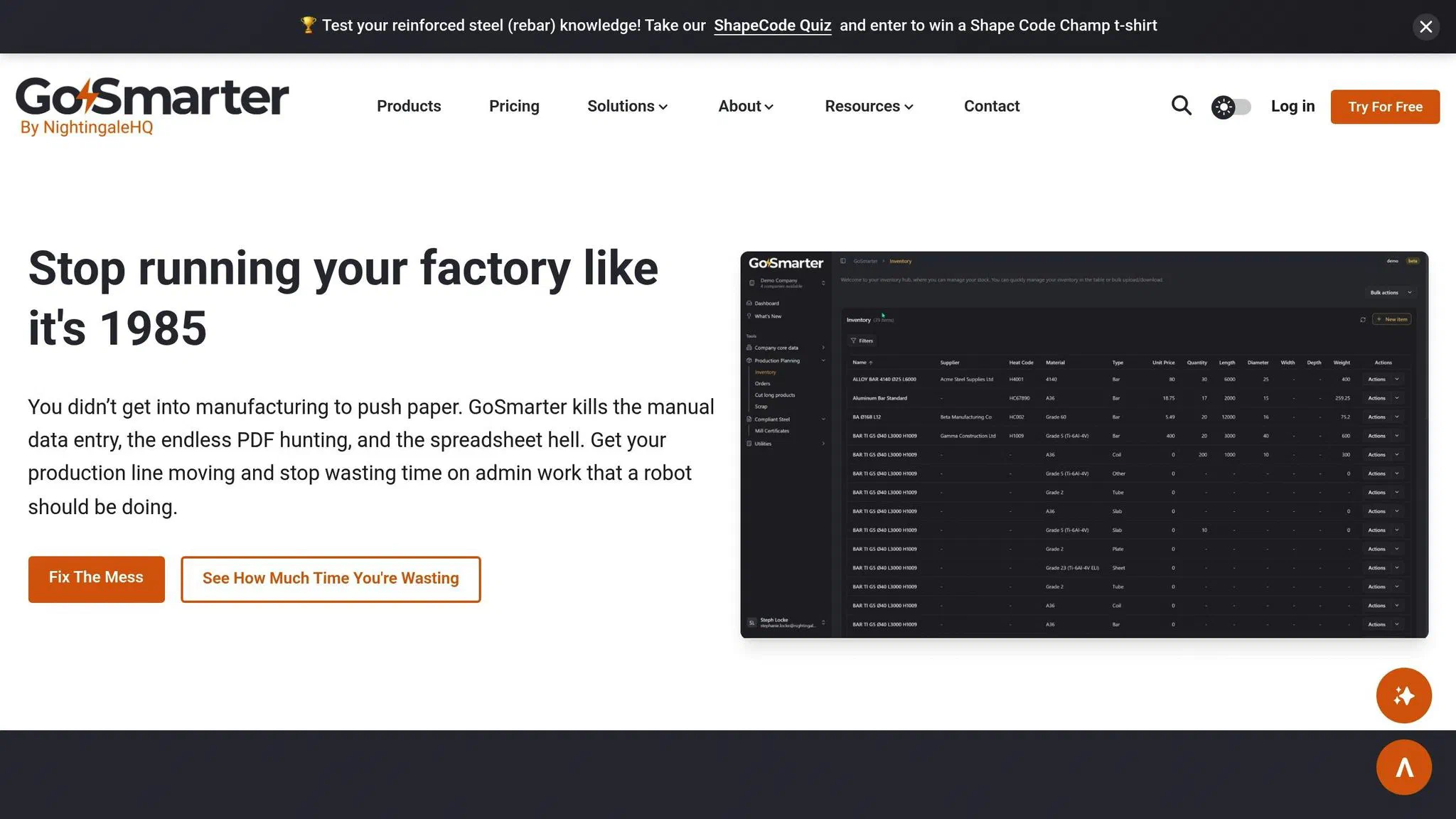
Relying on spreadsheets and paper-based mill certificates slows down operations and eats up valuable time. GoSmarter’s tools are changing the game for metals manufacturing by automating tedious processes and streamlining capacity planning. Designed specifically for this industry, GoSmarter captures messy data, cleans it up, and delivers insights that help manufacturers run faster and more efficiently. Its tools are built to integrate seamlessly with existing systems, turning complex workflows into actionable data.
Smart Production Scheduler: Simplifying Planning
The Smart Production Scheduler takes the headache out of production planning. By pulling data from inventory and orders, it creates optimised production plans that minimise scrap and improve delivery times.
As GoSmarter explains:
The production planner works for all long products… It turns a tedious morning job into a five-minute review. [17]
This tool handles the heavy lifting, freeing up engineers to focus on more strategic tasks instead of wrestling with manual schedules.
MillCert Reader: Faster, Error-Free Certificates
Mill certificates are essential, but managing them manually is a time sink. The MillCert Reader uses AI-powered OCR to scan and digitise these documents in seconds. It automatically renames files by heat code and links material data to inventory records.
GoSmarter puts it best:
Our AI tool saves hours every month by automatically pulling key data from mill certificates. It can rename documents in seconds which is a task that is usually painfully manual. [17]
This tool eliminates errors, ensures compliance, and keeps engineers focused on what they do best - innovating and improving operations.
Conclusion
AI-driven capacity planning is no longer a futuristic concept - it’s already delivering real results. Manufacturers are seeing dramatic improvements, like cutting scrap rates by up to 50%, boosting on-time delivery by 16–25%, and increasing asset utilisation by as much as 52%. Tasks that once dragged on for hours are now done in minutes, replacing guesswork with accurate, data-driven decisions. These advancements don’t just enhance efficiency - they also support more environmentally conscious production.
Industry examples highlight how quickly AI can deliver returns. Take this insight from a VP of Operations at an Integrated Steel Plant:
We were convinced we needed a new caster to meet demand. AI analysis revealed we were losing 18% of effective capacity to coordination failures… Fixing the scheduling problem delivered the capacity we needed at a fraction of the capital cost. - VP of Operations, Integrated Steel Plant [18]
The challenges of demand volatility, rising material costs, and sustainability pressures have outpaced what manual systems can handle. AI doesn’t just save time; it turns sustainability into a strategic advantage, tracking CO₂ emissions in real time and syncing production with green energy availability.
GoSmarter simplifies this shift. It integrates effortlessly with existing ERPs and spreadsheets, automating repetitive tasks like mill certificate processing, scrap rate optimisation, and production scheduling - without the pain of lengthy integration projects. Start small, see results quickly, and expand as needed. By replacing outdated manual processes with AI-powered tools, manufacturers can achieve the precision and flexibility essential for staying competitive today.
The message is clear: eliminate waste, ditch the drudgery, and act now for proven results.
FAQs
What data is needed to start AI capacity planning?
Can AI work with our existing ERP and spreadsheets?
How quickly can AI reduce downtime and scrap?
Go deeper
- AI for Metals Manufacturing — how AI applies across every role in metals, from production manager to finance
- Spreadsheet-to-System Planning for Metals — replacing the morning planning spreadsheet with live AI-generated plans
About the Author

Editor · Co-founder & Head of Product
Steph Locke is Co-founder and Head of Product at GoSmarter AI — former Microsoft Data & AI MVP building practical tools to cut paperwork and automate compliance for metals manufacturers.