Stop Wrestling with Iron: Using AI Agents to Fix the Mess of Heavy Sheet Logistics
- BlogSmarter AI
- Edited by Steph Locke
- Blog
- June 8, 2026
- Updated:
Table of Contents Show Hide
Heavy sheet logistics wastes more time, steel, and money than most fabricators realise and the fix does not require ripping out your existing systems.
What Heavy Sheet Logistics Actually Costs You
Heavy sheet logistics drains time, material, and margin every single day: lost plates, crane queues, and missing mill certificates are the norm, not the exception.
What GoSmarter Does About It
GoSmarter’s AI tools cut through the chaos. From tracking plates in real time to optimising crane moves and scrap use, these tools help you fix the mess without replacing your current systems. MillCert Reader digitises certificates instantly, while Smart Inventory keeps your operations moving.
What You Get
Here’s what GoSmarter delivers:
- Save hours by automating certificate data entry
- Reduce waste with smarter offcut use
- Avoid delays with AI-driven crane and material scheduling
- Stay audit-ready with full traceability
The Day-to-Day Pain of Heavy Sheet Logistics
Handling heavy sheet logistics manually is a daily grind of delays, wasted moves, and firefighting that eats into output, quality, and margins. Instead of fixing root problems, teams spend their days scrambling to put out fires.
Bottlenecks, Firefighting, and Missed Deadlines
Heavy plate operations pile up bottlenecks fast. The overhead crane is usually the first one. Every unplanned move demands a crane slot and a trained operator, both in short supply. When an urgent job jumps the queue, schedules collapse and delays ripple across work centres. Missed deadlines follow.
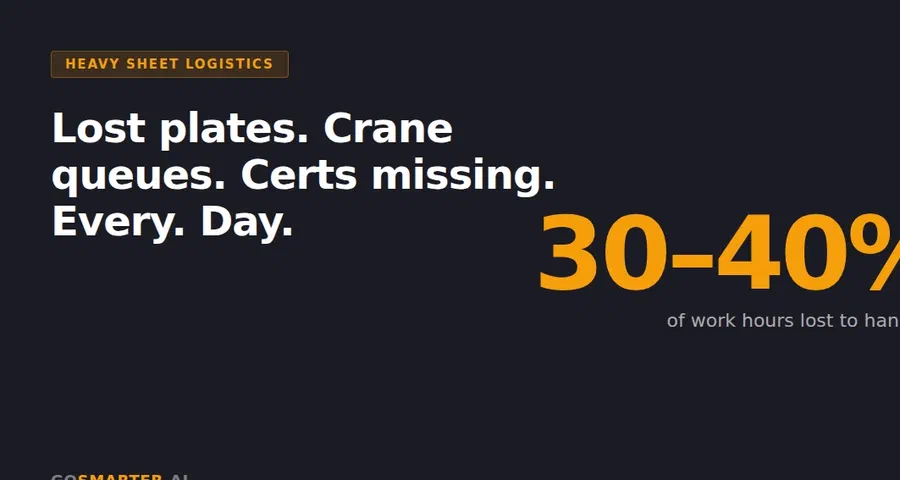
A World Steel Association technical paper on shipbuilding found that material handling and waiting times gobble up 30–40% of total work hours. The culprits are crane sharing, poor layouts, and clunky logistics. Research into steel fabrication flow lines found the same pattern: better scheduling and smoother material flow could slash lead times by 20–30%. Instead of fixing the process, teams lose confidence in planning, pad schedules with buffers, and resort to frantic expediting. The Manufacturing Technology Centre (MTC) found logistics and material handling soak up 20–40% of indirect labour time in manually planned environments driving cost without value.
Data Chaos and Traceability Gaps
When it comes to tracking plates, manual systems are a headache. Information is scattered across paint-marker tags, paper certificates, and outdated spreadsheets. The result? Traceability falls apart.
This matters greatly for UK fabricators who must meet EN 1090 for structural steelwork and EN 13445 for pressure vessels. Full traceability is non-negotiable. Lose a heat-code record or mislabel a plate, and you risk quarantining good material, reworking from scratch, or failing inspections. In metal fabrication, non-conformance and rework can chew up 5–10% of turnover. Poor documentation and traceability are usually to blame.
Poor Material Flow and Scrap Waste
The problems don’t stop at scheduling. When plates aren’t where they need to be, operators waste time moving the same sheet over and over. Every unnecessary move burns crane time, increases handling risks, and raises the chances of damage.
And then there’s the scrap issue. Without proper tracking, offcuts often sit around unidentified. Planners, unsure of their usability, order new plates instead. For a 100-tonne-per-week operation, this inefficiency can cost £1,200–£2,400 each week [1]. It’s not just a financial hit. It’s an environmental one too. Under the UK’s Streamlined Energy and Carbon Reporting (SECR) framework and customer-driven Scope 3 reporting, every tonne of wasted steel adds to your carbon footprint. Unnecessary crane movements and scrapped steel carry a hefty carbon cost.
| Issue | The Manual Way | The Consequence |
|---|---|---|
| Crane scheduling | Verbal coordination and static shift plans | Conflicts, queues, and idle machine time |
| Material identification | Paint-marker IDs, paper tags, and spreadsheets | Lost plates and incorrect cuts |
| Traceability & certificates | Paper filing and manual certificate matching | Missing heat codes, rework, and audit failures |
| Offcut management | Ad hoc saving with no system for location | Invisible offcuts, leading to unnecessary orders |
These daily frustrations add up fast. AI-driven tools address each one directly without the need to overhaul your entire operation.
How AI Agents Fix Heavy Sheet Logistics
The chaos of lost plates, crane bottlenecks, missing heat codes, and rising scrap costs isn’t inevitable. These headaches come from systems that simply weren’t built to handle the complexity of live plate operations. AI agents are designed to tackle that complexity head-on, enabling real-time adjustments and smarter decisions on the shop floor.
Real-Time Inventory Tracking and Traceability
It all starts with knowing exactly where your materials are. AI agents integrate with Enterprise Resource Planning (ERP) systems, barcode and Radio-Frequency Identification (RFID) readers, and machine data to maintain a live inventory. Every plate is logged with critical details like heat code, material grade, thickness, weight, dimensions, mill certificate, and precise location whether it’s on a rack, in a bay, or outside.
When a plate is moved or partially cut, the system updates instantly, keeping the traceability intact. Any offcuts inherit the original plate’s heat code and certificate link. For UK shops working under EN 1090 or EN 13445, audits that used to take days of paperwork chasing now wrap up in minutes.
GoSmarter’s MillCert Reader slots right into this process. It uses AI-powered Optical Character Recognition (OCR) to scan and digitise PDF mill certificates as materials arrive. The data attaches automatically to the right inventory record. That alone saves production teams over 10 hours a month on manual entry and cuts the risk of errors significantly.
Smarter Scheduling for Better Machine Use
Tracking is only half the battle. AI also transforms scheduling by dynamically adapting to real-world changes. Static once-a-shift schedules can’t handle plate operations. Urgent jobs, machine breakdowns, and rejected plates throw the entire day into chaos.
AI-driven scheduling takes all the variables — material availability, due dates, machine capabilities, crane constraints, and changeovers and it builds optimised cutting and processing plans. When disruptions occur, the system recalculates the schedule in minutes, saving planners from scrambling to re-sequence jobs manually. According to McKinsey, analytics-driven scheduling can cut lead times by 10–20% and boost schedule adherence by 20–30% [1].
For production managers, these improvements translate into fewer stoppages due to missing materials, better load balancing across cutting tables, and reduced overtime. Even a modest 3–5% increase in cutting table use can save tens of thousands of pounds annually.
Crane Move and Routing Optimisation
Overhead cranes are often the biggest bottleneck in plate operations, yet many plants still rely on verbal instructions or static plans to coordinate moves. AI changes this by treating every crane move as an optimisation problem.
By modelling the plant layout, stock positions, machine queues, and crane availability, AI systems minimise unnecessary movements and reshuffles. For example, it avoids scenarios where multiple plates are shifted repeatedly just to reach one buried at the back. It also prepositions plates in advance, reducing delays and congestion.
Studies on AI-driven crane scheduling report 10–35% reductions in crane travel distances and 15–30% cuts in handling times [2]. In busy operations, this means shorter queues at cutting lines, less aisle congestion, and lower risks of damaging expensive materials.
Scrap and Offcut Management for Cost and Carbon Savings
Every offcut is treated as valuable inventory, logged with details like geometry, grade, thickness, and usable area. Before allocating full plates to new jobs, the system checks the offcut catalogue and applies nesting algorithms to maximise material use, even with irregular shapes.
The results are tangible. Offcut optimisation can reduce raw material consumption by 2–5% [1]. For a UK plant processing large volumes, even a small percentage saving can translate into significant cost reductions and lower embodied carbon. GoSmarter’s Cutting Plans automates this, tracking offcuts and generating efficient cutting patterns to save money and support the UK’s carbon reduction goals.
How to Bring AI Agents Into Your Operations
AI agents can fix traceability gaps, reduce crane delays, and cut scrap waste in heavy plate operations. Knowing what they can do is useful. Knowing how to introduce them without disrupting your floor is the harder part. A survey by Capgemini found only 14% of industrial manufacturers have scaled AI beyond a pilot. The culprits are always the same: integration headaches and resistance to change. A phased approach sidesteps both.
Start with High-Impact, Low-Risk Workflows
The best way to start is with workflows that sit on top of your current processes rather than disrupting them. Certificate digitisation is a prime example. Every plate that comes into your facility arrives with a mill certificate, a PDF or scan loaded with heat numbers, grades, mechanical properties, and EN standard references. Right now, someone on your team is probably typing all that data into your ERP or Manufacturing Execution System (MES) by hand. It’s slow, and mistakes are inevitable.
GoSmarter’s MillCert Reader is built for exactly this kind of situation. Using AI-powered OCR, it can read any mill certificate format without needing template training. It checks extracted data against EN 10204 standards and flags anything unusual for human review. Importantly, it doesn’t touch your crane schedules, cutting queues, or machine programmes. It simply eliminates a tedious admin task and creates a searchable, traceable material record from day one.
Run MillCert Reader in “shadow mode” for the first four to six weeks. This means processing certificates alongside your existing manual workflow. Use this time to measure its accuracy against real data. Set a benchmark, like 98% accuracy on critical fields such as heat number, grade, and thickness, and only switch over when the system consistently hits that target.
Once certificate digitisation is running smoothly, you can move on to integrating AI into other areas in stages.
Build Adoption in Phases
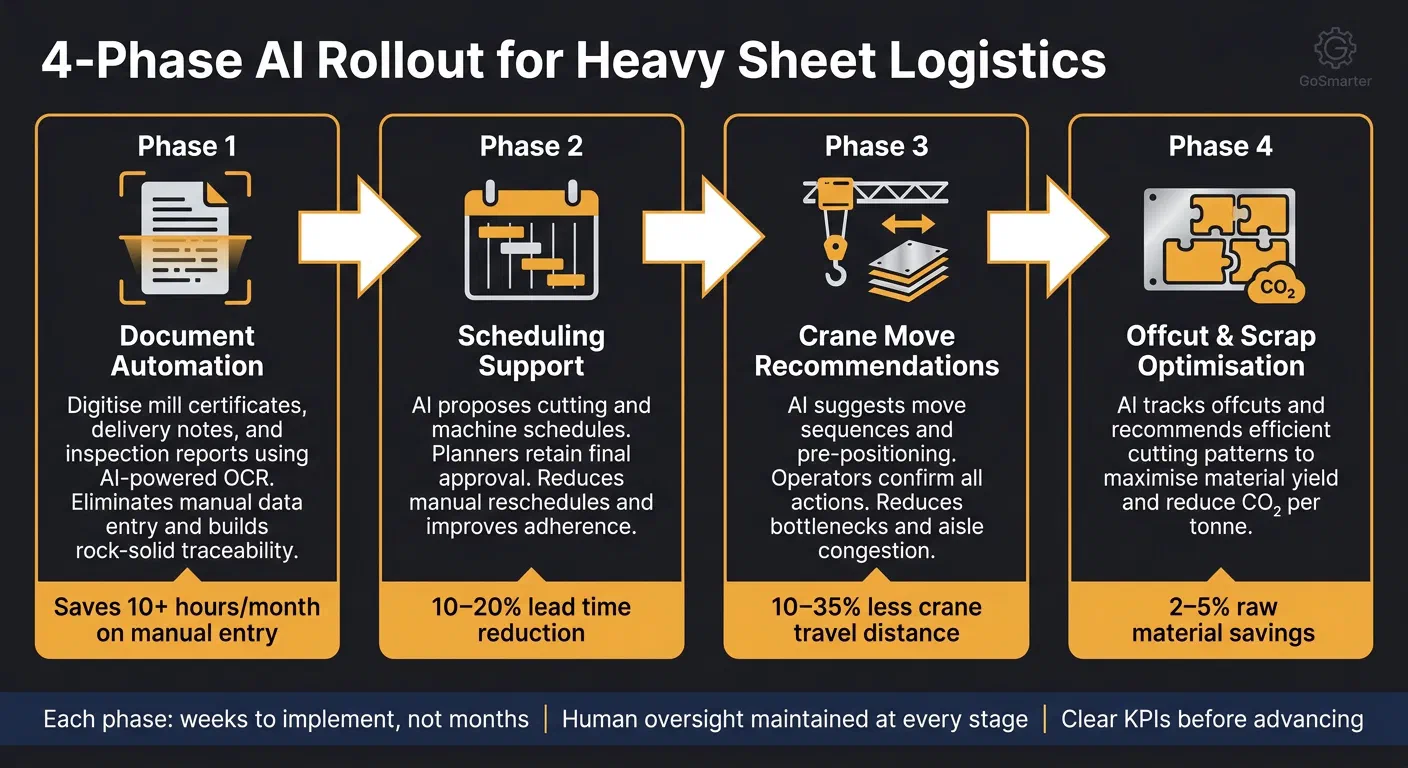
After automating document data, take a phased approach to roll out AI across your operations:
- Phase 1 – Document automation: Start with mill certificates, delivery notes, and inspection reports. This reduces admin time and ensures your traceability is rock-solid.
- Phase 2 – Scheduling support: Introduce AI to propose cutting and machine schedules. Planners still have the final say, but manual reschedules become less frequent.
- Phase 3 – Crane move recommendations: Use AI to suggest move sequences and pre-positioning. Operators confirm all actions, keeping control firmly in human hands.
- Phase 4 – Offcut and scrap optimisation: Let AI track offcuts and recommend efficient cutting patterns. This improves material yield and reduces CO₂ per tonne.
Each phase should be small enough to implement in weeks, not months. Set clear criteria before moving to the next step whether that’s hitting Key Performance Indicators (KPIs), gaining user approval, or passing safety checks. McKinsey data shows AI-driven planning can cut machine downtime by up to 30% and lift productivity by 10–20%. None of it works without reliable data first. That’s why Phases 1 and 2 are critical before tackling more complex tasks like crane moves or scrap optimisation.
Set Clear Rules and Keep Humans in the Loop
AI isn’t a magic wand, and manual errors and unpredictability mean human oversight is non-negotiable. From the start, define where the AI can recommend and where it can act.
For example, let the AI handle tasks like tagging documents, updating non-critical inventory fields, or flagging offcuts for reuse. But when it comes to approved schedules, material assignments, or handling standards, human sign-off should always be required. If the system encounters incomplete data or a confidence score drops below a set threshold say, an unusual certificate format or a mismatched grade, it should escalate to a person instead of guessing. Research shows AI projects with clear governance, defined roles, escalation paths, and sign-off rules are 40–50% more likely to succeed.
Keep the interfaces simple. Every AI recommendation should come with an explanation: which plates are available, why a specific cutting sequence was chosen, or what the yield impact is. When planners understand why the system is suggesting something, they trust it more, override it when needed, and give feedback that improves it over time. That feedback loop is what turns a promising pilot into a permanent fixture.
Next Steps: Stop Wrestling with Iron Today
The phased approach we’ve outlined isn’t just theory. It’s about building confidence and delivering results at every stage. From automating one admin task to overhauling crane operations across an entire bay, these steps turn strategy into action. Where should you actually begin?
Run a Trial with GoSmarter
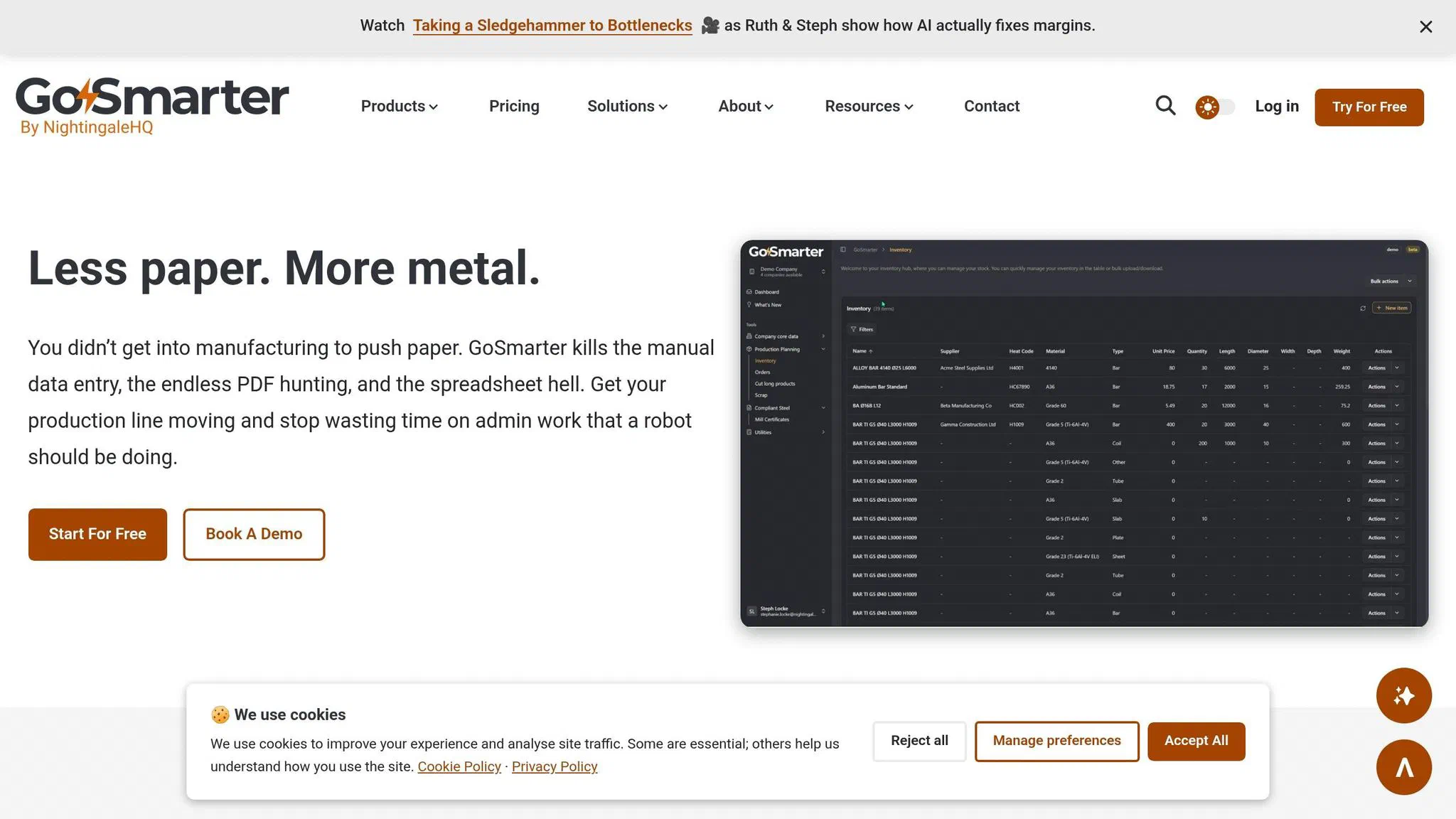
Sorting out the heavy sheet logistics mess starts with action, and a trial is your first move. Pick one critical workflow and commit to a four- to eight-week trial. For most UK metal fabrication plants, the best place to start is MillCert Reader at the goods-in desk. Upload mill certificates and let the AI handle the tedious bits: extracting heat numbers, grades, and EN 10204 references automatically.
GoSmarter picks up your inventory and Orders that you’ve entered into the system and builds an optimised cutting schedule to reduce waste and help you deliver on time. It’s browser-based setup skips the IT headaches: no servers, no long-winded projects. Just import your stock list and open orders via CSV, and you’ll be running your first AI-generated cutting plan within days.
Pricing? GoSmarter’s Workshop tier starts at £350/month rolling, or £280/month billed annually and covers AI certificate scanning, heat code linking, and full traceability. Plans are priced per site, not per user. That means your whole team gets access without extra charges.
Track Results and Build from There
Once the trial begins, measuring results is key. Before starting, take a week to gather your baseline numbers: scrap rate as a percentage of plate weight, productive machine hours versus planned hours, on-time delivery rates, and how often you’re scrambling with emergency reschedules. Then, during the trial, log every AI recommendation and its outcome. After eight weeks, compare the new data to your baseline. Turn those results into £ per tonne saved and overtime hours avoided - the numbers that make finance teams sit up.
Here’s what other plants have seen when shifting from manual nesting to AI-driven cutting plans:
- 5–10% material savings
- 8–12% improvement in on-time delivery
- Up to 25% cut in internal logistics time
Even if your trial delivers half those results, expanding to more bays, shifts, or product families becomes an easy decision.
FAQs
What data do we need before AI scheduling will work properly?
AI scheduling systems thrive on precise, up-to-the-minute data from your operations. To work effectively, they need:
- Live inventory details: Include specifics like grade, size, heat number, stock status, and, crucially, whether materials are available or already allocated.
- Machine and workforce data: Provide machine capacity, operator skill levels, shift schedules, and lead times.
- Real-time feedback: Share updates such as completion rates and hours worked, so the system can adjust schedules dynamically as things evolve on the shop floor.
Without this level of detail, you’re asking the AI to guess. That’s not what you want when margins are on the line.
How does AI keep heat codes and certificates linked after plates are cut into offcuts?
How quickly can we run a low-risk trial without disrupting production?
About the Author

Editor· Co-founder & Head of Product
Steph Locke is Co-founder and Head of Product at GoSmarter AI — former Microsoft Data & AI MVP building practical tools to cut paperwork and automate compliance for metals manufacturers.